
Preparing for war
A Geo-Political House Divided Cannot Stand
Israel, Gaza, Ukraine, and the US are under attack

My personal view is where we’re born on this Earth is not predetermined by fate. Each person’s life has value and the potential to enrich society. Manifest Destiny and Imperialism are not enviable concepts. We need to work harder, think more carefully, and act more responsibly to ensure a stable future.
Awakening to a global crisis
I took a break and the Earth continued to spin on its axis without me. It’s nice to be rather insignificant.
Then I read my email. Friends in various corners of the world had the same message, delivered in various degrees of civility.
Serina in France: “Americans need to stop acting insane. It’s not recess. Grow up and recognize the influence you have over the rest of the world, or go to your own corner and be quiet.”
Huh, I thought. What’d we do now? I hoped we’d at least been a bit quiet whatever it was, kind of like when mom and dad used to try to keep their voices down when fighting.
In the “Everything else” section my eyes fell on a Department of Defense bulletin.
As Israel launches airstrikes in response, many expect the retaliation to have unprecedented aspects as well.
A day of intense terror attacks by Hamas that killed more than 200 Israelis united observers in shock — not just at the toll, but at the sophistication of the assaults.
Saturday’s attack was “unprecedented and an apparent quantum leap in Hamas’s capabilities,” said Steven A. Cook, a senior fellow for Middle East and Africa Studies at the Council on Foreign Relations.
The surprise attack, which was apparently unforeseen by Israeli intelligence, began in the early morning hours of a Jewish holiday. Hamas forces fired multiple rockets into Israel, broke through barriers with explosives, made beach assaults with speedboats, and dispatched troops on pickup trucks, motorcycles, and even paragliders to infiltrate towns in southern Israel.
The Middle East has a complex history most Westerners can’t appreciate going back to before Jesus was born. But we appreciate alliances, loyalty, and autonomy and Israel is viewed by many as our 51st state.
My friend in India wrote, “We’re kind of nervous about how this will play out and what America will do. You know Hamas and Hezbollah are both funded by Iran, right?”
I messaged my friend in response.
Me: “I don’t think we did this, but I doubt we’ll stay out of it. Iran has been calling for the annihilation of Israel and America for as long as I can remember. Are you safe from the rain?”
Aman: “Y’all are supposed to be setting an example. The political unrest in Israel, anti-trans attitudes in Europe, and over-the-top protests are mirroring your own bad actors, ie Jan 6th insurrection. I’m good. What are you going to write?”
I wish he hadn’t gone to school in Texas. He doesn’t appreciate my limited reach. As with every piece, I questioned what value I could add to a developing story, and wondered if I’d regret publishing after positions and actions are taken.
Context, perspective, and a mature American attitude
A hundred thoughts hit as I recalled recent events in Israel and other parts of the world that could come into play:
1 — protests in Israel over Prime Minister Netanyahu’s attempts to remove the Supreme Court 2 — resentment among the military as a result 3 — President Herzog’s attempts at reconciling with Saudi Arabia 4 — China’s influence in forging new alliances 5 — Iran’s involvement in proxy wars and support of terrorism 6 — settlement encroachment 7 — Haifa’s ammonia plant as a preferred target 8 — possible US engagement 9 — funding for the Ukraine war effort 10 — reactions of Russia, North Korea, and allies 11 — a leaderless Congress 12 — and our own polarizing views and inability to reach consensus.
Not to mention the little things like religion, economic disparity, power struggles, tribalism, and ancestral feuds.
Oh yeah, and nuclear weapons.
Questions swirled in my mind. This isn’t going to be an isolated event. Who will react, and how? I would’ve suspected Hezbollah, not Hamas.
It’s often said the Middle East is a powder keg. Regional alliances can be tenuous and fluid. Major players like Iran, China, Russia, and the US can spur or calm the conflict.
The attack on October 8, 2023
A quick check of Al Jazeera reported fighting between Israel and Hezbollah in Lebanon. When Al Jazeera first came to prominence in the US in the late 1990s it was suspect because it’s funded by the Qatar government, which normally aligns with Hamas.
The Department of Defense is moving assets and intelligence gathering is in high gear. Hamas took hostages, people are hurting, and dying. Israelis have been captured and are being held hostage.
According to Reuters, the combined death toll stands over 1,100 so far. Americans and tourists from all over the world are included.
Israel pounded the Palestinian enclave of Gaza on Sunday, killing hundreds of people in retaliation for one of the bloodiest attacks in its history when Islamist group Hamas killed 700 Israelis and abducted dozens more.
Hamas fighters’ rampage through Israel towns on Saturday was the deadliest such incursion since Egypt and Syria’s attacks in the Yom Kippur war 50 years ago and has threatened to ignite another conflagration in the never-ending conflict.
Rockets were launched from Lebanon early in the conflict, and Israel responded with artillery fire. So far, I haven’t seen reports of Lebanese casualties.
The International community is pressuring Lebanon and neighboring countries to avoid engaging in the conflict. Israel and Gaza are bordered by Egypt, Jordan, Lebanon, Syria, The Palestinian territories, Cyprus, and the Mediterranean and Red Seas.
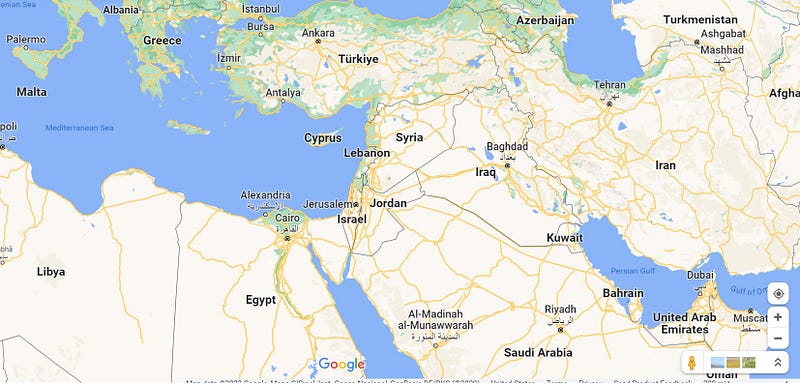
In the far left corner of the map is the United Arab Emirates, often referred to as the UAE. The distance between Israel and the UAE is about 1,500 miles — just 300 more than the distance between Seattle and San Diego. I’ve driven that route in 2 days. A non-stop commercial flight takes 3 hours.
The coast of Greece is just 750 miles from Israel, as the errant missile flies. Worry over missiles that have fallen in Poland as part of the Russia-Ukraine war has prompted fears of World War III.
As a General in the Israel Defense Force (IDF) spoke on a CBN newscast, emotional comparisons were made between Hamas and ISIS as the military leader promised an extreme, yet moral retaliation against terrorists in Gaza. At the same time, he proclaimed Israel has no quarrel with the citizens of Gaza or the West Bank Palestinian territories.
Lebanon — Israeli conflict and likely alliances
If Lebanon and Israel were to engage in war, the international support might go as follows -
- Israel: Israel will be supported by the United States and other Western countries. Israel may also receive support from some Arab countries, such as Saudi Arabia and the United Arab Emirates.
- Lebanon: Lebanon will be supported by Syria and Iran. Lebanon may also receive support from some other Arab countries, such as Qatar and Algeria.
- Egypt: Receiving a large portion of US funding, Egypt has supported the Gaza Strip blockade, but walks a tightrope in the region.
- Syria is supported by Iran and Russia and has weaponry from both.
Other countries in the region, such as Jordan and Egypt, may try to remain neutral in the conflict.
The familiar refrain, “God is on our side!” is shouted by each faction.
Proportional deliberated response
In foreign relations and interpersonal relationships, we often promote, “A thoughtful proportional response with consideration of the consequences.”
The US military isn’t known for computing proportional very well.
Of course, military and financial costs are not the only metrics in determining a reasonable response to aggression.
Maturity and wisdom are reflected in restraint when we’re tempted to act impulsively.
Israel is not an official member of the North Atlantic Treaty Organization but is a major non-NATO ally. Israel has had a special relationship with NATO since 1989. It was one of the first five countries recognized by the US administration as a preferred partner of the transatlantic alliance. Israel and NATO members often coordinate military readiness and exercises.
Israel and the Palestinian territories of the West Bank and Gaza Strip are home to Jews, Muslims, and Christians all living in close proximity. The peaceful integration of their cultures is usually successful at a personal level but must be improved on a large scale.
Military readiness and commitment in Israel
For several months Israel’s military has protested the possible dismantling of the Supreme Court. Many warned this was compromising national security. Protests were met with mixed reactions from reservists. Some reservists expressed support and stopped reporting to their posts while others criticized them.
Soldiers who supported the protests argue that the Israeli military has a long history of defending democracy and that the Supreme Court is an essential institution in protecting democracy and proposed reforms would undermine its independence and weaken checks and balances.
Those criticizing the protests argue that the military should not be involved in politics and that the protests could damage the military’s reputation and public trust. Some expressed concerns protests could lead to a civil war in Israel or could be used by the government to justify a crackdown on dissent.
I’ve not seen reports of Israeli soldiers refusing to fight as Prime Minister Netanyahu activated them, but I wonder how many carried through on threats to resign throughout the Spring and Summer of 2023.
Adversaries take advantage of disruptions and exploit weaknesses.
Military readiness and commitment in the US
The US is under attack from within.
I’m old. I remember the civil unrest of my I’m-too-young-to-be-a-hippi-but-am-anyways days. Images and the feelings of the Vietnam War protests, the Black Panthers, Watergate, and the Iran-Contra Affair are burnt into my memories. The civil unrest then had a different flavor than now. The rebellious display of burning US flags has been replaced with online trolls, hate speech, and an odd mix of cynicism and apathy.
A multitude of news sources has caused competition to see who can be the most outrageous and generate the most clicks. Our own biases are mirrored back to us and expanded.
We should be better than this.
Recent disparaging remarks made by former President Trump characterizing vets as “losers” and “suckers” and the threat against recently retired Chief of the Armed Forces General Milley have spurred dissent. Senator Tommy Tuberville’s delay of military promotions and appointments has diminished military morale. Our recent and impending threat of a government shutdown poses a threat to our national security according to the Department of Defense.
The importance of a cohesive military supported by the public and leaders cannot be overstated.
If the US were to enter a war in the region, congressional support could be needed for military operations. This is a problem without a House Majority Republican Speaker.
Protests are taking place in New York in support of Israel, and Palestinians.
The coast of Greece is just 750 miles from Israel, as the errant missile flies. Worry over missiles that have fallen in Poland as part of the Russia-Ukraine war has prompted fears of World War III.
Conflict in the Middle East is entrenched, complex, and nuanced. Netanyahu’s current leadership in Israel contrasts significantly with his 1996 role and ambitions.
Destabilizing Regions
As mentioned previously, each warring faction in the Middle East believes God is on their side. Individuals living on the border of the Gaza Strip might recognize a different God had they been born a mile away.
We have an obligation to honor our commitments to allies but need to do so with a calm, measured response.
There are now reports the attacks on Israel were planned with the aid of Iran during a meeting with Hamas in Beirut. I don’t believe the timing is coincidental. What better time to stage an attack than when the target nation is in upheaval? Add the fact the US Government’s House of Representatives is without a Majority Speaker to help pass legislation.
I’ve heard from former coworkers in China and Spain, and friends with family in Iran concerned about the Israel — Palestine conflict. Others in India and Brazil have expressed concern. Their messages are the same — “The 118th US Congress isn’t looking very functional. Can you do anything to help keep America calm?”
A full-scale war’s impact on the world’s economic, military, and public could cause instability in many countries and affect untold families.
Final Thoughts
I normally don’t like to write on quickly evolving stories, but we live in a time when inaccuracies and sensationalized misinformation spread like wildfire on social media. Meaningful contemplation of a subject and the potential consequences of actions aren’t always considered.
The way to combat misinformation and sensationalism is to not share it. There’s value in offering a balanced context and perspective to offset the noise, even if it doesn’t provide an immediate answer to the question, “Who should I be outraged for?” Maturity and wisdom are reflected in restraint when we’re tempted to act impulsively.
Log out of social media, create a new free email account, and then go back to YouTube, Twitter (X), and Facebook to get away from AI algorithms recommending even more sensational and extreme views than those you’ve already witnessed.
Take back your power to choose.
This is not a game where good sportsmanship is observed and opponents honor the rule to “don’t kick them when they’re down.”
Our own confusion, apathy, and internal political strife will be exploited if we continue without an intact Congressional leadership, and/or allow a government shutdown in the next month.
Israel’s leaders are signaling to the world they anticipate criticism over their retaliation for the events of October 8, 2023. We need to pay attention.
Rather than react emotionally and reflexively to each provocation, we need to accept our responsibility as a nation, electorate, and individuals as we consider and support a strategic response.
When people say “We’re going to bring the hammer down,” or FAFO, they’re referring to the US military as the tool.
Let’s use it wisely and improve cooperation in a functioning government.
Thanks for reading.
Copyright © 2023 Patricia Jeanne
Shorter, more light-hearted offerings


