A fossil dating back over 300 million years reveals an unknown species of spider.
After several years, it turned out that the fossil found by Germans is that of a spider. And what a spider it is! Scientists are calling it a historic discovery.
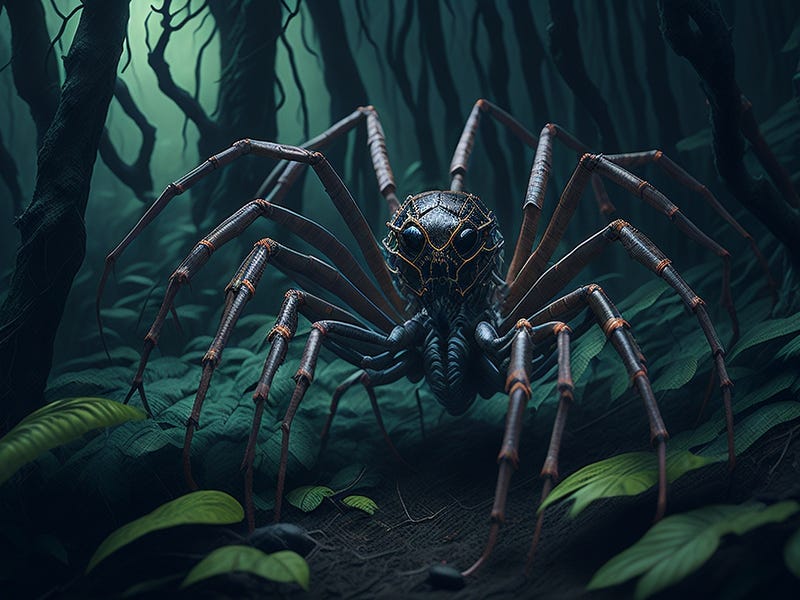
Fossils that are millions of years old aren’t always the remains of dinosaurs or plants. Sometimes they depict animals that are still familiar to us today, or rather, their ancestors. This is the case with the exceptional discovery in Germany. Scientists are already emphasizing its historical significance. However, it took several years to identify it.
We are talking about a recently unidentified fossil of a spider. Paleontologists extracted it near Osnabrück in Lower Saxony, Germany. Preliminary studies indicated that it came from the late Carboniferous period. It was only after examination by expert Dr. Jason Dunlop from the Museum für Naturkunde in Berlin that the creature was identified.
An extraordinary spider, an exceptional discovery.
This is the oldest spider ever found in Germany. The discovery is groundbreaking for another reason — it represents an entirely new species. It has been named Arthrolycosa wolterbeeki in honor of its discoverer, Dr. Tim Wolterbeek from Utrecht University. The fossil is estimated to be between 310 and 315 million years old. Despite its age, the spider has been remarkably well-preserved. The newly discovered species is one of only 12 Carboniferous species classified under the order Araneae.
What sets it apart from other spider-like relatives is the presence of spinnerets. This is a characteristic feature of true spiders.
Currently, scientists know about 12 spider species that lived during the Carboniferous period. While not insignificant, there were several times more spider-like arachnids closely related to them. Interestingly, the discoverer of this previously unknown spider species was not specifically researching spiders in his work. His studies were focused on the Earth. Members of the scientific community emphasize that this experience demonstrates how researchers don’t always limit themselves to specific disciplines.
“It’s been almost four years since I found this unidentified spider fossil near Osnabrück in Germany. It has been a wonderful experience, as I learned a lot about arachnids, spiders, and spinnerets along the way,” Dr. Wolterbeek wrote on an internet forum.
Spiders in the world.
Not much is currently known about the specific spider in question. The fossil alone did not provide enough information for scientists to determine how Arthrolycosa wolterbeeki lived or what it fed on. Spiders often evoke fear due to their appearance and potential danger. However, it’s worth remembering that the vast majority of spiders pose no threat to humans. It is estimated that only about 3% of spiders have venom dangerous to humans, including species like the black widow, Brazilian wandering spider, or brown recluse.
One of the most feared spiders is the tarantula, mainly due to its size. However, the venom of tarantulas is not dangerous to humans, with its effects often compared to the poison left by wasps.
Thank you for reading! If you enjoyed this content, please consider giving it a clap, leaving a donation, or offering a tip to support my work. Your generosity helps me continue creating valuable content.