
A FILM TO REMEMBER: “VERTIGO” (1958)
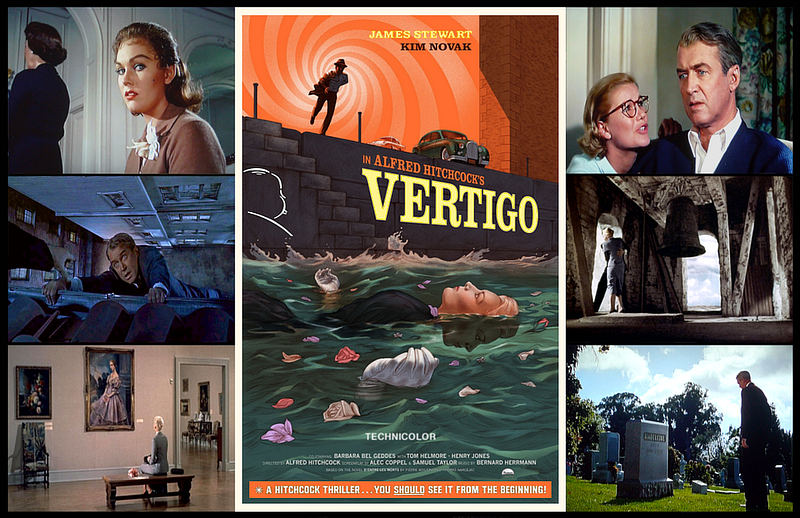
Before I get into this, I want to make mention “A FILM TO REMEMBER” will be a series about films that have reached a milestone anniversary since their origin in being culturally, historically, or aesthetically significant. The articles will contain the film’s plot outline, director, cast, a compilation of trivialities, various photos, movie trailer, critical reception and more. So, let’s start:
We are here to mark the celebration of the 60th Anniversary of Alfred Hitchcock’s “Vertigo”. Let’s take an inside look at the film:
PLOT OUTLINE:
A former police detective juggles wrestling with his personal demons and becoming obsessed with a hauntingly beautiful woman.
STUDIO:
Universal Pictures
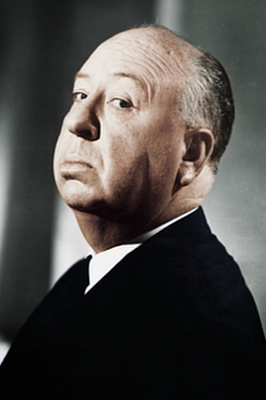
DIRECTOR:
Alfred Hitchcock
CAST:
- James Stewart … John “Scottie” Ferguson
- Kim Novak … Judy Barton/Madeleine Elster
- Barbara Bel Geddes … Marjorie “Midge” Wood
- Tom Helmore … Gavin Elster
- Henry Jones … Coroner
- Raymond Bailey … Scottie’s Doctor
- Ellen Corby … Manager of McKittrick Hotel
- Konstantin Shayne … Pop Leibel
- Lee Patrick … Car Owner Mistaken for Madeleine
- Margaret Brayton … Ransohoff’s Saleslady (uncredited)
- Paul Bryar … Capt. Hansen (uncredited)
- Fred Graham … Policeman on Rooftop (uncredited)
- Sara Taft … Nun (uncredited)
GENRE(S):
Mystery | Romance | Thriller
TAGLINE:
The most intense SUSPENSE…..EXCITEMENT….EMOTION ever generated by a motion picture!
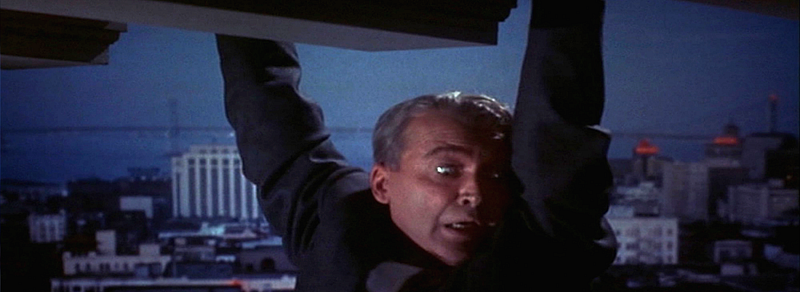
The film is know for being often cited as director Alfred Hitchcock’s masterpiece and one of the defining works of his career in this spellbinding study of a rich, resonant meditation of male romantic obsession, fear and control of women through an alluringly acrophobic performance by James Stewart in making this as one of the most highly renowned classics. The film is based from Boileau-Narcejac’s novel “D’entre les morts” (from “Among the Dead”), it received a mixed reception initially, attracting significant scholarly criticism, common to all of these critical views though is a lack of sympathy with the basic structure and drive of the film in this mastery of suspense but it has widely been reappraised over the course of time as being consensually, acclaimed as one of the best films of all-time in the annals of cinema.
Here’s what some of the critical receptions have been for the film over the years:
David Ansen from Newsweek says: “Why is this movie Hitchcock’s masterpiece? Because no movie plunges us more deeply into the dizzying heart of erotic obsession.”
Mike Clark from USA Today says: “You watch this guy going slowly over the brink and realize, good grief, this is Jimmy Stewart.”
Bosley Crowther from New York Times says: “There! No more hints! Coming or not? What more’s to say? Well, nothing, except that ‘Vertigo’ is performed in the manner expected of all performers in Hitchcock films.”
TIME Magazine Staff from TIME Magazine says: “The old master, now a slave to television, has turned out another Hitchcock-and-bull story in which the mystery is not so much who done it as who cares.”
Peter Stack from San Francisco Chronicle says: “In its dark heart, the film is a sorrowful contemplation of love and the veils that manipulate sexual passions.”
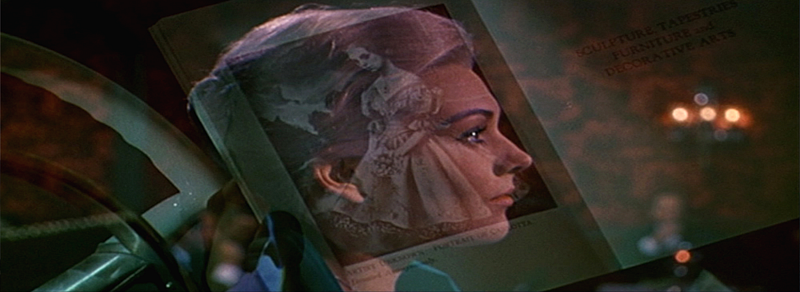
As you can tell by the critical reactions, the film has garnered mixed results with negatives being that its far-fetched, too long, slow and bog down to certain respects. While others, more positively have claimed Hitchcock’s mastery as an artistic triumph, using his Hitchcockian hallmarks all mesmerizingly on view that dives deeply into the dizzying nucleus of erotic obsession and the brash flair for psychological shocks of the lure of death, the power of the past, the near-fetishistic use of symbol and color and the guilty complicity of a clean-cut hero performed steadfastly by Stewart in this slick, mysterious, dream-like, film-noir cognitive neurosis tour de force. But I’ll let you decide…
So, to get a better look at the film, here’s a link to the movie trailer of Alfred Hitchcock’s “Vertigo”:
Here I have provided 12 interesting and intriguing trivia facts (I wanted to keep it limited) about “Vertigo”:
- The original source material for the film was the French novel “D’entre Les Morts” and the action was set in Paris. Director Alfred Hitchcock changed the setting to San Francisco, a city well known for its unique topography and hilly landscape, in order to add a further torment to Scottie’s life and emphasize the debilitating nature of his vertigo.
- First ever film to use computer graphics (Intro sequence done by Saul Bass).
- Uncredited second-unit cameraman Irmin Roberts invented the famous “zoom out and track in” shot (now sometimes called “contra-zoom” or “trombone shot”) to convey the sense of vertigo to the audience. The view down the mission stairwell cost $19,000 for just a couple of seconds of screen time.
- Alfred Hitchcock had originally wanted to use his now-famous Vertigo zoom in “Rebecca” (1940), but due to lack of technology at that time he couldn’t do it. The technique was inspired by a time when Hitchcock had fainted during a party.
- Actors Joseph Cotten, Lee J. Cobb and Everett Sloane was also under consideration for the role of Gavin Elster (played by Tom Helmore).
- The Empire Hotel where James Stewart eventually finds Kim Novak is (as of 2009) the Hotel Vertigo (formerly the York) located at 940 Sutter St. in the heart of San Francisco. Novak’s character lived in Room 501, which still retains many of its aspects captured in the film.
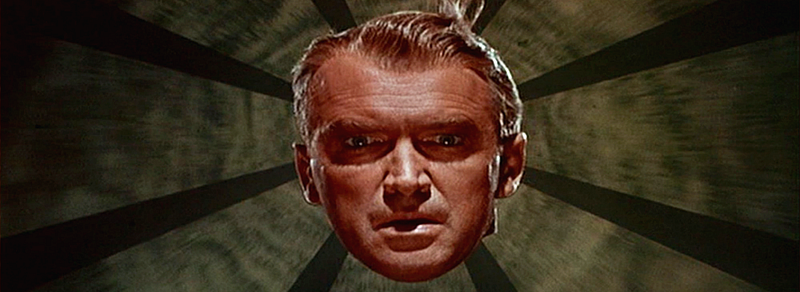
- There is a 25 year age difference between James Stewart and Kim Novak, who were 49 and 24 respectively when the film was shot in 1957.
- The name “Madeleine” refers, of course, to Mary Magdalene, or Mary of Migdala. “Migdal “is Hebrew for “tower.” “Madeleine” is the only name of the four main characters from the original French novel that was retained in the film. “Judy” was “Renée” in the book. So it is fascinating that Hitchcock did not keep the name. After all, Renée = re-née = reborn.
- This film is often credited (blamed) for creating or popularizing the misconception that vertigo means a fear of heights. For the record, the proper name for that condition is “Acrophobia”, whereas vertigo is “a sensation of whirling and loss of balance, associated particularly with looking down from a great height” (Oxford Dictionary).
- When Alfred Hitchcock’s wife, Alma Reville, saw the film, she said that she liked it, except for one shot where Kim Novak walks towards the San Francisco Bay, which she felt made Novak look too large on the screen. For years afterward, when discussing this film, Hitchcock would insist that Alma hated this film.
- In a later interview, Alfred Hitchcock said he believed Kim Novak was miscast and the wrong actress for the part. Novak wasn’t Hitchcock’s first choice by any means as originally he wanted actress Vera Miles to play Madeleine/Judy, but she became pregnant and was therefore unavailable. Hitchcock considered actress Lana Turner in the lead role as his second choice, but she “wanted too much loot” and was dropped from consideration.
- Alfred Hitchcock was embittered at the critical and commercial failure of the film in 1958. He blamed this on James Stewart for “looking too old” to attract audiences any more. Hitchcock never worked with Stewart again, despite previously being one of his favorite collaborators.
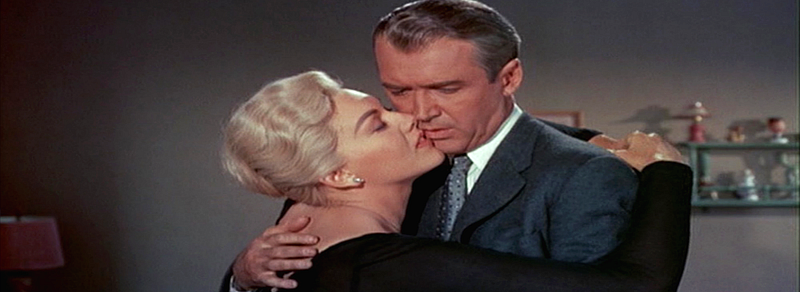
To conclude, Alfred Hitchcock’s “Vertigo” is a landmark that transcends barriers of generic making into an enigmatic ascendance for the mastery of suspense and mystery. Alfred Hitchcock is composedly efficacious in establishing characterization, atmosphere and uncertainty that’s psychologically dense with a twisted introspective of an unpredictable mysterious thriller. The film’s elements double as a mournful rumination on attachment, erotic obsession, commitment, human comfort and dual identities that all merge to create a voluptuous tale of thwarted love that’s anchored with a fixedly emotional performance from James Stewart in this thrilling, stylistic and fetishized romantic psychological cinematic masterpiece.
NOTE: The article contains sources from IMDb and Wikipedia.
Follow me and check out other articles of mine: