
A FILM TO REMEMBER: “2001: A SPACE ODYSSEY” (1968)
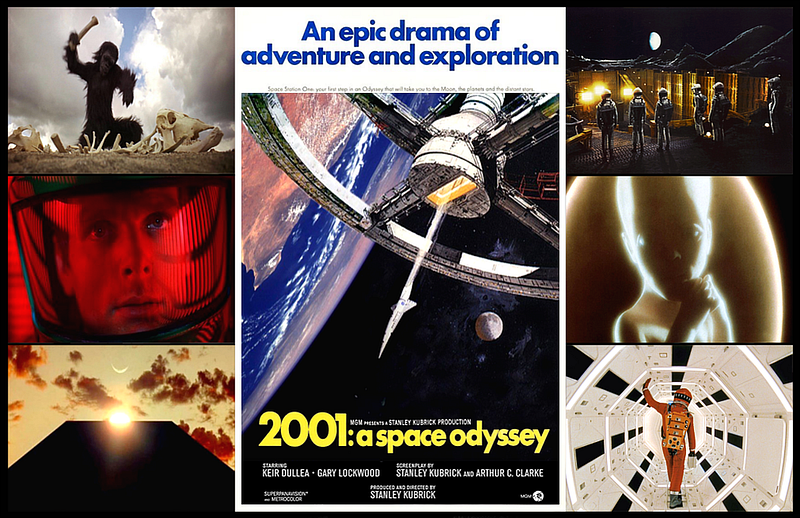
Before I get into this, I want to make mention “A FILM TO REMEMBER” will be a series about films that have reached a milestone anniversary since their origin in being culturally, historically, or aesthetically significant. The articles will contain the film’s plot outline, director, cast, a compilation of trivialities, various photos, movie trailer, critical reception and more. So, let’s start:
We are here to mark the celebration of the 50th Anniversary of Stanley Kubrick’s “2001: A Space Odyssey”. Let’s take an inside look at the film:
PLOT OUTLINE:
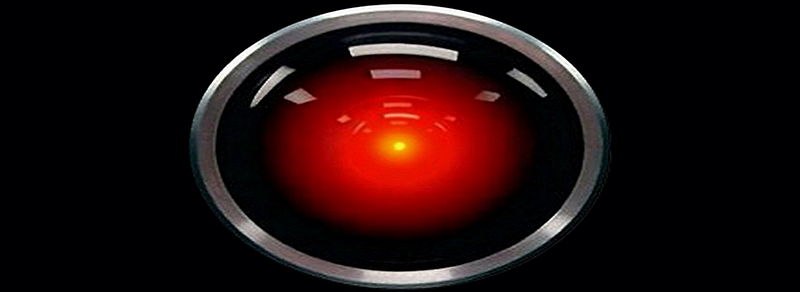
A space-opera spanning the dawn of man to humanity reaching the stars, telling the story of the Black Monolith, humanity’s evolution and the rise of A.I.’s ultimate supercomputer HAL 9000.
STUDIO:
Metro-Goldwyn-Mayor (MGM)
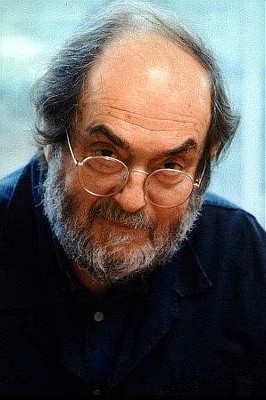
DIRECTOR:
Stanley Kubrick
CAST:
- Keir Dullea … Dr. David Bowman
- Gary Lockwood … Dr. Frank Poole
- William Sylvester … Dr. Heywood Floyd
- Douglas Rain … HAL 9000 (voice)
- Daniel Richter … The Chief Man-Ape (novel and film cast list give the character the name “Moonwatcher”)
- Leonard Rossiter … Dr. Andrei Smyslov
- Margaret Tyzack … Elena
- Robert Beatty … Dr. Ralph Halvorsen
- Sean Sullivan … Dr. Roy Michaels
- Frank Miller … Mission Controller
- Edward Bishop … Lunar Shuttle Captain
- Edwina Carroll … Aries Stewardess
- Penny Brahms … Stewardess
- Heather Downham … Stewardess
- Alan Gifford … Poole’s Father
- Ann Gillis … Poole’s Mother
GENRE(S):
Adventure | Sci-Fi
TAGLINE:
Let the Awe and Mystery of a Journey Unlike Any Other Begin
The film is known for pushing the limits of narration and special effects as director Stanley Kubrick commandeers a marriage of music, imagery, sound and philosophy towards a meditation on technology and humanity as it’s bereft of a time, or period, and unfolds a compelling and brilliant journey while also challenging audiences every single time that is by image, metaphor, poetry and suggestion making it one of the most mysterious, talked about, and intellectually stimulating films of all time. The film is based on Arthur C. Clarke’s story “The Sentinel,” it has stirred much debate and controversy over its time with a polarized critical reception, receiving both ecstatic praise and vehement derision, but despite the polarizing perspectives, it’s now considered, consensually, as one of the major artistic cinematic works of the 20th century, with many considering it a masterpiece of cinema.
Here’s what some of the critical receptions have been for the film over the years:
Scott Rosenberg from Salon.com says: “I assumed that this was what all movies ought to be: treasures for moral and aesthetic contemplation that did not provide all their answers on first contact.”
Pauline Kael from The New Yorker says: “A monumentally unimaginative movie.”
Geoff Andrew from Time Out says: “For all the essential coldness of Kubrick’s vision, it demands attention as superior sci-fi, simply because it’s more concerned with ideas than with Boy’s Own-style pyrotechnics.”
Joe Morgenstern from Newsweek says: “As whimsical space operetta, then frantically inflates itself again for a surreal climax in which the imagery is just obscure enough to be annoying, just precise enough to be banal.”
Roger Ebert from Chicago Sun-Times says: “The film creates its effects essentially out of visuals and music. It is meditative. It does not cater to us, but wants to inspire us, enlarge us.”
As you can tell by the critical reactions, the film is without a doubt as controversial and divisive with it’s receptions as any film in cinematic history, ranging from abysmally slow and completely absorbed in its own problems while at the same time, being proclaimed as an extraordinary, obsessive, beautiful work of art and a masterpiece for the ages in a journey through outer space, but it is also an expedition through cinematic space. Kubrick conjures the future by making you sit through its vision of the future, spending time just being in it as it shows the violence, deception, and hubris as built inside our DNA with permanence fated to fuel our demise in a film that made one giant leap in science fiction cinema that’s never been matched. But I’ll let you decide…
So, to get a better look at the film, here’s a link to the movie trailer of Stanley Kubrick’s “2001: A Space Odyssey”:
Here I have provided 12 interesting and intriguing trivia facts (I wanted to keep it limited) about “2001: A Space Odyssey”:
- In the premiere screening of the film, 241 people walked out of the theater, including actor Rock Hudson, who said, “Will someone tell me what the hell this is about?” Arthur C. Clarke once said, “If you understand ‘2001’ completely, we failed. We wanted to raise far more questions than we answered.”
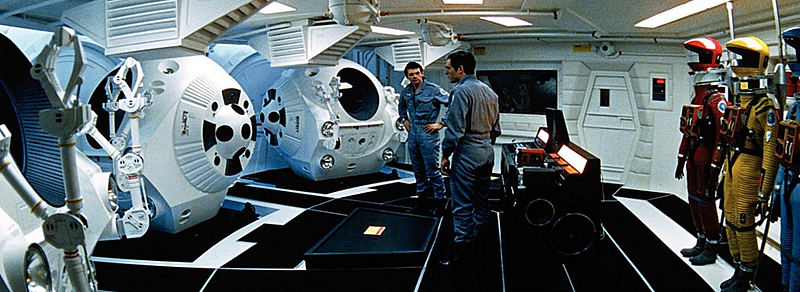
- For spacecraft interior shots, ostensibly containing a giant centrifuge that produces artificial gravity, Stanley Kubrick had a 30-short-ton (27 t) rotating “Ferris wheel” built by Vickers-Armstrong Engineering Group at a cost of $750,000. The set was 38 feet (12 m) in diameter and 10 feet (3.0 m) wide. Various scenes in the Discovery centrifuge were shot by securing set pieces within the wheel, then rotating it while the actor walked or ran in sync with its motion, keeping him at the bottom of the wheel as it turned. The camera could be fixed to the inside of the rotating wheel to show the actor walking completely “around” the set, or mounted in such a way that the wheel rotated independently of the stationary camera, as in the jogging scene where the camera appears to alternately precede and follow the running actor. The shots where the actors appear on opposite sides of the wheel required one of the actors to be strapped securely into place at the “top” of the wheel as it moved to allow the other actor to walk to the “bottom” of the wheel to join him. The most notable case is when Bowman enters the centrifuge from the central hub on a ladder, and joins Poole, who is eating on the other side of the centrifuge. This required Gary Lockwood to be strapped into a seat while Keir Dullea walked toward him from the opposite side of the wheel as it turned with him.
- According to Arthur C. Clarke, Stanley Kubrick wanted to get an insurance policy from Lloyds of London to protect himself against losses in the event that extraterrestrial intelligence were discovered before the movie was released. Lloyds refused. Carl Sagan commented, “In the mid-1960s, there was no search being performed for extraterrestrial intelligence, and the chances of accidentally stumbling on extraterrestrial intelligence in a few years’ period was extremely small. Lloyds of London missed a good bet.”
- According to special photographic effects supervisor, Douglas Trumbull, the total footage shot was some 200 times the final length of the film.
- The movie was not a financial success during the first weeks of its theatrical run. MGM was already planning to pull it back from theaters, when it was persuaded by several theater owners to keep showing the film. Many owners had observed increasing numbers of young adults attending the film, who were especially enthusiastic about watching the “Star Gate” sequence under the influence of psychotropic drugs. This helped the film to become a financial success in the end, despite the many negative reactions it received in the beginning.
- The last film made about men on the moon before Neil Armstrong and Buzz Aldrin walked there in real life. More than 40 years later there are still conspiracy theorists who insist that this is not a coincidence, claiming that all footage of Armstrong’s voyage was a hoax film directed by Stanley Kubrick using leftover scenes and props from this movie.
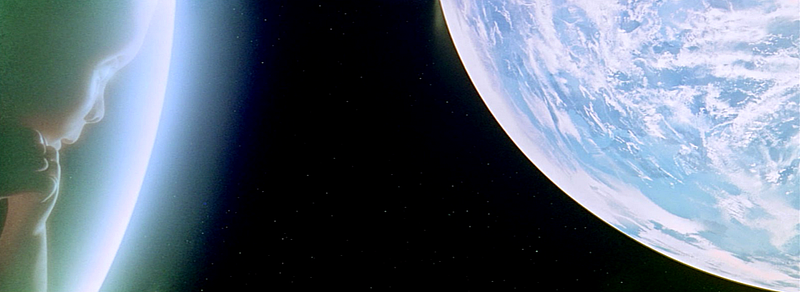
- Stanley Kubrick worked for several months with effects technicians to come up with a convincing effect for the floating pen in the shuttle sequence. After trying many different techniques, without success, Kubrick decided to simply use a pen that was adhered (using newly invented double-sided tape) to a sheet of glass and suspended in front of the camera. In fact, the shuttle attendant can be seen to “pull” the pen off the glass when she takes hold of it.
- Having calculated that it would take one person 13 years to hand draw and paint all the mattes needed to insert the assorted spacecraft into the starry backgrounds, Stanley Kubrick hired 12 other people who then did the job in 1 year.
- There is no dialogue in the first 25 minutes of the movie (ending when a stewardess speaks at 25:38), nor in the last 23 minutes (excluding end credits). With these two lengthy sections and other shorter ones, there are around 88 dialogue-free minutes in the movie.
- After seeing a documentary called “To the Moon and Beyond” (it’s not listed on IMDb) at the 1964 New York World’s Fair, Stanley Kubrick hired one of its special effects technicians, Douglas Trumbull, to work on this film. Trumbull developed a process called Slit-scan photography to create the wild, kaleidoscopic images Bowman experiences going through the Star Gate. It involved moving the camera rapidly past different pieces of lighted artwork, with the camera shutter held open to allow for a streaking effect. The overall effect gave the audience the sense of plunging into the infinite. Trumbull was later hired by ABC to produce the famous opening sequence for the ABC “Movie of the Week” using the same slitscan technique used for 2001.
- Astronomer Carl Sagan wrote in his book “The Cosmic Connection” that Arthur C. Clarke and Stanley Kubrick asked his opinion on how to best depict extraterrestrial intelligence. Sagan, while acknowledging Kubrick’s desire to use actors to portray humanoid aliens for convenience’s sake, argued that alien life forms were unlikely to bear any resemblance to terrestrial life, and that to do so would introduce “at least an element of falseness” to the film. Sagan proposed that the film suggest, rather than depict, extraterrestrial super-intelligence. He attended the premiere and was “pleased to see that I had been of some help.” Kubrick hinted at the nature of the mysterious unseen alien race in “2001” by suggesting, in a 1968 interview, that given millions of years of evolution, they progressed from biological beings to “immortal machine entities,” and then into “beings of pure energy and spirit”; beings with “limitless capabilities and ungraspable intelligence”.
- From very early in production, Stanley Kubrick decided that he wanted the film to be a primarily nonverbal experience that did not rely on the traditional techniques of narrative cinema, and in which music would play a vital role in evoking particular moods. About half the music in the film appears either before the first line of dialogue or after the final line. Almost no music is heard during any scenes with dialogue.
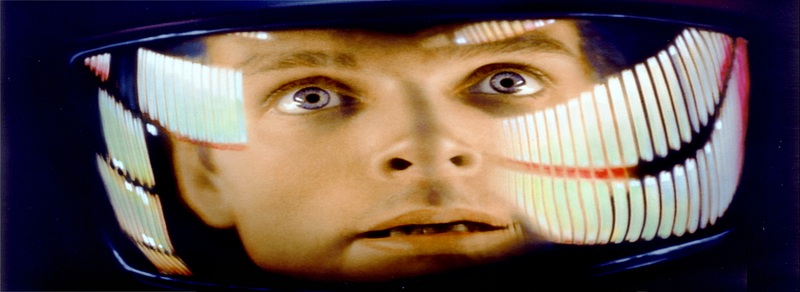
To conclude, Stanley Kubrick’s “2001: A Space Odyssey” is matched by Stanley Kubrick’s photographic eye to a story about watching, that transformed him into a director that altered the relationship between sound and imagery with a uniqueness that permits it to transcend the ordinary, causing cultural shock, in forever changing the conventions, style, and prestige of the previously debased genre in making one of the most influential of all sci-fi films — and one of the most controversial — as its delicate, poetic meditation on the ingenuity — and folly — of mankind through a philosophical experience and monumental questions of historical discourse, as it evokes with the most profound and confounding exploration of humanity’s relationship to technology, violence, sexuality and social structures as the film has become one of the true cinematic masterpiece monoliths of being one of the greatest films of all-time.
NOTE: The article contains sources from IMDb and Wikipedia.
Follow me and check out other articles of mine:


