
A FILM TO REMEMBER: “THE TRUMAN SHOW” (1998)

Before I get into this, I want to make mention “A FILM TO REMEMBER” will be a series about films that have reached a milestone anniversary since their origin in being culturally, historically, or aesthetically significant. The articles will contain the film’s plot outline, director, cast, a compilation of trivialities, various photos, movie trailer, critical reception and more. So, let’s start:
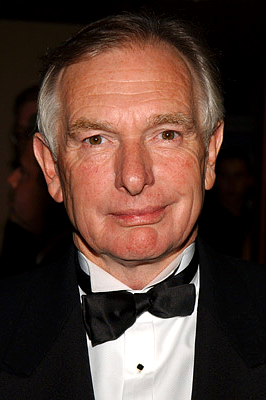
We are here to mark the celebration of the 20th Anniversary of Peter Weir’s “The Truman Show”. Let’s take an inside look at the film:
PLOT OUTLINE:
An insurance salesman/adjuster lives a happy life but what he doesn’t know is that his life is the focus of a reality TV show aired since his birth, that he’s the star, his hometown is a giant set piece, and everyone around him is an actor going by a script.
STUDIO:
Paramount Pictures
DIRECTOR:
Peter Weir
CAST:
- Jim Carrey … Truman Burbank
- Laura Linney … Hannah Gill / Meryl Burbank
- Ed Harris … Christof
- Noah Emmerich … Louis Coltrane / Marlon
- Natascha McElhone … Sylvia / Lauren Garland
- Brian Delate … Walter Moore / Kirk Burbank
- Holland Taylor … Alanis Montclair / Angela Burbank
- Paul Giamatti … Simeon
- Peter Krause … Lawrence
- Blair Slater … Truman Burbank — Young
GENRE(S):
Comedy | Drama | Sci-Fi
TAGLINE:
On The Air. Unaware.
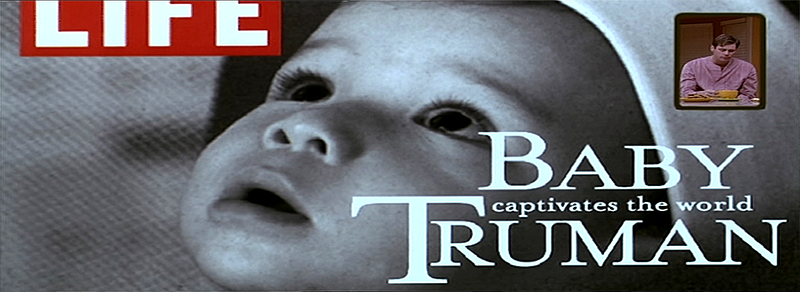
The film is known for being a deceptively simple fairy tale; a hilariously subversive satire…and that’s an elegant parable about truth and happiness with evocative religious resonances. But it’s also a subtly layered, perceptive, and pointedly truthful commentary on the media and its and our own voyeuristic tendencies. Director Peter Weir brings a cleverly conceived and thought-provoking sublime execution that forms the basis of a very witty exercise that guides a diverse cast led by a remarkable performance by Jim Carrey in this strikingly seditious piece of an informational-age paranoia, metaphysic classic feature. The film is based from an original idea by Andrew Niccol that was inspired by an episode of “The Twilight Zone” called “Special Service,” it was overall a widely acclaimed that fulfills its own ideological ambitions that bores through the boundaries of our entire media-saturated culture in this reality paradigm social satire.
Here’s what some of the critical receptions have been for the film over the years:
Peter Travers from Rolling Stone says: “‘The Truman Show’ finds a near-miraculous balance of humor and feeling in the keen intelligence of the script by Andrew Niccol and the prodigal inventiveness of ‘Dead Poets Society’ director Peter Weir at his very best.”
Sean P. Means from Film.com says: “A brilliant and daring film that blends charming comedy, affecting drama, thought-provoking satire and even a touch of biblical parable.”
Ella Taylor from L.A. Weekly says: “In the end, Weir’s movie is more a capitulation than a challenge to television, and a vulgar one at that. Truman turns out to be more Burbank than he is True-man.”
Michael Wilmington from Chicago Tribune says: “It’s a satire/comedy/fantasy about the future of television and the people caught in its omnipresent electronic net: a supremely intelligent jape about a man named Truman Burbank.”
Charles Taylor from Salon.com says: “The conception is so audacious and inventive that the movie winds up doing something genuinely radical: it bores through the boundaries of our entire media-saturated culture.”
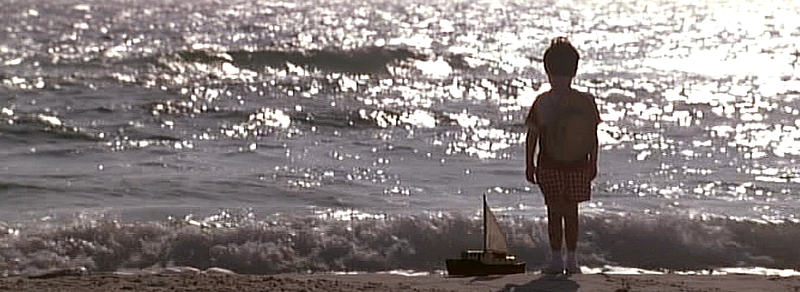
As you can tell by the critical reactions, some pundits’ criticisms felt the film was less profound and/or edgy then it was perceived as being, however, consensually, the majority found Weir’s touch is light and effortless, the film’s pleasures falling as gently as the Mozart music piped from a Seahaven’s sky. This ingenious satirical comedic drama with a top-notch cast about media omnipotence which is both dazzling and sophisticated, brings forth more thoughts as to whether our society could ever be this extreme, and with each viewing, its themes deepen in this funny, moving, imaginative and wickedly provocative cinematic exemplary of addictive power of comfy illusion. But I’ll let you decide…
So, to get a better look at the film, here’s a link to the movie trailer of Peter Weir’s “The Truman Show”:
Here I have provided 12 interesting and intriguing trivia facts (I wanted to keep it limited) about “The Truman Show”:
- In an interview, director Peter Weir stated he wanted to have cameras installed in every theater the film was shown in, having the projectionist at one point cut the power, cut to the viewers, and then cut back to the film.
- Ed Harris and Jim Carrey never met during filming.
- The Trumania bit, where Truman draws on the mirror with soap and acts strange, was completely improvised by Jim Carrey. In another take, he drew long curly hair and a dress.
- The overall look was influenced by television images, particularly commercials: Many shots have characters leaning into the lens with their eyeballs wide open, and the interior scenes are heavily lit, because Weir wanted to remind viewers that “in this world, everything was for sale”. Those involved in visual effects work found the film somewhat difficult to make, because 1997 was the year many visual effects companies were trying to convert to computer-generated imagery. CGI was used to create the upper halves of some of the larger buildings in the film’s downtown set. Craig Barron, one of the effects supervisors, said that these digital models did not have to look as detailed and weathered as they normally would in a film because of the artificial look of the entire town, although they did imitate slight blemishes found in the physical buildings.
- Every street name in Seahaven refers to a movie actor, e.g. “Lancaster Square” or “Barrymore Road.” All of the “cast” members are likewise named after movie stars: Meryl, Marlon, Lauren, Kirk, Angela, etc.
- Peter Weir wanted the film to be funnier, feeling that Andrew Niccol’s script was too dark, and declaring “where he [Niccol] had it depressing, I could make it light. It could convince audiences they could watch a show in this scope 24/7.” Niccol wrote sixteen drafts of the script before Weir considered the script ready for filming. Later on in 1995, Jim Carrey signed to star, but because of commitments with “The Cable Guy” (1996) and “Liar Liar” (1997), he would not be ready to start filming for at least another year. Weir felt Carrey was perfect for the role and opted to wait for another year rather than recast the role. Niccol rewrote the script twelve times, while Weir created a fictionalized book about the show’s history. He envisioned backstories for the characters and encouraged actors to do the same.
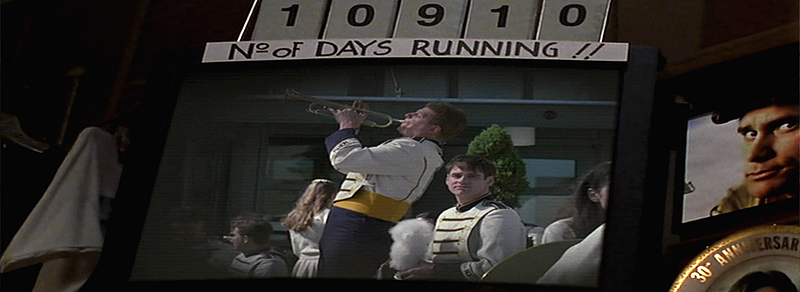
- The events in the film take place over a four to five-day time span, Day 10,909 to Day 10,913 of the show, as shown by the ticker over the TV in the Truman Bar. Truman would have been six to seven weeks from his 30th birthday. A “30th Anniversary” Truman Show commemorative plate can be seen hanging in the bar.
- The original script was darker and had crucial differences from the shooting draft. The city was not a utopian society but there were staged criminal incidents. Truman had a drinking problem. It is stated clearly that Truman makes love to his wife (whose real name is Hannah). Christoff’s intention was for Truman to have Meryl impregnated and the child would carry on the show. There were more clues that help Truman realize the truth. The scene where Truman confronts Meryl was far more aggressive. Finally, and most importantly, after Truman passes the door, he meets Christoff and the main cast members on a rooftop, while in the film the story ends with Truman’s exit from the fake world. In the encounter at the rooftop, which was in the script the actors stare at him sheepishly, but Truman in his rage attacks Christoff and tries to strangle him, but the rest of the actors hold him back. He is finally reunited with Sylvia.
- Jim Carrey and Peter Weir initially found working together on set difficult (Carrey’s contract gave him the power to demand rewrites), but Weir was impressed with Carrey’s improvisational skills, and the two became more interactive.
- This was Jim Carrey’s first time taking on a serious dramatic leading role. Carrey said of the film, “It was one of the best scripts I ever read. It works on so many levels.”
- Jim Carrey was Peter Weir’s first choice to play Truman Burbank from the outset.
- Joel Gold, a psychiatrist at the Bellevue Hospital Center, revealed that by 2008, he had met five patients with schizophrenia (and heard of another twelve) who believed their lives were reality television shows. Gold named the syndrome “The Truman Show delusion” after the film and attributed the delusion to a world that had become hungry for publicity. Gold stated that some patients were rendered happy by their disease, while “others were tormented”. One traveled to New York to check whether the World Trade Center had actually fallen — believing the 9/11 attacks to be an elaborate plot twist in his personal storyline. Another came to climb the Statue of Liberty, believing that he would be reunited with his high school girlfriend at the top and finally be released from the show. In August 2008, the British Journal of Psychiatry reported similar cases in the United Kingdom. The delusion has informally been referred to as “Truman syndrome,” according to an Associated Press story from 2008. Reportedly, many afflicted specifically mentioned the film in therapy. More recently, on September 16, 2013, the detailed account of one Ohio student who suffered for years from the Truman Show delusion was documented in the New Yorker magazine article “Unreality Star” by Andrew Marantz. After hearing about the condition, Andrew Niccol, writer of “The Truman Show” said, “You know you’ve made it when you have a disease named after you.”
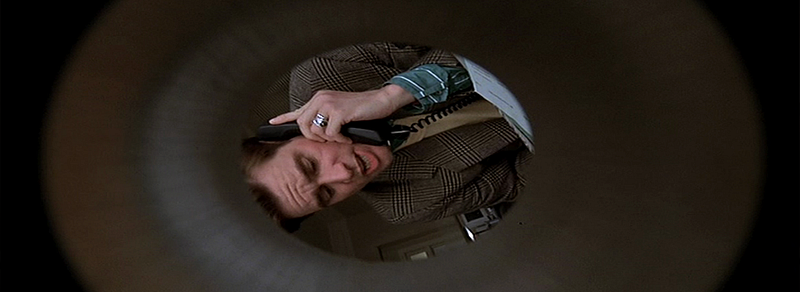
To conclude, Peter Weir’s “The Truman Show” is a funny, tender, and stimulating dramatization of Plato’s “Allegory of the Cave”…a fable that would be relevant 50 years earlier and no doubt will remain relevant 50 years hence. The film is all the more noteworthy for its remarkably prescient vision tailor-made for our era of celebrity spectacles, theme parks, the incursion of pop culture into all aspects of our lives and a nation with an insatiable thirst for the private details of ordinary lives. Peter Weir guides his first-rate cast led by an understated and effective performance from Jim Carrey in this bracingly intelligent, provocative and witty mix of entertainment values and long cognitive themes of analyzation as a thesis on Christianity, metaphilosophyd, simulated reality, existentialism and reality television in a mesmerizing classic delusion of a visual dimension of the dangers of mass-media and the horror of totalitarianism.
NOTE: The article contains sources from IMDb and Wikipedia.
Follow me and check out other articles of mine:


