
A FILM TO REMEMBER: “GROUNDHOG DAY” (1993)
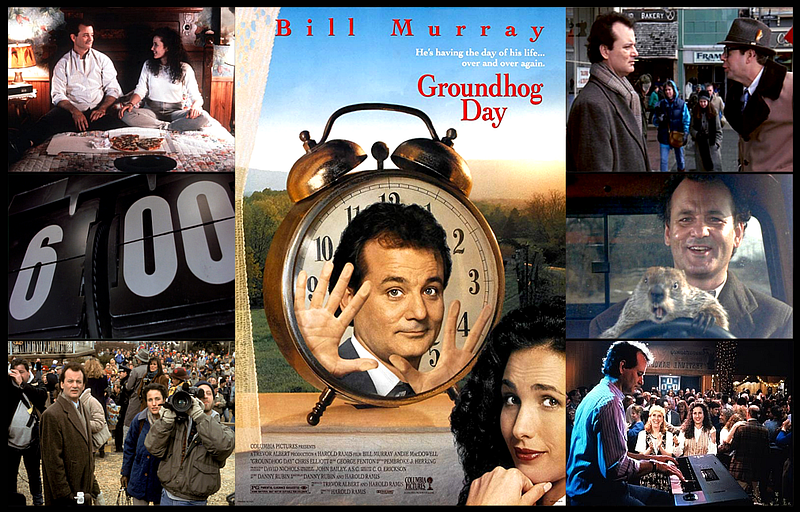
Before I get into this, I want to make mention “A FILM TO REMEMBER” will be a series about films that have reached a milestone anniversary since their origin in being culturally, historically, or aesthetically significant. The articles will contain the film’s plot outline, director, cast, a compilation of trivialities, various photos, movie trailer, critical reception and more. So, let’s start:
We are here to mark the celebration of the 25th Anniversary of Harold Ramis’ “Groundhog Day”. Let’s take an inside look at the film:
PLOT OUTLINE:
A weatherman finds himself inexplicably living the same day over and over again.
STUDIO:
Columbia Pictures
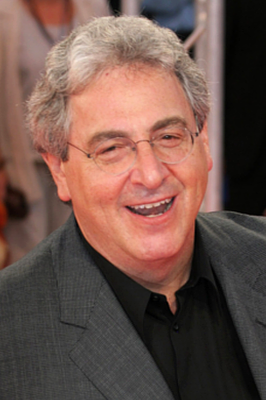
DIRECTOR:
Harold Ramis
CAST:
- Bill Murray … Phil Connors
- Andie MacDowell … Rita Hanson
- Chris Elliott … Larry
- Stephen Tobolowsky … Ned Ryerson
- Brian Doyle-Murray … Buster Green
- Angela Paton … Mrs. Lancaster
- Rick Ducommun … Gus
- Rick Overton … Ralph
- Robin Duke … Doris the Waitress
- Marita Geraghty … Nancy Taylor
- Ken Hudson Campbell … Man in Hallway
- Harold Ramis … Neurologist
- Richard Henzel … D.J. #1 (voice)
- Rob Riley … D.J. #2 (voice)
- David Pasquesi … Psychiatrist
- Hynden Walch … Debbie
- Michael Shannon … Fred
- Rod Sell … Groundhog Official
- Tom Milanovich … State Trooper
- John M. Watson Sr … Bartender
- Peggy Roeder … Piano Teacher
- Lee R. Sellars … Cop
- Chet Dubowski … Bank Guard Felix
- C.O. Erickson … Bank Guard Herman
- Timothy Hendrickson … Waiter Bill
- Martha Webster … Waitress Alice
- Angela Gollan … Piano Student
- Shaun Chaiyabhat … Boy in Tree
- Dianne B. Shaw … E.R. Nurse
- Barbara Ann Grimes … Flat Tire Lady
- Ann Heekin … Flat Tire Lady
- Lucina Paquet … Flat Tire Lady
- Brenda Pickleman … Buster’s Wife
- Amy Murdoch … Buster’s Daughter
- Eric Saiet … Buster’s Son
- Lindsay Albert … Woman with Cigarette
- Roger Adler … Guitar Player
- Ben A. Fish … Bass Player
- Don Riozz McNichols … Drum Player
- Brian Willig … Saxophone Player
- Scooter … The Groundhog
GENRE(S):
Comedy | Fantasy | Romance
TAGLINE:
He’s having the day of his life…over and over again.
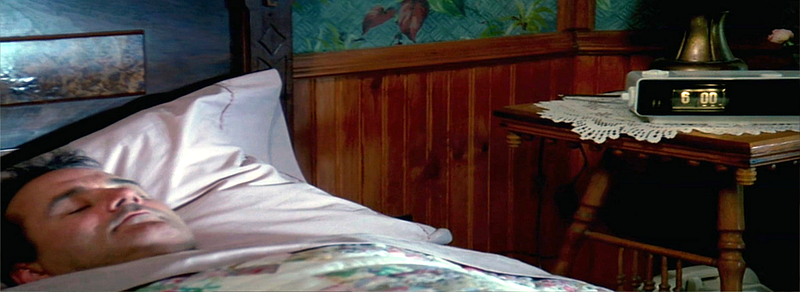
The film is known for being an interesting twist on reincarnation that continually replays a single day that could quickly become tedious but, strangely enough, never does as it digs deeper than most magic-realist comedies with its ingenious, sarcastic take on redemption through a blazingly imaginative experience. Director Harold Ramis guides wisely in unraveling the narrative, using both variation and repetition to prime effect, knowing what’s coming but not surely knowing how it’s going to happen as it’s all believable, in a way. The film is inventive, humorous, humane and thought-provoking yet, entertaining — relying on the ultimate gimmick while no plot point is over-explained, and when touching on the spiritual, it becomes neither soppy nor dogmatic while it expertly calculates to derive maximum comic energy from its principal performances of Andie MacDowell, Chris Elliott and particularly, the commanding wiseacre persona of Billy Murray in this quirky, crafty, witty and charmingly comedic gem. The film is based from an original idea by Harold Ramis and Danny Rubin, it garnered generally positive critical reviews with a bit of criticism but its attracted critical acclaim over the years and is considered one of the best comedy films of all-time.
Here’s what some of the critical receptions have been for the film over the years:
Kenneth Turan from Los Angeles Times says: “‘Groundhog Day’ may not be the funniest collaboration between Bill Murray and director Harold Ramis…Yet this gentle, small-scale effort is easily the most endearing film of both men’s careers, a sweet and amusing surprise package.”
Stanley Kauffmann from The New Republic says: “Bill Murray, more often than not, is pretty unbearable; but here, playing a man who is unbearable, Murray begins convincingly, amusingly, and gets even more amusing as he metamorphoses.”
Steven Rea from Philadelphia Inquirer says: “Murray hasn’t made a comedy this winningly dumb and smart and — yes — sweet in a long time. If, indeed, he ever has.”
Michael Booth from Denver Post says: “Since arriving as a mild success in 1993, ‘Groundhog Day’ has gradually achieved the status of beloved. The American Film Institute rates it №34 on its list of all-time funniest movies, and it’s a story that bears frequent repeat viewings.”
Richard Corliss from TIME Magazine says: “Bill Murray carries ‘Groundhog Day’ with his uniquely fritters nonchalance and makes the movie a comic time warp anyone should be happy to get stuck in.”
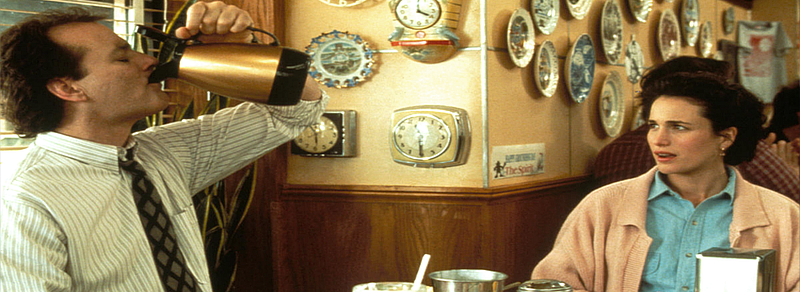
As you can tell by the critical reactions, the film generally got favorable reviews but a few pundits felt it was a marginal success as promising yet disposable high-concept comedy. However, it achieves a harmony of wit and wisdom as Ramis uses every cinematic trick in the book to keep what is essentially a one-gag film brimming with life and fresh ideas with revealing in its absurd repetitions, surprising us with narrative ellipses, and allowing ample space for its cast of spirited performances by Andie MacDowell, Chris Elliott and especially, the virtuosic, deadpan mug and the drop-dead I’m-not-impressed line readings of Bill Murray in this charmingly romantic, amusingly witticism, dramatically effective and an inventively fantasia comedic master work. But I’ll let you decide…
So, to get a better look at the film, here’s a link to the movie trailer of Harold Ramis’ “Groundhog Day”:
Here I have provided 12 interesting and intriguing trivia facts (I wanted to keep it limited) about “Groundhog Day”:
- Danny Rubin had completed and sold his script for “Hear No Evil” and moved from Chicago to Los Angeles to become a professional screenwriter around 1990. His agent suggested that he prepare a “calling-card” script that he could use to gain meetings with various producers. He came up with the core idea of the script which would become “Groundhog Day” while sitting in a movie theater. He asked himself the question “If a person could live forever, if a person was immortal, how would they change over time?” Having this character be immortal and having the world change around them would have been too cumbersome for filming. Instead he came back to a concept he had written down about two years earlier about a man living the same day over and over. With the idea of a person changing over time, this repeating day motif found its “deeper purpose” within the new script. The 2 ideas, combined, answered his proverbial question as well as opened up several possibilities of drama and comedy with that framework.
- Danny Rubin first conceived of the dating aspect for the film, “being able to use your superior knowledge to pick up women”, which led to the film leaning more to the comedy side. He knew he needed some calendar date to use for the day, and his earlier concept had the character reliving a late January day over and over; when he looked at his calendar, he saw Groundhog Day, February 2, as a date with great potential as a recognized holiday but one with little fanfare, and a date on which the film could be played annually, similar to Christmas or Halloween specials. Groundhog Day also presented Rubin with the idea of being able to take his character out of his home town into the unfamiliar territory and relative isolation of Punxsutawney, and cementing the character being named Phil in honor of Punxsutawney Phil, as well as making him a weatherman. Rubin took about seven weeks to fix the basic concepts and “rules” for the time loop in the film, and then completed the first draft of the screenplay within 3 to 4 days.
- Danny Rubin started to shop the screenplay to around 50 producers. While many studios expressed interest, they told him they would not be able to film it, though Rubin was able to secure additional work through these meetings. After his own agent left the industry, Rubin hired a spec agent to help sell the script more. The script got to the hands of Richard Lovett in the Creative Artists Agency, who was able to get it to director Harold Ramis around 1991, leading to Ramis offering to produce the film.
- In the first draft of the script, Danny Rubin had not wanted to have to explain to the audience how the character of Phil Connors (played by Bill Murray) got in the loop, and so had the movie start in medias res, with Phil already in the midst of the looping; the audience would have followed one of his days after waking up to “I Got You Babe” where he is already aware of what will be happening, and thus provoking the audience’s curiosity; the film would then have used voice-over narration by Phil to provide some of the backstory. Rita Hanson (played by Andie MacDowell) would also confess to being trapped in a time loop of her own. Rubin considered this draft to be more in line with the black comedy “Kind Hearts and Coronets” (1949), particularly with regards to how Phil’s suicides were presented
- While Harold Ramis wanted to keep this approach, the studio applied pressure to use a more standard narrative structure, forcing Danny Rubin to rewrite the script under Ramis’ direction. A major change was to restructure the film as a standard three-act piece. This second draft of the screenplay established the reason for the character of Phil being put in a time loop, according to actor Eddie Deezen. In that version, Phil unceremoniously dumps his current girlfriend Stephanie during the introductory scenes of the film at the studio. While Phil is at Punxsutawney, a scorned Stephanie devises a way to cast a spell to trap Phil within the loop for 10,000 years. According to Rubin, he felt that he had taken a defensive position in writing these new scenes, feeling that it would “take away everything that was innovative and interesting and turn it into an easily dismissed Hollywood comedy”, and acknowledges that Ramis interceded on his behalf to remove these explanatory scenes while keeping the three-act format.
- Another change in the second draft was to change the character of Phil’s attitude from having come to accept the nature of the time loop, to one that was more optimistic about being able to end the loop, making the role more suited to Bill Murray’s comedy talents. Harold Ramis had known Murray since their days in The Second City improv troupe and had used him in several successful films prior to this one, so Ramis knew how to play on Murray’s strengths to persuade him to take the role. Ramis originally, prior to Murray’s casting, wanted Tom Hanks for the role of Phil Connors, but decided against it, saying that Hanks was “too nice”. Ramis offered Michael Keaton the lead role but he turned down because he found the idea to be confusing when he read the script. Ramis also looked towards Chevy Chase, Steve Martin and John Travolta for the role of Phil Connors, but he considered them as “far too nice” compared to Murray.
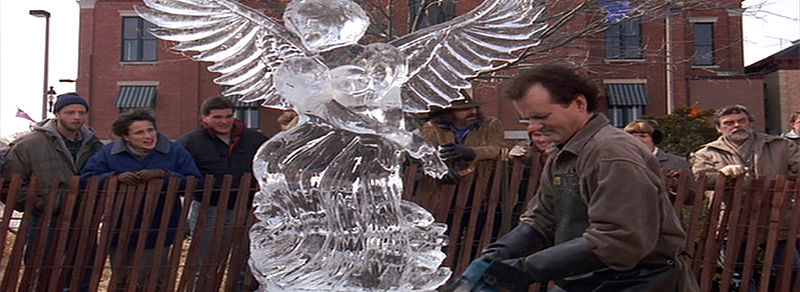
- The film was shot in Woodstock, Illinois, 60 miles (97 kilometers) northwest of Chicago near the Wisconsin border, because Punxsutawney “didn’t have a town center that looked good on camera,” according to Ramis, and because Punxsutawney’s remote location magnified the logistical problems and expense of filming there. Woodstock was a suitable replacement for Pennsylvania in the winter months; further, Ramis knew the area as a Chicago native and recognized it would be easy to obtain licenses to film there and operate the film’s production during the winter months. Punxsutawney officials, miffed that their town had been passed over, refused to allow the real Punxsutawney Phil to appear in the film, but sent representatives to Woodstock to make sure the ceremony was being depicted accurately; according to producer Trevor Albert, the Punxsutawney officers “were actually very pleased” with their recreation of Gobbler’s Knob, the site near Punxsutawney used for the Groundhog Day ceremonies. Filming began on March 16, 1992, and continued through May. Much of the filming was done in colder-than-normal weather, with Bill Murray saying that temperatures were often under 20 °F (−7 °C), and had snowfall that lasted through May.
- Punxsutawney Phil was played by a series of groundhogs collectively known as Scooter. “[The animals] hated my guts from day one,” said Bill Murray, who was bitten twice during shooting, including during the filming of the scene where he drives himself and Phil (the groundhog) into a ravine. The bites were severe enough that he was forced to undergo precautionary rabies immunization afterward.
- Bill Murray was undergoing a divorce at the time of filming, and was obsessing about the film. He would ring Harold Ramis constantly, often in the early hours of the morning. Ramis eventually sent Danny Rubin to sit with Murray, and iron out all his anxieties, this was one of the reasons why Murray stopped speaking to Ramis for several years.
- According to Harold Ramis, most of the time, when he tried to explain a scene to Bill Murray, Murray would interrupt and ask, “Just tell me — good Phil or bad Phil?”
- The idea of the character of Phil reading to Rita while she sleeps came from Bill Murray. His wife drank too much champagne on their wedding night and fell asleep early, so Murray read aloud to her until he too fell asleep.
- According to the website Wolf Gnards, Bill Murray spends 8 years, 8 months and 16 days trapped in Groundhog Day. The Movie Truth review series calculated Murray spent 4,576 days (25 years, 6 months, and 11 days) stuck in the loop. While the website Obsessed With Film claims he was trapped 12,403 days, just under 34 years, in order to account for becoming a master piano player, ice sculptor, et cetera.
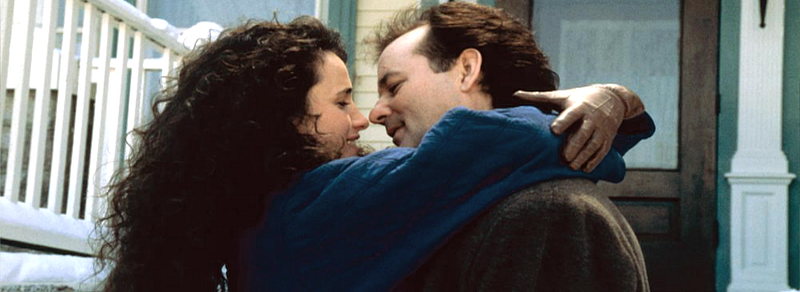
To conclude, Harold Ramis’ “Groundhog Day” is a phrase in American vernacular that has become a synonym for déjà vu as the term ‘groundhog day’ is now used to describe a recurring situation in government and military arenas. Harold Ramis direction is often steady and restrained while wisely avoiding to play into the narration’s underlying sentimentality in taking this intriguing premise just about as far as it could be taken. The film manages to be wildly humorous without being moronic, romantic without being cloying, and meaningful without being preachy while still bringing eternal philosophical questions of why we’re here and what we’re up to as it balances such different moods without ever taking a wrong turn with its solid cast and poignant performances from Andie MacDowell, Chris Elliott and specifically, Billy Murray’s evolution from inspired comedian to minimalist seriocomic actor in this existential dramatic comicality about self realization that wanders into high-minded Frank Capra territory as an unorthodox, good-natured, shrewd, thoughtful and entertainingly cinematic comedy classic.
NOTE: The article contains sources from IMDb and Wikipedia.
Follow me and check out other articles of mine:


