
KTHT OPPOSING VIEWS COLLABORATIVE PROMPT
A False Belief In Love Can Destroy The World
Essay
They say true love is liberating. True love is knowing how and when to let go of someone or something. True love is unconditional. The idea of not expecting anything in return. But in reality, is that practical or attainable?
I have always pondered on concepts of love for as long as I can remember. I turned to books in search of their meaning. C.S. Lewis is one of such writers I chanced upon. In his book, The Four Loves, Lewis describes such unconditional love as “agape”, the kind that God has for us.
Throughout the Christian Bible, there are countless verses all pointing to this agape love. One of the most recited one being in John 3:16, “For God so loved the world that He gave His only begotten Son, that whoever believes in Him should not perish but have everlasting life.” (NKJV).
When we hold on to this image, we think of men and women who served as missionaries, like Mother Theresa, who are willing to put aside their needs for the betterment of mankind. Some of us might even think of mothers as the next closest living beings, besides the saints, who are also able to exhibit agape love.
These people seem to be able to demonstrate the kind of unconditional love, without expectations or restraint. They protect, nurture, and give themselves willingly to others.
Besides mothers and missionaries, how do mere mortals like us express our love and where do we place our hearts?
The KTHT collaborative challenge statement given to me is “a false belief in love can destroy the world”.
But I challenge the truth behind this statement.
To define love is akin to mankind’s lifelong pursuit of proving heaven and hell exist, that there are other dimensions beyond our 3-dimensional world.
What does it even mean to love, hence what does it mean to have a false belief in love? How do we also define what is true and false?
When we take our love in an extreme way, it does show its destructive effects on relationships, businesses, and nations through narcissism, obsession, deceit, abuse, and in severe cases, murder.
All of these effects that result from the extremist way of showing love often involve some kind of excessive power control, manipulation, lack of showing compassion and empathy for others.
When any of these misfortunes happen, is that even love anymore? What can we say what love is?
In fact, I further contend that love cannot be defined by mere simple words, and perhaps only to be felt. Yet if love is to be felt, then it is also subjected to our own beliefs and perceptions. Our beliefs can change with time, location, people, and experiences.
Perhaps the phrase “a false belief in love” cease to be valid, rather it is a distorted sense of what love is, that may destroy our world.
What are some of the ways we get a distorted sense of love
Since love is probably better felt than defined, our belief in love is influenced by what we see, hear, read and do.
We may grow up listening to statements such as,
- Love is hard, so we have to fight to get love or struggle to fall in love or stay in love.
- All you need is love to stay happily ever after.
- Love will keep us alive, so we don the ostrich mentality and bottle up our real emotions creating a disconnect with self and others. We spiral into resentment or passive-aggressiveness, years later.
- Men are afraid or bad at feeling, expressing, or embracing love. Or that all men are emotionless. But the reality is, men love feelings, they want to connect.
- When there is no argument or conflict between two or more, it means we are having a good kind of love.
- Falling in love completes me, you are my other half, the perfect one, statements we hear in song lyrics and movies.
Yet if we really observe our surroundings, the kind of love that liberates, that makes us feel connected, and is without conditions, is a kind of love that involves the act of congruent actions through time and space.
We don’t chase love but express love through actions, speeches, and well-meaning intentions. It is not conditional, nor it is out of selfish or insecurity reasons.
True love is about the cultivation of trust and respect for mutual acceptance. True love is trust and respect that allows us to love “freely” and “peacefully”. True love makes us alive, as a sustainable force of effortless action. It has a longevity aspect or feels to it.
Two teachings from Zen Buddhist monk, Thich Nhat Hanh illustrates this beautifully and succinctly.
“If you love someone but rarely make yourself available to him or her, that is not true love.” — Thich Nhat Hanh (Living Buddha, Living Christ)
“We really have to understand the person we want to love. If our love is only a will to possess, it is not love. If we only think of ourselves, if we know only our own needs and ignore the needs of the other person, we cannot love. We must look deeply in order to see and understand the needs, aspirations, and suffering of the person we love.
This is the ground of real love. You cannot resist loving another person when you really understand him or her. From time to time, sit close to the one you love, hold his or her hand, and ask, ‘Darling, do I understand you enough? Or am I making you suffer? Please tell me so that I can learn to love you properly. I don’t want to make you suffer, and if I do so because of my ignorance, please tell me so that I can love you better so that you can be happy.” If you say this in a voice that communicates your real openness to understand, the other person may cry. That is a good sign because it means the door of understanding is opening and everything will be possible again. Maybe a father does not have time or is not brave enough to ask his son such a question. Then the love between them will not be as full as it could be. We need the courage to ask these questions, but if we don’t ask, the more we love, the more we may destroy the people we are trying to love. True love needs understanding. With understanding, the one we love will certainly flower.” — Thich Nhat Hanh (Peace Is Every Step: The Path of Mindfulness in Everyday Life)
The second quote from Thich in “Peace is Every Step”, pierces through my soul and heart and sends tingles down my spine in a good way.
Imagine your spouse, partner, a close friend sitting close to you, holding your hand and without distraction, asking you, “Darling, do I understand you enough?”.
I am tearing even as I am saying this to myself.
Love and hate can co-exist, but ultimately, love prevails.
We can’t harbor hate for too long, lest with time, one way or another, we will break or the world around us will crumble, just like what is happening right now in the world.
I sketched this image as a visual analogy to describe how we are to look at love and hate.
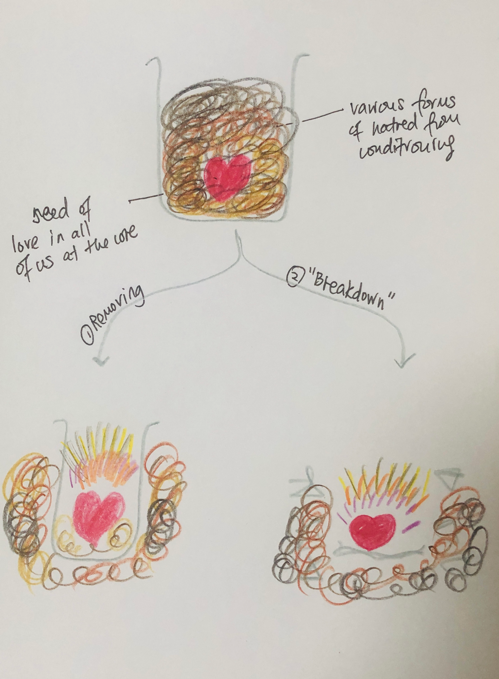
Each of us holds a seed of love at the core of us, wrapped around in a “beaker”.
With false conditioning from others and society, the seed of love is then clouded with hatred in all forms.
There are two possible outcomes to how love-and-hate can go:
- We either remove hate and let the seed of love be exposed and grow to fill our beaker and overflows, or,
- We continue to let hate grow for a while, filling up the beaker. Eventually, the beaker will shatter and thus exposing the seed of love that is underneath us.
This reminds me of the first two stanzas from a Confucian philosophy text recited in Three Character Classic (三字经).
“人之初,性本善。” which directly translates as “man’s nature by birth is good (or kind)”. “性相近,习相远。” which directly translates as, “the natures of men are closely similar, it’s the habits that separate them.”
These two stanzas clearly encapsulate how our beliefs, upbringing, behavior, and actions can alter, influence, or mask our deep-seated goodness in our hearts.
Therefore, it is not a false belief in love that destroys the world, but a distorted sense of love, which then becomes not love anymore, that may do so.
Yet we can take heart knowing that even a false sense of love is temporary, as love will prevail among us. And it has not so much to do with a Savior coming down or rising up from the ashes to love us but the inherent seed in us that is capable of giving true love.
Pry open my heart to you
As I prepared writing this essay, I reflect on the past 37 odd years of my life and apply the points that transpire through the discussion on how I have perceived love to be.
I have always believed that love does set us completely free, and love is a happy paradise to be in. With love, nothing is impossible. You know the song by Eagles “Love Will Keep Us Alive”? Yea, that is how I look at love, even to this day.
In familial and romantic relationships, I came to experience that we all express and perceive love in different ways, usually subjected by our childhood experiences, the beliefs we were exposed to, and later in adulthood, the events that influence our behaviors and their consequences on our lives.
With my family, I witnessed how my late grandmother’s heart was broken into pieces when her beloved son turned astray and involved himself in all kinds of get-rich-quick schemes and scams. At one point, he even deceived her and used her name as guarantor for his shenanigans. The last few years of her life, I saw how she had turned from a jovial, light-hearted, and friendly woman into a sad, dejected, and worried soul who often cooped herself up as she felt a tremendous sense of disappointment and shame.
On her deathbed, she said to him and the rest of the family, that the main reason she was lying in the hospital was because of him. The amount of emotional and mental stress over the last 3 years of life was too much for her heart to bear. She passed away at a mere 62.
Was my grandmother’s love for her son falsified? Did she not love him at all or did she love him “wrong”?
One thing that became clearer for me years later is she loved her son, but at some point, she let her fear of not wanting to accept the changes in her son who had now fallen short of her expectations cloud her judgment. Of course, her son was a manipulative person, and preying on an old woman, his mother no less, was just an easy immoral act by him.
My distorted belief of love was all to mask my deeper insecurity and low self-worth
With some of my personal relationships, I had my moments of letting my distorted belief of love take precedence. These led to episodes of miscommunication, physical, verbal and emotional abuse.
Perhaps as many can relate in our younger days, how many of us, haven’t gone through in our intimate relationships, thinking that “if I do this, or say this, he/she will love me more or love me back”?
Thus, we tend to blur the lines between compromise, personal boundaries, and values in order to keep the relationship alive.
We sacrifice our time, energy, money, even body (usually through sex in a non-consensual way), just to feel some kind of acceptance, or a sense of love, whatever our distorted perception of it may be, to fill up some kind of void within us.
As I continue my journey in understanding and practicing love, I draw my experiences and wisdom from various teachings.
One element to doing so became clearer to me is the skill of asking and accepting forgiveness towards self and others.
When we are able and willing to slow down the speed of our busy lives, fully open our hearts and forgive, we begin the journey back to true healing. We begin to clarify what our true belief in love is. Remember the analogy earlier of the beaker? That’s exactly how I see it.
When true forgiveness happens, we break apart the hatred surrounding the love seed beneath all that.
We now allow love to illuminate and grow with intentional actions of understanding.
Forgiveness involves listening first and talking next, from there compassion and lovingkindness emerge. Reconciliation results. There is no rocket science to this, but to actually do it consistently and intentionally, with as little or no influence from our own hurts as possible.
Today, I am still learning the art and living the delicate balancing of true love through various connections both within and outside of myself.
Lately, I learn about the art of honoring my own energy needs, mental, emotional, and physical capacity. I accept the cycles of my female body with the seasons of life. I use these as a personal benchmark to love myself and those around me, be it dogs, nature, my family, friends, or neighbors.
Slowly but surely, I felt an unwavering sense of inner peace, freedom, and security. Isn’t that what love truly is all about anyway? Free-flowing, beautiful, and effortless action.
May we all find our art of loving truthfully at all stages of our lives here on Earth.
Author’s note:
Writing this was unexpectedly challenging for me. I had to confront my own belief of what “false” and “love” is. But the 2.5hour discussion with Ravyne Hawke has helped me to break down my perceptions and understand what Diana was trying to achieve.
I enjoyed the discussion, and despite several hiccups in her life, whilst managing the PromptlyWritten publication, plus our 14 hours’ time difference, we manage to find time to squeeze in one lively chat.
It makes me feel loved, (pun intended) as I don’t feel alone writing this, a sentiment some writers on Medium often express. In fact, I had new clarification of what love means, as opposed to what love is.
It was time-fitting that this topic challenge came as I embark on a renewed spiritual healing journey of healing from childhood traumas, rejection, and low self-worth. I see it as the Universe/God/Source way of nudging me to continue trusting the healing process, unveil all the dark entitles surrounding the beautiful spirit underneath my heart, as we all have one.
I was also writing a guest post for a newsletter on my 14-year cancer survival story, which I will be publishing here soon.
I hope through my sharing here, you have taken some pieces for your reflection and reconnecting to what love truly is. Because let’s face it, we all flourish far better when we operate on a love frequency, which is higher, than on the lower frequency of fear, guilt, shame, hate, and blame.
I love you all, xoxo Yan. ❤️
I welcome your thoughts, sharing, and private notes if you prefer.
Response to Diana C.’s November Collaborative prompts
List of stories I wrote on love
Hello there, Thanks for reading. I am honored and grateful for your time. I don’t claim to know everything, but I will always strive to share every single bit of truth with thought and humility.
Yours Yan, hang out and support my journey on Substack, Instagram, YouTube, Twitter. Or just get updates sent straight to your emails.


