avatarKim Vertue

Free AI web copilot to create summaries, insights and extended knowledge, download it at here

2047

Abstract

in the chapel was arresting and impressive while fitting into the chapel’s overall scheme.</p><p id="0816">Why two versions?</p><p id="b5b1">We know that Leonardo and his assistant artists, the Predis brothers, were in a dispute with the chapel over payment, and so the earlier version, completed in 1486, was sold to a private art lover. The second version completed 1508, was the one finally displayed in the chapel with two side panels, one an angel playing a violin, the other angel playing a lute, which were painted by the Predis brothers and are now owned by the National Gallery London. Both these angelic figures had an element of <i>trompe-l’œil</i> to them, painted as if in three-dimensional recesses, and would have acted as a transition from the central painting to the surrounding statuary.</p><figure id="ccb6"><img src="https://cdn-images-1.readmedium.com/v2/resize:fit:800/1*nxQlEo6ewq1xprAOjlYjJg.jpeg"><figcaption>‘Virgin of the Rocks’ (c.1491-1508) by Leonardo da Vinci, the National Gallery version [<a href="https://en.wikipedia.org/wiki/File:Leonardo_da_Vinci_Virgin_of_the_Rocks_(National_Gallery_London).jpg">view license</a>]</figcaption></figure><p id="e46d">The differences between the two paintings show that Leonardo was always testing and seeking to improve the impact that the painting would have <i>in situ</i>, using his discoveries in the science of optics and art techniques to perfect the final painting. There are differences in colour and tone, and in the first version, the Angel points towards John the Baptist while in the second version his hand rests naturalistically on his knee while the child John the Baptist holds a staff. This emphasised his identity while the chubby infant between Mary and the Angel is the Christ child.</p><p id="49ea">Archangel Gabriel’s wings have greater solidity and, generally, the rendering is smoother. Perhaps this was intended to echo the marble surfaces of statues that would be competing with the painted figures. This time, he has added subtle halos — just simple

Options

golden hoops, hovering.</p><p id="fd3b">In 2019, the National Gallery undertook an extensive study of their version of the painting using the latest imaging technology. This revealed there was an underdrawing that suggested different poses for the Virgin and Angel before Leonardo returned to his original composition. There is even a handprint in the primer left on the face of the Virgin, perhaps Leonardo’s own. Such insights into the stages that went into Leonardo’s masterpiece are fascinating glimpses of the thought processes of a genius, something which will always enthral us.</p><p id="2d9d">Even the most rudimentary of Leonardo’s sketches are beautiful — his personal explorations of the natural world, the <a href="https://readmedium.com/we-are-the-golden-rule-eafed209ec31">anatomical studies</a>, and working drawings for commissions. One of his most complete full-length sketches, thought to be a preparatory drawing for a painting never completed, is often referred to as <i>The Burlington House Cartoon</i> and is also owned by the National Gallery.</p><p id="fce7">It shows the Virgin and infant Christ with Saint Anne and John the Baptist, also sitting on rocks in a natural setting. Sketched around 1500, during the period he was working on the two editions of <i>Virgin of the Rocks</i>, it is exquisite, showing a more natural mother and child pose, which perhaps offers a greater personal connection with Leonardo.</p><figure id="ff77"><img src="https://cdn-images-1.readmedium.com/v2/resize:fit:800/1*rAa6GCsnU4zSYq2ud-EAXA.jpeg"><figcaption>‘Virgin and Child with Saint Anne and John the Baptist’ (c.1500) by Leonardo da Vinci, aka ‘The Burlington House Cartoon’ [<a href="https://en.wikipedia.org/wiki/File:Leonardo_da_Vinci_-_Virgin_and_Child_with_Ss_Anne_and_John_the_Baptist.jpg">view license</a>]</figcaption></figure><p id="d8f2"><a href="https://readmedium.com/that-mona-lisa-strangeness-a28d364d1ed3">Leonardo’s <i>Mona Lisa</i> has been previously discussed by Remy Dean in The Signifier</a></p></article></body>

A Double Virgin of the Rocks!

Leonardo da Vinci only finished a few paintings yet he did this one twice…

Leonardo da Vinci, renaissance genius, scientist, artist, l’huomo universale — the universal man, who was interested in everything about the natural world, completed very few paintings in his lifetime. The Virgin of the Rocks is one — in fact, he made two versions of this painting. The Louvre owns the earlier version, the National Gallery London owns the latter.
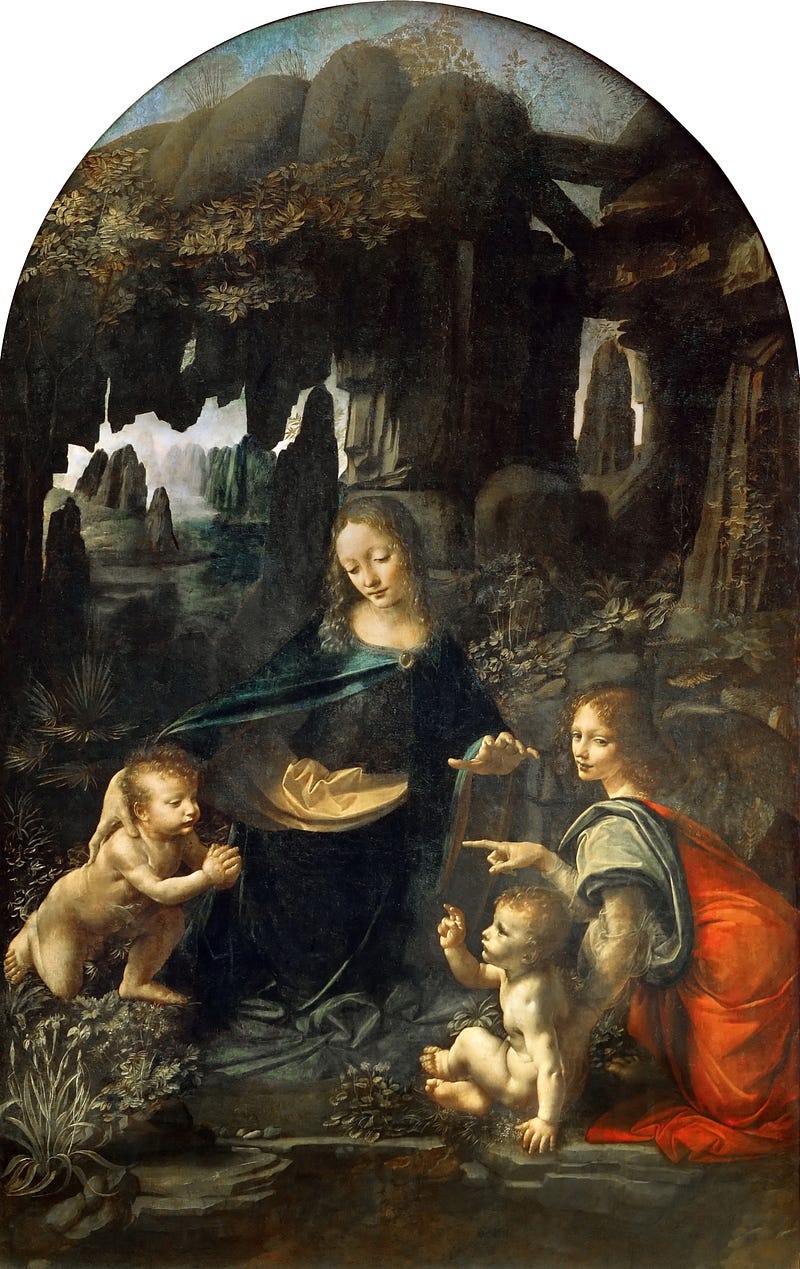
‘Virgin of the Rocks / Vergine delle Rocce’ (1483–86) by Leonardo da Vinci, the Louvre version [view license]

It was commissioned for a chapel in Milan dedicated to the Immaculate Conception of the Virgin Mary and was to portray the Virgin in keeping with this relatively recent doctrine — hence the presence of the Archangel Gabriel, denoted subtly by ethereal wings, and the surroundings of a rocky grotto and hybrid flowers in the foreground that emphasise the Eden like purity of the Holy Mother. The infant Christ child, the archangel, and the child John the Baptist by her side are carefully arranged in a circular yet pyramidal composition with the Virgin at its apex. All set before a cavernous interior space and receding landscape.

Leonardo’s characteristic use of sfumato — blurring of shade to suggest movement — and chiaroscuro — realistic shading to add distance to the mountains beyond and which gives a three-dimensional solidity to the figures, is a perfect demonstration of Leonardo’s technique. Rather than any halo, it is the beauty of the faces and their statuesque poise that reflect their divinity and ensured that a painting displayed next to marble statues within the chapel was arresting and impressive while fitting into the chapel’s overall scheme.

Why two versions?

We know that Leonardo and his assistant artists, the Predis brothers, were in a dispute with the chapel over payment, and so the earlier version, completed in 1486, was sold to a private art lover. The second version completed 1508, was the one finally displayed in the chapel with two side panels, one an angel playing a violin, the other angel playing a lute, which were painted by the Predis brothers and are now owned by the National Gallery London. Both these angelic figures had an element of trompe-l’œil to them, painted as if in three-dimensional recesses, and would have acted as a transition from the central painting to the surrounding statuary.
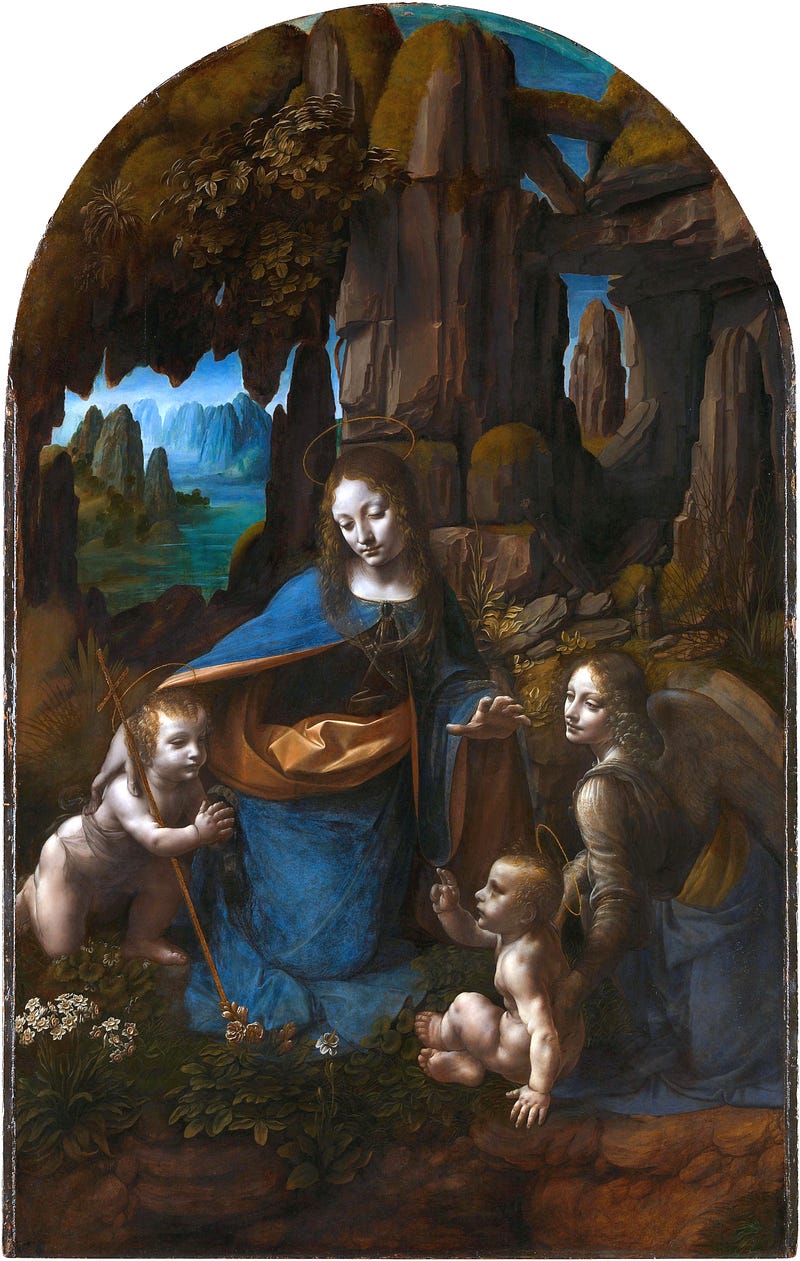
‘Virgin of the Rocks’ (c.1491-1508) by Leonardo da Vinci, the National Gallery version [view license]

The differences between the two paintings show that Leonardo was always testing and seeking to improve the impact that the painting would have in situ, using his discoveries in the science of optics and art techniques to perfect the final painting. There are differences in colour and tone, and in the first version, the Angel points towards John the Baptist while in the second version his hand rests naturalistically on his knee while the child John the Baptist holds a staff. This emphasised his identity while the chubby infant between Mary and the Angel is the Christ child.

Archangel Gabriel’s wings have greater solidity and, generally, the rendering is smoother. Perhaps this was intended to echo the marble surfaces of statues that would be competing with the painted figures. This time, he has added subtle halos — just simple golden hoops, hovering.

In 2019, the National Gallery undertook an extensive study of their version of the painting using the latest imaging technology. This revealed there was an underdrawing that suggested different poses for the Virgin and Angel before Leonardo returned to his original composition. There is even a handprint in the primer left on the face of the Virgin, perhaps Leonardo’s own. Such insights into the stages that went into Leonardo’s masterpiece are fascinating glimpses of the thought processes of a genius, something which will always enthral us.

Even the most rudimentary of Leonardo’s sketches are beautiful — his personal explorations of the natural world, the anatomical studies, and working drawings for commissions. One of his most complete full-length sketches, thought to be a preparatory drawing for a painting never completed, is often referred to as The Burlington House Cartoon and is also owned by the National Gallery.

It shows the Virgin and infant Christ with Saint Anne and John the Baptist, also sitting on rocks in a natural setting. Sketched around 1500, during the period he was working on the two editions of Virgin of the Rocks, it is exquisite, showing a more natural mother and child pose, which perhaps offers a greater personal connection with Leonardo.
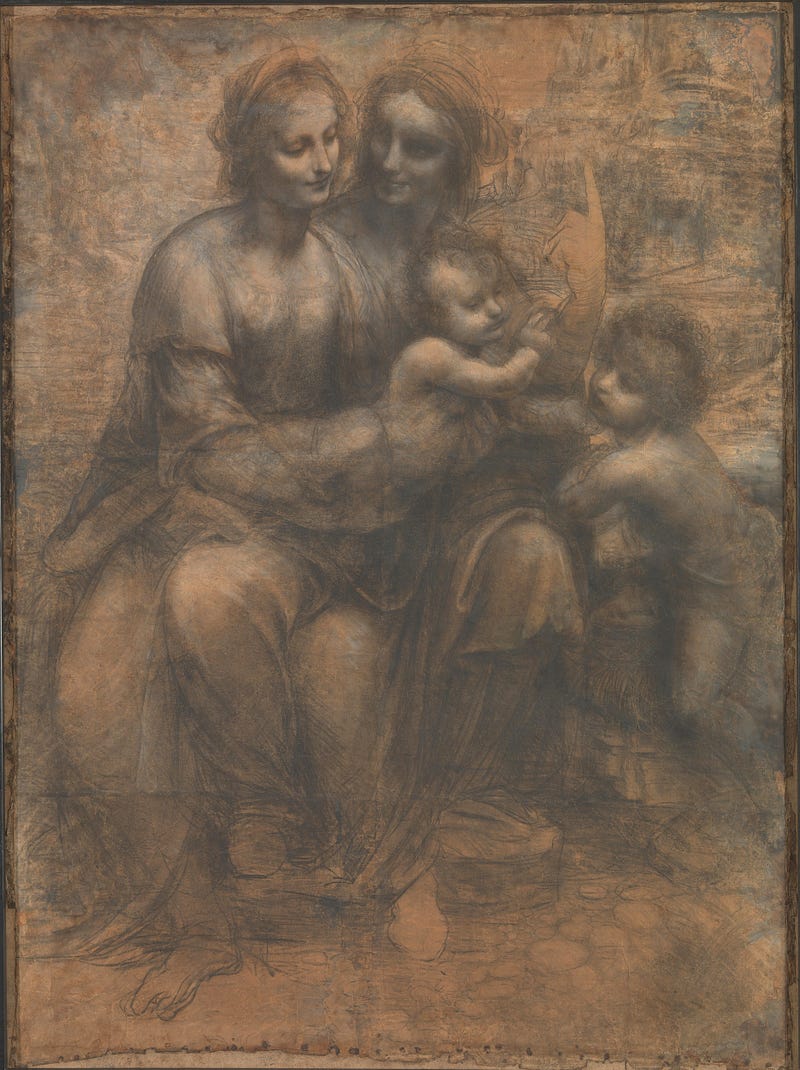
‘Virgin and Child with Saint Anne and John the Baptist’ (c.1500) by Leonardo da Vinci, aka ‘The Burlington House Cartoon’ [view license]

Leonardo’s Mona Lisa has been previously discussed by Remy Dean in The Signifier

Art
Art History
Painting
Renaissance
History
Recommended from ReadMedium