A Clockwork Orange: 50 Years On
Stanley Kubrick’s incendiary masterpiece is still provocative, subversive, shocking, and relevant.
NOTE: Contains Spoilers.
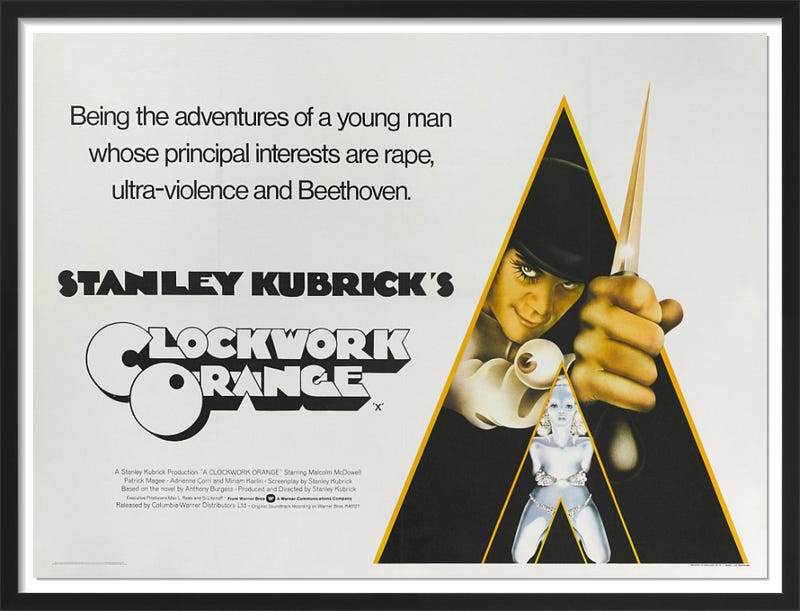
As a budding cineaste growing up in the 1980s, I was aware that several specimens of extreme cinema had been censored or banned in the UK, due to a combination of moral panics and the peculiarities of the then head of the British Board of Film Classification, James Ferman. Casting as a near mythological shadow over all these films was the curious case of Stanley Kubrick’s 1971 masterpiece A Clockwork Orange, which you could not legally see in any form — at the cinema, on video, or on television — between 1973 and 2000 in the UK. Ironically, this was not due to the BBFC, but Kubrick himself, who withdrew the film from UK distribution in view of supposed copycat crimes and death threats he received.
I’ve written extensively elsewhere about the bizarre history of UK film censorship, and am pleased to report that these days of lunacy are behind us. However, having caught a re-release screening of A Clockwork Orange at the cinema last week, in conjunction with the film’s 50th anniversary, I thought it an appropriate time to reflect on this extraordinary, singular piece of work. It is a film that if anything feels more relevant today. Nor has it lost any of its power to shock. At the screening I attended, there was at least one outraged walk-out within the first ten minutes. I could feel the collective anxiety of the largely younger audience, and at times could sense how much offence was being taken at the initial movement of the film.
The opening scenes of A Clockwork Orange remain intensely disturbing viewing. Opening on a close-up of protagonist Alex (Malcolm McDowell, in his finest ever performance), the camera slowly pulls out to reveal he and his “Droog” gang drinking “Moloko” — milk spiked with drugs — at a pseudo-futuristic bar containing tables formed from statues of naked women in sexually submissive poses. It’s an extraordinary shot, punctuated by Alex’s narration which at once introduces the viewer to “Nadsat” — an English-based fictional dialect that also contains Russian terms, as per the Anthony Burgess source material. It is remarkable how Nadsat terms require no explanation, as they are given life by Kubrick’s astonishing visuals.
Kubrick frames the sequences of violence, rape, and mayhem that follow in a deliberately thrilling manner. We are invited to be exhilarated by Alex and the rampage of his fellow Droogs, and we experience events through Alex’s eyes. Kubrick stages the violence in a highly choreographed manner, scored to various classical tracks, predominantly Beethoven (or “Lovely Ludwig” as Alex calls him). An early attempted rape is staged as a kind of dance; the way the girl’s clothes are torn off, and the way a rival gang manhandles her, feels highly choreographed on purpose. The scene even plays out on the stage of an abandoned theatre.
Alex and his Droogs show up, and the naked girl flees. The gangs fight, again in a highly choreographed, purposefully exhilarating fashion, occasionally punctuated by a sudden shot of a bottle being smashed into a face, creating a shocking juxtaposition between the balletic wide shots, and the brutal close-ups. Kubrick makes us feel as uncomfortable as possible throughout because there’s a real feeling of the audience being complicit, as though we were part of Alex’s thuggish gang.
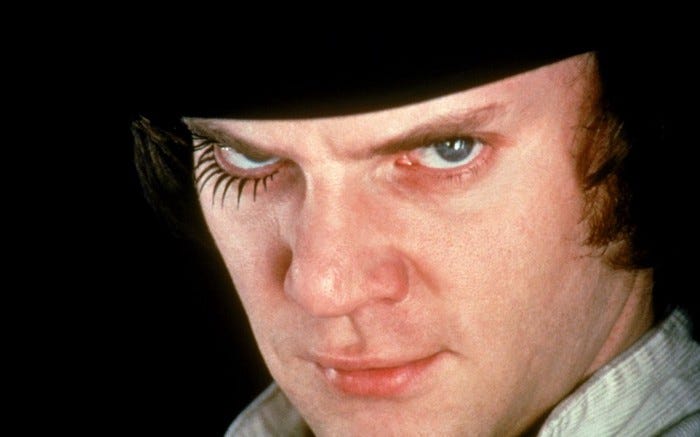
Alex’s rampage continues, beating up a homeless man, joyriding stolen vehicles through dark country lanes (with deliberately artificial rear-projection effects), and causing violent chaos. At one point, he and his gang infiltrate the home of a writer, beat him up, and brutally rape his wife, whilst singing the title song from Singin’ in the Rain. It’s a squirm-inducing sequence, and proved too much for the aforementioned audience member, who stormed out of the cinema, muttering at how offensive it was.
All of which got me thinking, what exactly is it about A Clockwork Orange that makes it so unsettling? It isn’t particularly bloody, and there have since been far more violent films, with far more directly explicit images. I think part of it is to do with the way events are depicted from Alex’s point of view. At the same time, the distress of the victims is clear throughout. The camera’s gaze is unsparing, and the amount of nudity isn’t simply an expression of breaking free from censorship (unlike many films of the period) but a deliberate aesthetic choice. Kubrick invites us to lustfully leer, like Alex.
In truth, you can’t really make a convincing case for A Clockwork Orange being a straightforward anti-violence/anti-rape film. If it were, Kubrick would have fallen into the depicting-something-to-condemn-something trap, rather like the manner in which last year’s Cuties was criticised for condemning child sexualisation by arguably doing just that. However, A Clockwork Orange isn’t preoccupied with such straightforward questions, and taking it at face value in that respect is a mistake. Depicting something does not always equate to endorsing something, but Kubrick is attempting, through a subversive satirical lens, to be ruthlessly honest about why Alex and his Droogs do what they do, in their dystopian future. (Indeed, with references to lunar colonies and the like, whilst law and order fall to bits on Earth, there’s a real sense in which the film could be taking place in a concurrent timeline to events in Kubrick’s previous film 2001: A Space Odyssey.)
It is only once we get past the opening twenty minutes of violence, which culminate in the accidental killing of a woman with a giant phallus, that Alex is incarcerated and sentenced to fourteen years in prison. As Alex puts it in his narration: “This is the real weepy and like tragic part of the story beginning, oh my brothers.” The opening sequence is vital context, because without it we would simply feel sorry for Alex, in view of his subsequent suffering. But Kubrick makes clear from the outset that he is a dangerous, violent psychopath.
During the prison sequences (which have a somewhat homophobic undercurrent that could offend modern audiences), Alex reads the Bible. He finds himself fantasising about perpetrating the violence it contains, whether participating in Old Testament battles or assisting in Jesus’s crucifixion. He also fantasises about sleeping with the handmaidens of the patriarchs. Outwardly, his fascination with the Bible and his facade of attempted reform endears him to the prison chaplain, who takes Alex under his wing. This chaplain at first comes off as a stereotypical Irish hellfire preacher, but eventually becomes a voice of reason in the face of what follows.
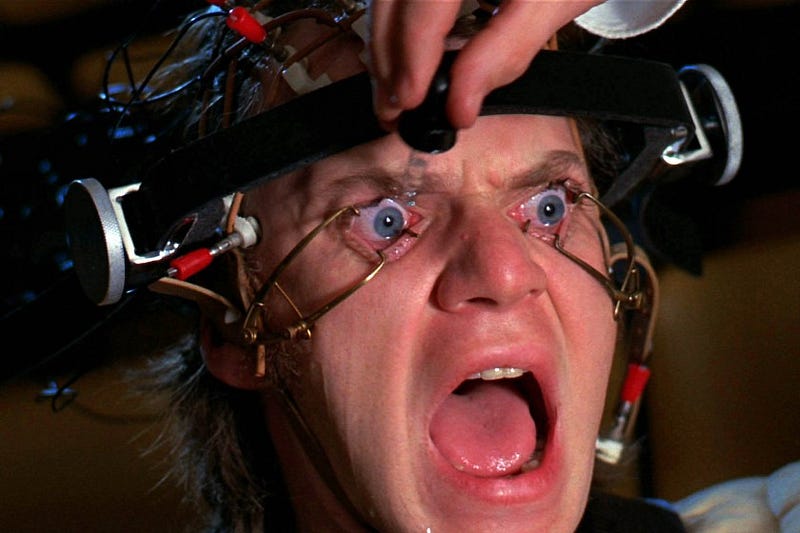
In the background of the story, the British government is becoming increasingly right-wing, fascist, and dictatorial. Prisons are too full, and they are needed for political prisoners, rather than common thugs. Because government ministers don’t want to spend more money on the penal system, experimental therapies are introduced to rehabilitate violent prisoners early. Alex volunteers for the experimental Ludivico treatment to get out of prison. In this treatment, he is brainwashed so he becomes incapable of committing acts of rape and violence. Unfortunately, one of the brainwashing films he is shown contains a Beethoven soundtrack, meaning the 9th Symphony becomes a torment for him to hear. The aforementioned preacher condemns the Ludivico process because Alex has no real moral choice in the matter.
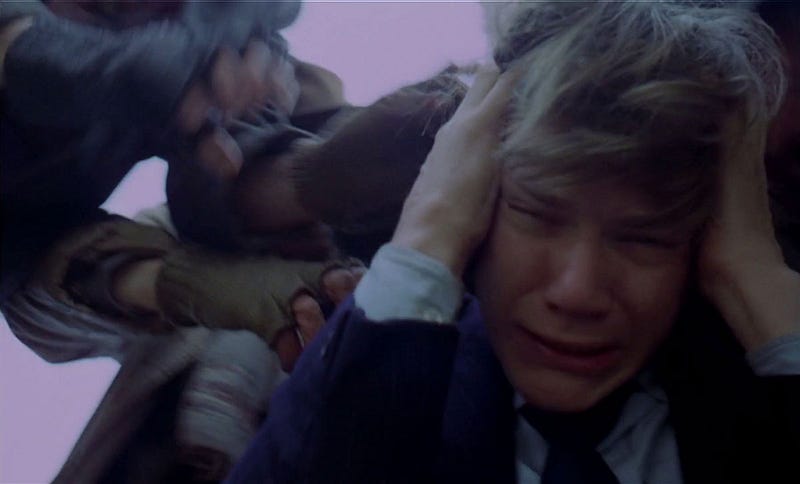
Once Alex is released back into society, Alex finds things have changed. In a deliberately arch and melodramatic scene, he finds his parents have taken in a lodger who has become a kind-of replacement son. Determining to make his way on his own, he leaves, only to be recognised in the streets by the homeless man he almost beat to death earlier in the film. Said homeless man then attacks him, with several other homeless people joining in.
Eventually, the police break up the brawl, but the police turn out to be two of Alex’s former Droogs, who have since found they can get their kicks just as easily as policemen, given the fascist direction the country has taken. They brutally beat Alex, nearly drowning him. Disorientated from the beating, Alex staggers around in the darkness, and happens across the home of the writer that appeared earlier in the film. His wife is now dead, supposedly from pneumonia, but the writer claims it was a result of the brutal rape.
At first, Alex is welcomed in by the writer, as it turns out he is a political subversive trying to bring down the government. He wants to use Alex’s horrific treatment at their hands to help make his case. However, after offering Alex a bath, he overhears Alex singing Singin’ in the Rain, and realises this is the man who raped his wife (Alex had been masked during the earlier sequence).
Subsequently, Alex is drugged and imprisoned in a bedroom on the top floor of a country house. He awakens, only to hear Beethoven’s 9th Symphony being played through the floor to him at deafening volume. This triggers the Ludivico treatment reactions in him. He feels violently sick and wants to die. Alex throws himself out of the window in a suicide attempt.
He awakens in hospital, not dead, but having been in a coma with several broken limbs. Whilst in a coma, the government has been severely criticised for the Ludivico treatment, and is on the back foot, trying to undertake a political U-turn with as little fuss as possible. As a result, Alex is slowly brainwashed back to “health”, ie his previous mental state. He is visited in hospital by a government minister who implies that if Alex makes statements supportive of his government, he will be free to do as he pleases. The final shot of the film is Alex experiencing a delirious sexual fantasy, declaring: “I was cured all right.”
This is a very deliberate change from the novel. Burgess included a chapter where Alex appears to put aside teenage thuggery and violence, entirely as a result of growing up. Kubrick omits this, as he perhaps found it unconvincing as an assessment of human nature, and that having carefully backed the audience into a corner, it let them off the hook. After all, the film is making a very bold, subversive assertion: It is better to be able to choose between good and evil, and choose evil, than it is to have no choice at all. Even when that choice negatively affects others. By contrast, “I was cured all right” in the novel is more open to an interpretation of genuine character reform, rather than the politically expedient reversion to psychopathy that Kubrick hints at here.
As I pondered this proposition, I kept thinking about current political debates — around Covid vaccinations, for instance. I also thought about the increasingly authoritarian stance taken by western governments, and the way they respond to public demands. I thought about the way celebrities are urged to endorse official government advice. I thought about how the film depicts a future in which sexualising and objectifying women is the norm, and considered how prophetic Kubrick was in that respect, as though he foresaw the effects of internet pornography.
As a result, A Clockwork Orange provokes infuriatingly contradictory ideas. It is almost maddeningly thought-provoking and jabs raw nerves at every turn. This is despite the fact that it was shot on a fairly low budget, and is clearly a product of the post-mod, pre-punk era in which it was made. Yet it still looks fabulously immersive on a big screen, as do all Kubrick films. It also remains a darkly comic, bracing, incendiary, incisive, shocking experience that even now has the power to jolt audiences out of their apathy. The fact that I’m still not sure how I feel about it, even all these years later, is arguably another testament to the film’s greatness.
Author’s note: I hope you enjoyed this article. For more about me and my writing, please click here.