
A Checklist for Using the Spotify Model
Adopting the Spotify Model is more than renaming your teams to squads. Download our free checklist for the top 25 cultural elements of the Spotify Model.
Previously I posted about some of the great information that has come out of Spotify’s agile journey including the top 10 Spotify Graphics from Henrik Kniberg. I also wrote about how the Spotify Model is not an agile method and it certainly isn’t a scaling approach.
In that post, I identified 25 top cultural elements of Spotify’s approach. My point was that simply renaming your teams to squads would be meaningless and unproductive; it is the culture change that made Spotify, Spotify.
I have extended that analysis of the Spotify approach and created a simple Checklist of the Spotify Model you can use to gauge your adherence to the so-called Spotify Model. You can use this checklist of the Spotify Model to determine if your culture is anything like Spotify’s.
A Checklist for the Top 25 Cultural Elements of the “Spotify Model” of Agility
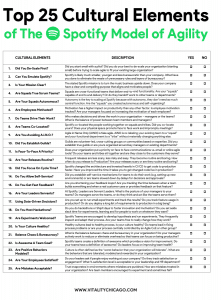
1. DID YOU DE-SCALE FIRST?
Did you start small with a pilot? Did you do your best to de-scale your organization (starting small) before trying to scale agile to fit your existing large organization?
2. CAN YOU EMULATE SPOTIFY?
Spotify is likely much smaller, younger and less bureaucratic than your company. What have you done to eliminate the waste of unnecessary rules and layers of bureaucracy?
3. IS YOUR MISSION CLEAR?
The stated Spotify mission is to turn the music business upside down. Does your company have a clear and compelling purpose that aligns and motivates people?
4. ARE SQUADS TRUE SCRUM TEAMS?
Squads are cross-functional teams that deliver end-to-end functionality. Are your “squads” capable of end-to-end delivery? Or do they handoff work to other teams or departments?
5. ARE YOUR SQUADS AUTONOMOUS?
Autonomy is the key to scaling at Spotify because with autonomy, they don’t need as much central function. Are the “squads” you created autonomous and self-organizing?
6. ARE EMPLOYEES MOTIVATED?
Motivation has a higher impact on productivity than any other factor. Is employee motivation tracked? Are your managers focused on increasing the motivation of each employee?
7. DO TEAMS DRIVE THEIR WORK?
Who makes decisions and drives the work in your organization — managers or the teams? What is the balance of power between team members and managers?
8. ARE TEAMS CO-LOCATED?
Spotify co-located the people working together on squads and tribes. Did you co-locate yours? Does your physical space promote face to face work and impromptu meetings?
9. ARE YOU AVOIDING A.I.N.O.?
Agile in Name Only (AINO) is fake agile that is not consistent with the 4 agile values and 12 agile principles. AINO is re-labeling your existing team to a “squad” and your functional department to a “tribe” without materially changing anything else.
10. DID YOU ESTABLISH GUILDS?
Guilds are volunteer-led, cross-cutting groups or communities based on expertise. Did you establish true guilds or are yours organized around key managers or existing departments?
11. IS FACE TO FACE A PRIORITY?
Does your organization put a priority on face-to-face communications vs. email or online agile tools? Do your teams and tribes sit together and are they close to the customers they serve?
12. ARE YOUR RELEASES ROUTINE?
Frequent releases are less scary, less risky and easy. They become routine and boring. How often do you release to Production? Are your releases scary or are they routine and boring?
13. DID YOU FOCUS ON CYCLE TIME?
Spotify changed the architecture and invested heavily in CI/CD to get code to production faster. Have you improved the time it takes you to get changed code live in production?
14. DO YOU ALLOW SELF-SERVICE?
Did you establish self-service mechanisms for teams to do their work (e.g. setting up new environments) or are teams slowed down by delays for decisions and approvals?
15. DO YOU GET FAST FEEDBACK?
Are you shortening your feedback loops? Are you tracking the time between when a team builds something and when a real customer uses or provides feedback on that feature?
16. ARE YOUR LEADERS SERVANTS?
At Spotify, Leaders are Servant Leaders. What is the posture of your managers to your teams? Do managers serve the teams, or do they think and act like the teams serve them?
17. USING DATA-DRIVEN DECISIONS?
Are you set up to run small experiments and track the results? Do you track feature usage in production? Or do you deploy a long list of requirements to production in a big bang?
18. DO YOU HOST HACKATHONS?
Do you do hackathons or ShipIt days to foster innovation and motivation? Do you set aside slack time for experiments, learning and for people to work on whatever they want?
19. ARE EXPERIMENTS WELCOMED?
Spotify Teams are encouraged to develop hypotheses and run experiments. They frequently inspect and adapt their process. Are your teams free to really change how they work?
20. IS YOUR CULTURE HEALTHY?
Healthy cultures lead to healthy process. Is your culture healthy? Do teams lead in fixing process problems or are your process centrally controlled by an Agile CoE or other groups?
21. BALANCE CHAOS & BUREAUCRACY?
What is the balance between chaos and bureaucracy in your organization? Do your managers actively work to reduce or eliminate overhead so that teams can focus on being productive?
22. IS AWESOME A TEAM GOAL?
Spotify teams create a definition of awesome which provides a vision for improvement. Do your teams have a definition of awesome? Do leaders focus on improving team health?
23. ARE POSITIVE BEHAVIORS MODELED?
Culture is often defined as the “worst behavior that your organization will tolerate”. What are the behaviors that are tolerated, modeled and rewarded in your organization?
24. ARE YOUR EMPLOYEES SATISFIED?
Do your leaders ask if people enjoy working at your company? Do they track satisfaction or engagement? What % satisfaction level is acceptable to your leadership and HR department?
25. ARE MISTAKES ACCEPTABLE?
Trust evaporates in environments where mistakes are punished. How are mistakes treated in your organization? Are team members encouraged to experiment and sometimes fail?
Scoring the Checklist for the Spotify Model
So what is an appropriate “score” for the checklist of the Spotify Model? I think you would need to have more than half of the 25 items be a “yes” to be anywhere near where Spotify was. And I suspect that for most people that bother to use this checklist, the actual number of yeses will be 5 or less.
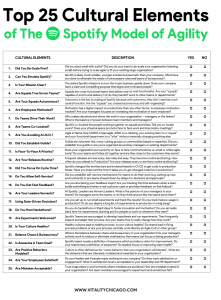
You can download a printer-friendly version of the checklist for the Spotify Model here: Printer Friendly Version of Checklist for the Spotify Model
I hope you enjoyed this checklist for the Spotify Model and found it useful. I’d love to hear your feedback. How did you score your organization?
⭐️Thank you for reading. If you enjoyed this article, feel free to hit that clap button 👏 to help others find it.
Let’s connect on Twitter or find me professionally in Linkedin.
Leave a comment below if you have any questions, and subscribe to receive the latest updates in Agile and Scrum.
Anthony Mersino is the founder of Vitality Chicago, an Agile Training and Coaching firm devoted to helping Teams THRIVE and Organizations TRANSFORM. He is also the author of two books, Agile Project Management, and Emotional Intelligence for Project Managers.


