avatarJanice Harayda

Free AI web copilot to create summaries, insights and extended knowledge, download it at here

2689

Abstract

neral. Another explains how Xi, who has no military experience, has a ‘deep feeling for the army’ because he wore military uniforms when he was a child. There is plenty of nationalist chest-thumping, as students learn how Xi defeated Covid-19, lifted China out of poverty and set the country on a path towards becoming a ‘modern socialist great power.”</p></blockquote><p id="6026">By adding “Xi Jinping Thought” to the national curriculum, China <a href="https://www.reuters.com/world/china/china-add-xi-jinping-thought-national-curriculum-2021-08-25/">aims to </a>“establish Marxist belief” in students and promote Xi’s “thought on socialism with Chinese characteristics in the new era,” the Ministry of Education said. It also intends to strengthen “resolve to listen to and follow the Party” through materials that “cultivate patriotic feelings.”</p><figure id="64d0"><img src="https://cdn-images-1.readmedium.com/v2/resize:fit:800/1*-_msnPZp5CQCKvlEIK4dxw.jpeg"><figcaption>“Quotations From Chairman Mao” / <a href="https://en.wikipedia.org/wiki/Quotations_from_Chairman_Mao_Tse-tung">Wikimedia Commons</a></figcaption></figure><p id="b8cd">Attempts to foster a Mao-like “personality cult” around Xi go beyond the changes to the curriculum. China abolished term limits for the president, which would potentially allow Xi to rule for life in 2018. And since taking office in 2012, he has tightened the Chinese Communist Party’s grip not just on schools but on businesses and cultural groups.</p><p id="9a86">Yet Xi’s efforts to enshrine his ideas in the curriculum may be too little, too late. China’s draconian “zero-Covid” policies backfired disastrously late last year when they sparked nationwide protests. In their wake, the government ended lockdowns, scrapped quarantines, and opened borders closed for nearly three years.</p><p id="0d29">As restrictions eased, COVID cases and deaths surged, creating new problems, including overburdened hospitals and inadequate supplies of some medicines. The Chinese economy is reeling from the damage inflicted by Xi’s COVID policies, which disrupted supply chains and led to worker and customer shortages. The <i>New York Times</i> said last month that it faces a <a href="https://www.nytimes.com/2023/01/02/business/china-economy-covid.html">“perilous road”</a> to recovery.</p><p id="b38c">Then there are the limits of Xi himself. He will turn 70 in June, and videos have surfaced suggesting that his health recently has declined.</p><p id="3c87">During the spy balloon crisis, China first apologized for the craft’s appearance over the U.S. and then changed its tone when it <a href="https://www.nytimes.com/live/2023/02/04/us/china-spy

Options

-balloon">denounced</a> the decision to shoot it down. All of this raises the question of whether “Grandpa Xi” has the will, the political support, and the energy to put his house in order.</p><p id="5037">It was one thing for China to center a personality cult on Mao, whose pithy “little red book,” <i>Quotations From Chairman Mao,</i> published by the government, became a global phenomenon. Xi is harder to idealize. Ian Williams has said that for older Chinese, the efforts to impose “Xi Jinping Thought” evoke “painful memories of Mao’s Cultural Revolution.” In reporting on the adoption of “Xi Jinping Thought” in schools, he summed up a problem unlikely to get an airing in classrooms.</p><p id="c08c">“At least it could be argued that Mao had a personality to make a cult out of, warped and dangerous though it was,” Williams said. “Dour, humorless Xi is a harder sell.”</p><p id="84b7"><i>@janiceharayda is an award-winning journalist and critic who has been the book critic for Ohio’s largest newspaper and a vice president of the National Book Critics Circle. She has written for many thoroughbred media, including the </i>New York Times<i>, the </i>Wall Street Journal<i>, the </i>Washington Post<i>, the </i>Christian Science Monitor,<i> and </i>Salon<i>.</i></p><p id="c010"><b><i>You might like my other articles about threats to freedom worldwide:</i></b></p><div id="522a" class="link-block"> <a href="https://readmedium.com/the-moral-courage-of-pussy-riot-8d407e8c5ec7"> <div> <div> <h2>The Moral Courage Of Pussy Riot</h2> <div><h3>The anti-Putin protest group returns to America with a show opening Jan. 27 in Los Angeles</h3></div> <div><p>medium.com</p></div> </div> <div> <div style="background-image: url(https://miro.readmedium.com/v2/resize:fit:320/1*rd9Os8sUVdqeLH5ZgwQ7oA.jpeg)"></div> </div> </div> </a> </div><div id="8d3a" class="link-block"> <a href="https://readmedium.com/the-heroism-of-olena-zelenska-b84c906aa76a"> <div> <div> <h2>The Heroism of Olena Zelenska</h2> <div><h3>Ukraine’s first lady deserves praise — not criticism — for speaking to Vogue. Here’s why people should put away their…</h3></div> <div><p>medium.com</p></div> </div> <div> <div style="background-image: url(https://miro.readmedium.com/v2/resize:fit:320/1*_VOvEWUfXH5GfYTHcBqxjA.jpeg)"></div> </div> </div> </a> </div></article></body>

NEW RULES FOR SCHOOLS

A Change in China That’s Scarier Than A Spy Balloon

Xi Jinping is trying to impose ‘a personality cult not seen since Mao Zedong’
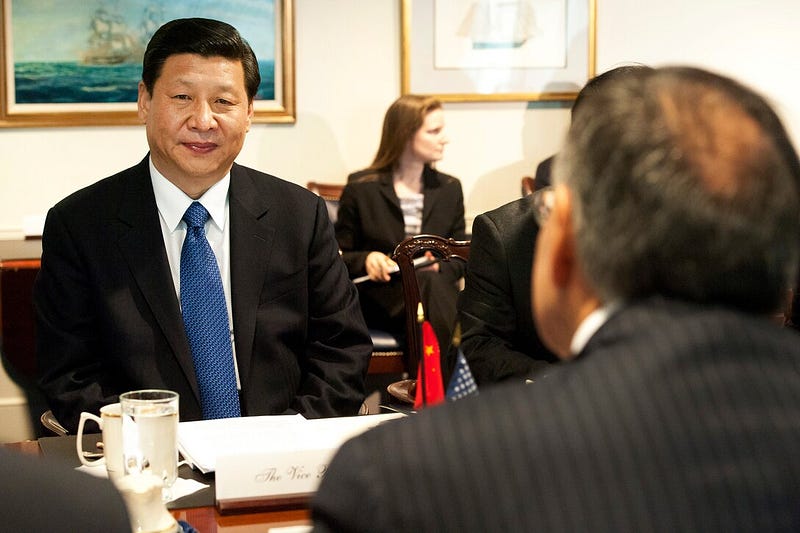
Xi Jinping, then vice president of China, in the U.S. in 2012 / Credit: Defense.gov

American media went full throttle when a U.S. fighter jet used a Sidewinder missile to shoot down a high-altitude Chinese spy balloon on Feb. 4. Journalists ignored other alarming news that’s long flown under the radar here: China is seeing — as the London-based journalist Ian Williams put it — “an extension of a personality cult not seen since Mao Zedong.”

Clear signs of the trend have surfaced in schools, though they go beyond education. “Xi Jinping Thought” has been part of China’s national curriculum at all levels — from elementary through graduate schools — since Sept. 2021. Williams wrote when it was introduced:

School textbooks are emblazoned with Xi’s smiling face, together with heartwarming slogans telling readers as young as six that their leader is watching over them. ‘Grandpa Xi Jinping is very busy with work, but no matter how busy he is, he still joins our activities and cares about our growth,’ reads one.

Williams added that textbooks are tailored for each age group:

Six- to eight-year-olds are told of the need ‘button the first button of life correctly,’ an injunction often used by Xi to stress the need for conformity and obedience from an early age.
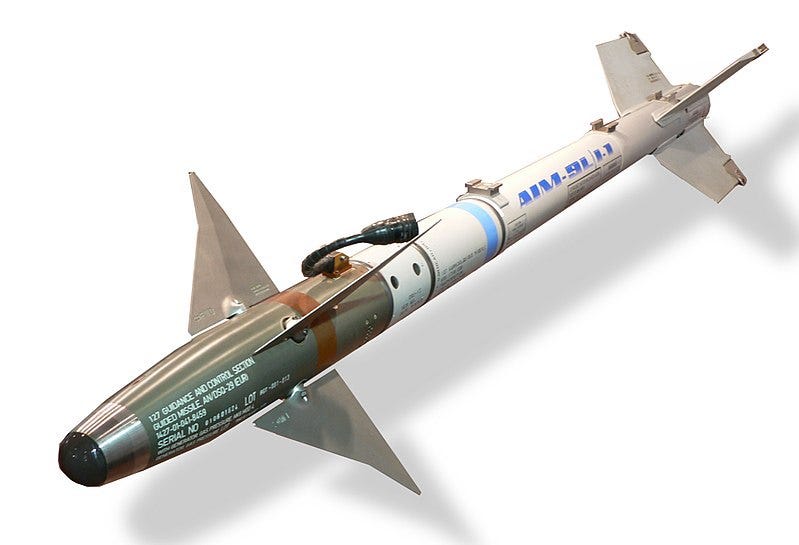
A Sidewinder missile / David Monniaux on Wikimedia Commons CC License

China incorporated “Xi Jinping Thought” into its constitution in 2018, but the changes to the national curriculum go further.

“The books often employ folksy homilies to make their point,” Williams wrote. “One explains how Xi’s love for China began with a lecture his mother gave him at an early age about a Song Dynasty general. Another explains how Xi, who has no military experience, has a ‘deep feeling for the army’ because he wore military uniforms when he was a child. There is plenty of nationalist chest-thumping, as students learn how Xi defeated Covid-19, lifted China out of poverty and set the country on a path towards becoming a ‘modern socialist great power.”

By adding “Xi Jinping Thought” to the national curriculum, China aims to “establish Marxist belief” in students and promote Xi’s “thought on socialism with Chinese characteristics in the new era,” the Ministry of Education said. It also intends to strengthen “resolve to listen to and follow the Party” through materials that “cultivate patriotic feelings.”
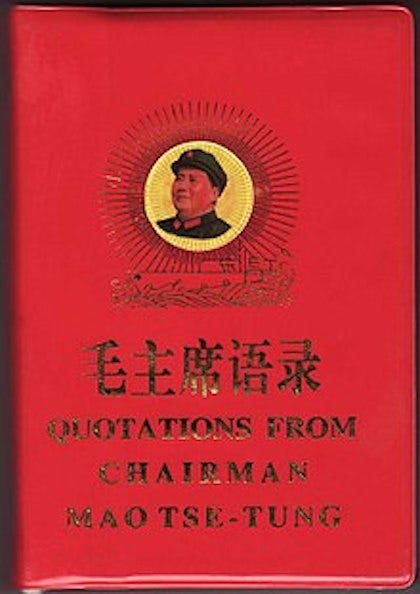
“Quotations From Chairman Mao” / Wikimedia Commons

Attempts to foster a Mao-like “personality cult” around Xi go beyond the changes to the curriculum. China abolished term limits for the president, which would potentially allow Xi to rule for life in 2018. And since taking office in 2012, he has tightened the Chinese Communist Party’s grip not just on schools but on businesses and cultural groups.

Yet Xi’s efforts to enshrine his ideas in the curriculum may be too little, too late. China’s draconian “zero-Covid” policies backfired disastrously late last year when they sparked nationwide protests. In their wake, the government ended lockdowns, scrapped quarantines, and opened borders closed for nearly three years.

As restrictions eased, COVID cases and deaths surged, creating new problems, including overburdened hospitals and inadequate supplies of some medicines. The Chinese economy is reeling from the damage inflicted by Xi’s COVID policies, which disrupted supply chains and led to worker and customer shortages. The New York Times said last month that it faces a “perilous road” to recovery.

Then there are the limits of Xi himself. He will turn 70 in June, and videos have surfaced suggesting that his health recently has declined.

During the spy balloon crisis, China first apologized for the craft’s appearance over the U.S. and then changed its tone when it denounced the decision to shoot it down. All of this raises the question of whether “Grandpa Xi” has the will, the political support, and the energy to put his house in order.

It was one thing for China to center a personality cult on Mao, whose pithy “little red book,” Quotations From Chairman Mao, published by the government, became a global phenomenon. Xi is harder to idealize. Ian Williams has said that for older Chinese, the efforts to impose “Xi Jinping Thought” evoke “painful memories of Mao’s Cultural Revolution.” In reporting on the adoption of “Xi Jinping Thought” in schools, he summed up a problem unlikely to get an airing in classrooms.

“At least it could be argued that Mao had a personality to make a cult out of, warped and dangerous though it was,” Williams said. “Dour, humorless Xi is a harder sell.”

@janiceharayda is an award-winning journalist and critic who has been the book critic for Ohio’s largest newspaper and a vice president of the National Book Critics Circle. She has written for many thoroughbred media, including the New York Times, the Wall Street Journal, the Washington Post, the Christian Science Monitor, and Salon.

You might like my other articles about threats to freedom worldwide:

Politics
Government
Journalism
Culture
China
Recommended from ReadMedium