
A black hole has been observed tearing apart a passing star nearby. See the amazing animation!
What happens when a star gets too close to a massive black hole? It will first be stretched and then torn apart. The spectacular phenomenon has been observed with the help of NASA telescopes.
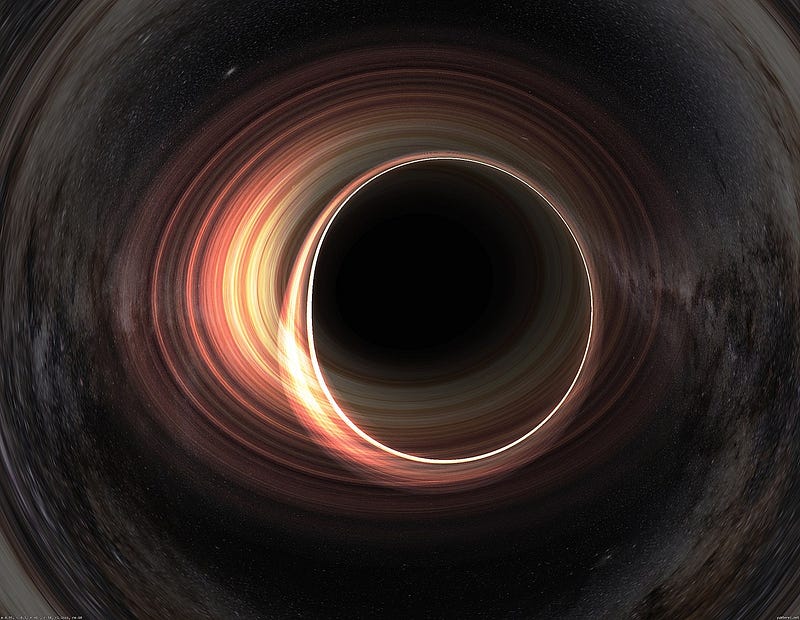
Black holes have a tremendous effect on the space-time around them. They attract everything in their vicinity — both matter and light. Their mass is so great that they can even destroy a star if it has the misfortune to get too close.
Such a phenomenon was observed last year in a galaxy 250 million light years away from Earth. Several NASA telescopes — along with a highly sensitive instrument operating on the NuSTAR (Nuclear Spectroscopic Telescopic Array) satellite — recorded an unusual event: the bursting of a star by the gravity of a black hole. The phenomenon was accompanied by strong X-ray radiation.
Its appearance means that the remnants of the star attracted by the black hole have formed a corona above it. This is an ultra-hot and very bright structure consisting of plasma. The entire process can be seen in a spectacular animation. It shows exactly how forcefully the black hole interacts with matter and how violent phenomena occur in its vicinity.
Black hole rips apart star
Most black holes that scientists can observe are surrounded by hot gas. It accumulates over millennia and takes the shape of a disk as wide as billions of kilometers. This disk can be brighter than entire galaxies.
When a star is in the path of such objects, powerful tidal forces begin to act on it. Extremely strong gravity causes the star to begin to be stretched. This process is called spaghettification. As a result of it, the spherical object gradually begins to take on an elongated shape (and resemble spaghetti).
Finally, a Tidal Disruption Event (TDE) occurs. The star bursts and collapses, turning into a giant cloud of matter.
How does a black hole corona form?
“Tidal burst phenomena are like a cosmic laboratory,” comments astronomer Suvi Gezari. — “It’s our window through which we can observe the black hole feeding itself,” she adds.
The matter coming from the burst star is immediately attracted to the black hole. It begins to spin around it, and the particles of which it is composed bump into each other. Streams of gas shoot into space. Electromagnetic radiation appears: visible light, ultraviolet light and strong X-rays. Gradually — over weeks or months — the matter forms a spinning disk around the black hole.
This kind of phenomenon was observed by NASA telescopes last year. During the event, designated AT2021ehb, a star approached the black hole at the center of the galaxy. The black hole had a mass as much as ten million times that of the Sun. That is, the Sun next to it would be like a bowling ball next to the Titanic.
Observations began in March 2021. After 300 days, the galaxy where the TDE occurred began to be tracked by the NuSTAR satellite. It detected a corona formed above the black hole, emitting high-energy X-rays.
Black hole without jets
This surprised scientists because coronas usually form together with jets. That is, with streams of matter that shoot out from the black hole’s poles perpendicular to the plane of its accretion disk. In this case, jets were not observed for the first time.
“We have never seen a tidal burst coupled with the emission of strong X-rays, while without the appearance of jets,” notes Yuhan Yao of Caltech. — “This provides a unique opportunity to study what causes jets and what causes corona,” he adds.
Scientists suspect that the appearance of the corona is the result of the existence of a very strong magnetic field. — “However, we would like to know what makes it so strong,” says the researcher.
The formation and evolution of the black hole’s corona are described in a paper published in the Astrophysical Journal.
Source: Astrophysical Journal, phys.org
Cool that you made it to the end of this article. I will be very pleased if you appreciate the effort of creating it and leave some claps here, or maybe even start following me. It would be nice if you also left a tip! Thank you!


