
Allow Being. You Don’t Need to Achieve Anything Beyond Yourself.
How to find refuge within.
“We mistakenly think we have to keep achieving things in order to fulfil our individual potential.
But in fact, the only true way to realise this potential is to simply live without expectations, cravings, aversion, or ignorance.”
— His Eminence Shyalpa Tenzin Rinpoche
Our lives are a constant search for happiness.
If one thing’s common for every being on this planet, it is that: we all, without exception, strive for happiness.
Everyone wants to experience joyful, happy lives.
Yet, happiness seems so fleeting. Unattainable at times.
That’s because we seek satisfaction from ephemeral objects outside of ourselves.
If we turned our mind’s eyes inwards, we’d discover that everything we ever wanted was already there. We just didn’t know how to access it.
Since there’s nothing to be achieved outside of ourselves that can make us happy, we can stop valuing the act of doing so much.
Instead, we could try on the idea that simply being can be the ultimate answer to our anxieties, burnouts, and despair.
The freedom of simply being.
We often resist the idea of simply being because we associate it with passivity. We think meditation is a waste of time, and slowing down equals missing out.
However, it’s important to understand that being isn’t an antithesis to doing.
Rather, being is a backdrop state that encompasses all activities and thoughts. It is a container for all life experiences.
As such, it is always there. But because it’s so omnipresent, it isn’t easy to sense it.
That’s why sometimes we forget about the possibility of simply being, getting too preoccupied with its ever-changing contents.
Being means seeing and appreciating the world as it is.
It is a state free from expectations, desires, aversions, and frustrations. Rooted in the present moment, it is the most genuine expression of being a human.
As long as we value doing more than being, we will be lost. However, learning how to embrace it will enable a deeper and fuller participation in life events.
Returning to the default state of being as a way of experiencing our lives will allow us to be more content, more at peace with ourselves and our lives, and more happy. We won’t look for anything beyond what’s already there, neither will we project our desires onto the future nor scold ourselves for “doing nothing”.
It doesn’t mean that by embracing being, we cease to work on improving our lives, relationships, or health.
As I said, it doesn’t equal passivity.
We still do these things, but we take each step with an appreciation of where our feet stand right now. We no longer believe that any achievement outside of ourselves can grant us lasting happiness and satisfaction.
With this understanding, the goal is no longer more important than the path. With every step, we arrive.
No other experience in life can bring us such a profound sense of joy, peace, and fulfillment. Only being can do that.
His Eminence S.T. Rinpoche elaborates on this thought in his book “Living Fully”. There, he offers a perspective shift:
Do not measure yourself by how affluent, successful, or influential you are. Measure yourself by how content you are, by how present you can be in each moment.
Luckily, each of us can learn how to exercise being.
It requires some commitment, but it’s absolutely possible to integrate into regular, everyday life.
How to practice being.
#1 Open yourself to a perspective shift
Invite and explore the idea that perhaps the way society measures individual worth isn’t necessarily accurate.
Perhaps our worth isn’t dependent on what we are achieving, how much we are doing, what kind of clothes we wear, the numbers on our bank account, and how recognisable we are.
Perhaps what matters more is how kind, open, gentle, attentive, and compassionate we are becoming.
If we allow this thought, we might discover that the real value doesn’t lie in external objects that constantly change due to factors like economic crashes, theft, sickness, breakups, divorce, decay, and trend shifts.
Rather, the value is in whatever good we nourish within.
Our minds create our world. That’s why the more warmth, kindness, openness, and goodwill we exercise within, the more expressions of it we will enjoy around us.
To make this thought resonate better, it is helpful to think of your death regularly.
Reflecting on your mortality is only depressing if you miss the point (as Ryan Holiday accurately noted). When done right, it acts as an inoculation against the life-wasteful virus we all are infected with – ignorance.
Your death will come, and nobody can predict when and how.
To ensure you use your time wisely and balance being with doing, you can try asking yourself a question like the one I often ponder:
“What if I were to die tomorrow in an accident? What if I leave the house and a car hits me, and I never see anyone again, never do anything I planned on doing, and never experience anything else but this last moment of death? How do I want to be today? What are my ultimate priorities?”.
This little mental exercise helps me take some pressure for constant achievement and action off my shoulders.
It helps me to allow being.
A simple thought of death brings to your attention the very thing it promises to take away from you: being.
It is worth pondering how you want to spend your breaths.
#2 Secure the time for just being
I know you probably have heard advice like, “Try making some time for meditation, try journaling, try going for a walk, try making time for therapy”.
And that’s okay. We can keep trying.
But if we only keep trying and never actually decide to do something — it will never help.
Sometimes, it’s perfectly fine to go easy on yourself. It’s not healthy to constantly push and demand maximum performance.
But the thing with inner work is that we hardly ever feel like working on ourselves.
It’s not easy or pleasant.
It is hard work.
So, we need to make time for it consciously.
“Simply being” is actually hard work, too.
Doesn’t sound like it?
Then stop whatever you are doing now and spend the next three hours simply sitting, enjoying your life as it is, celebrating yourself, and cherishing your breath. No expectations, no thoughts of what you should be doing right now instead, no craving, no aversions.
As soon as your mind isn’t occupied, it will flood you with thoughts.
And even if you manage to deal with them, letting them float around without pulling you in, the mind will pull out a stronger armour: emotions. Anxiety, stress, resentment, anger, craving, passion, sadness. One by one or all at once.
If you don’t train your mind, you will always feel the urge to cover being with doing.
Even though it is our natural, original state, we need to learn how to return to it. And that requires time and practice.
The best thing, though, is that as we continue practising, we will keep seeing the benefits. We don’t need to commit to this idea and work hard for years without seeing any effects.
Every day that we practice being, we will see how much it helps. But, yes, we have to do it every single day.
If we do it only when we “feel like it”, it won’t help.
If we do it when we happen to have 10 minutes free, it won’t help.
It can only help if we prioritise it.
We have to commit to it.
#3 “Simply being” is a skill. Keep learning how to be.
Consciously making time for just being — whether through meditation, silent walks, journaling, or other activities that allow you to be present without occupying your mind too much — is crucial.
Not only because it provides a necessary break from the usual way of living, but most importantly, because it shows our minds a different way of experiencing life.
Being changes the habit pattern of our minds.
If you keep making room during the day to simply be without distractions and goal-oriented action, you will slowly begin finding contentment in the present moment.
It will help you manage stress, relax, make better decisions, solve conflicts more easily, and think more clearly.
Step by step, the practice of being will bring more happiness and satisfaction into your life.
Not the fleeting happiness that comes from quick fixes.
You will establish in yourself the kind of happiness that’s not dependant on anything other than your inner light — lasting, stable, all-encompassing, and pleasantly warm and safe.
“The meaning of life is just to be alive. It is so plain and so obvious and so simple. And yet, everybody rushes around in a great panic as if it were necessary to achieve something beyond themselves.”
— Alan Watts
As you practice being, you will see that very slowly, very gently, your default perspective on yourself and life changes.
You’re becoming more content with what you already have. You might still crave some things, but you start understanding that they’re just extras; they won’t bring you satisfaction.
You start enjoying time alone more, knowing it is an excellent opportunity to practice being. And even if you still feel lonely at times, you know that this is the old habit pattern of your mind.
Once you experience the happiness flowing from within, you won’t think another person can grant you that anymore.
You still fall in love. You still make friends. You can still get married and have kids if you want. But you don’t depend on those connections to bring you fulfillment. They cannot. And you are at peace with that thought.
You still work, learn new skills, and strive to earn more to have a stable life, but you’re learning to observe your motivations around it. Your ego becomes weaker, and the nudge for growth isn’t dictated by self-interest anymore; it slowly transforms into the willingness to serve others.
You’re parting with your selfish ways and opening your heart to all beings around you.
Then the walls in your mind will fall, and you won’t think of yourself as separate from everyone else, but you will see how similar everyone is and that being a human is being in unity with all of humanity.
As S.T. Rinpoche wrote:
“Everyone is constantly attempting to find happiness. We all share this common experience; therefore, I have tremendous respect for everyone. We are journeying together, and this path is not an easy one. Until we discover the true nature of our being, we suffer. And we all suffer together.”
Once you allow being and experience the peace and happiness resulting from it, you will never again put as much importance on doing.
You might wobble around at first, sometimes forget your ways, and get lost in the common narrative. But coming back to yourself will become easier and easier.
You will see that the path we’re all told to walk isn’t the only path that is there.
And that perhaps going off-road is sometimes the best thing you can do for yourself.
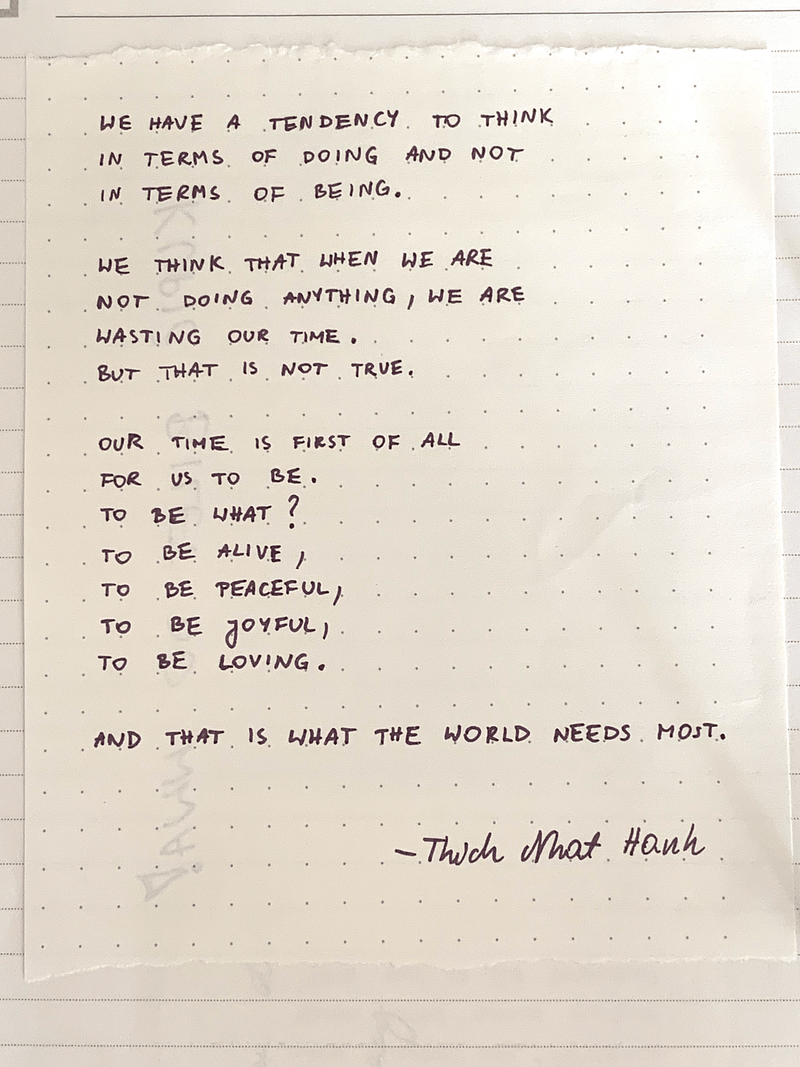
Let’s secure some time every day to simply be — doing nothing, craving nothing, chasing nothing.
Unrestricted by our desires and anxieties, our life will unfold naturally.
There’s no rush.
You can just be.
Before you go
I’m Justyna Cyrankiewicz, and I write about simple things that make up over-complicated minds.
If you enjoyed this piece, consider subscribing to my free weekly letters. It’s a community of people who, like you, care about what’s up in their heads.
P.S. Please note that this story is based on my personal experience and the books I’ve read. I share what helped me and others whom I spoke to. Don’t follow online advice if your mental health is severely at risk; consult a therapist or psychiatrist.
Thank you for being here.