
When the Eisenhower Matrix Fails
The Eisenhower Matrix makes assumptions about mental load many women can’t make
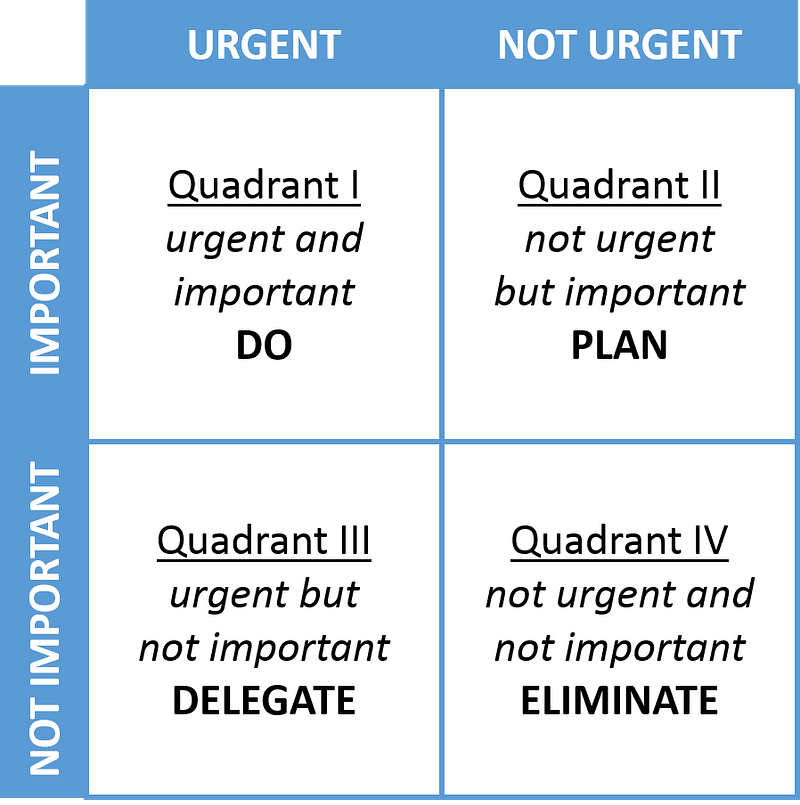
The Eisenhower Matrix: every self-help book I’ve read on productivity mentions it. Before you can make your Most Important Tasks list, you need to know what you’re working with, and then remove as much of it as possible. So put things into this matrix, the gurus say. Eliminate the unnecessary. Then Delegate, then Plan, then Do. Easy, they say. With this guide, you’ll have complete success.
But the Eisenhower Matrix was almost the death of me in January. See, I’m a freelance editor. Much of the year, I work for whoever sends me requests. I edit novels, and non-fiction, and journal articles, among other things. But I also have an established relationship with a particular university. I’m a recommended dissertation editor in their handbook, and I’ve also been editing dissertations for them long enough that some of the current advisors were once students I edited for.
On top of that, when the university changed formats, I spearheaded the work of establishing new expectations, both making design decisions and creating the templates the students would use. Their projects have gotten design-heavy and technical.
Which means that between forty and seventy people could reach out to me for an edit, and they all have the same deadline. Plus, those same people might not need my help editing, but do have technical questions about the templates: questions they’re unlikely to get answered by anyone else.
My takeaway from January? When a list skews heavily toward urgent–important, it’s impossible to sort out your priorities.
Here’s the other thing about that matrix, and those gurus: an entire quadrant assumes you have someone to delegate to.
I’m a freelancer editor and a mother now, but before this, I was an editor and administrative assistant at a small company. I was the person who got delegated to. I did not get to delegate.
When my administrative or editing duties became too much, my boss told me my job was to say yes and “figure it out.” I was subject to everyone else’s deadlines, everyone else’s schedules, and thirty people who could decide to proactively give me work — or dump it on my desk as urgent with no warning. I had a mix of both.
Working for myself now — and not making enough money to have any kind of administrative support — feels similar to how I felt at that job. Especially when a bunch of people have my email address and a handbook that says to reach out to me with technical questions.
But at the same time? I have individual clients with deep work: close to 150,000 words of technical materials to edit in one month, all with the same deadline as each other. Also the same deadline as those emailed questions.
The Eisenhower Matrix says I should do the work that I specialize in, and put the emails in the other categories. Here’s the problem with that.
- No one else on staff can solve the technical issues (and really, this is the work I specialize in), so Delegate is out.
- No student wants me to decide that their question isn’t important enough, so Eliminate is out.
- Every student thinks their question is both urgent and important, so Plan has a rough timeline of, say, ten hours.
Therefore, everything piled into that Urgent–Important quadrant until the whole matrix was meaningless. “Do, Rochelle. Do it now. Every project, every question, every technical piece of advice. You have no support, and you have no time. You can sleep in February.” That was my self-talk for a month. I don’t recommend it.
I’m still recovering from it a week after I sent back the final project, not least because there are still lingering technical difficulties I need to fix, and people reaching out for editing for round two: a 15 February deadline of broadly the same kind of work. Sleeping in February might be out of the question, too.
Also? I didn’t get to stop being a mother during this time. I didn’t get to stop being neurodiverse. I didn’t get to stop having migraines, either.
My youngest spent much of January acting out at school, with his teacher regularly messaging me asking if something was going on at home, what the trouble was, why he kept forgetting his homework, reminding me to check in with him.
I researched what to do to gently parent a defiant kid. The articles I researched all said the same thing: get to the heart of what’s really bothering him, then be a consistent, steady presence. Offload his executive function to yourself as you teach him how to do it. Set firm boundaries and always stick to them. Give undivided attention.
You know. Do for him the things I can’t even do for myself.
In January, between my two kids and myself, we had seven appointments, plus phone calls and emails about these, plus remembering to call the school when they’d be late or out early. Plus my oldest got the flu and was home for four days, and I had no less than seven days of migraine — none of which co-occurred with my kid’s flu.
The Eisenhower matrix doesn’t do shit for that. Delegate the caregiving, delegate the admin, delegate the phone calls. To whom? My wife? That’s what most male gurus seem to assume.
I’ve always been frustrated by the classist structures of productivity systems. They don’t work equally well for everyone because they assume you have an underling — or a wife— who can do “other things” so that you can focus on the work that’s most important. The work that moves the needle. The work that gets you paid.
But like we learned with the pandemic shutdown, essential workers are essential. All the knowledge-sector jobs in the world don’t ensure we have food on the table, or clean buildings, or trash picked up every Tuesday.
And, it turns out, it doesn’t matter how much I want to do my job. It doesn’t matter that I’m an expert in my field, or that not many people do what I do. It doesn’t matter that I love it. Because my job doesn’t have health insurance. My job doesn’t have stability. My job doesn’t have the myriad benefits we get from what my husband does for a living.
So that Eisenhower matrix folds into a square. “Be everyone,” it says. “Be everything. Do the highly technical work. Check in with your kids’ teachers. Research their medical needs. Advocate for their ADHD care. Spend uninterrupted quality time with them. Make deep work non-negotiable. Prioritize self-care. Keep up on your email. Don’t lose sight of your passions and hobbies.”
I was talking with my therapist this week about how it all feels untenable. I can’t do my job and advocate for/drive around my kids. I can’t. I have to.
She said, “I don’t know if it helps you to hear this, but many mothers, even neurotypical ones whose kids don’t have special needs, feel this overwhelm at this stage of life.”
“It doesn’t,” I said. “Because either I am very broken to feel like a near-universal problem is too much for me when everyone else can handle it, or the whole world is. And if the whole world is broken, what hope does any one of us have?”


