
I Doubled my Substack Revenue (96 Weeks on Substack, $12 K)
Here’s what I learned
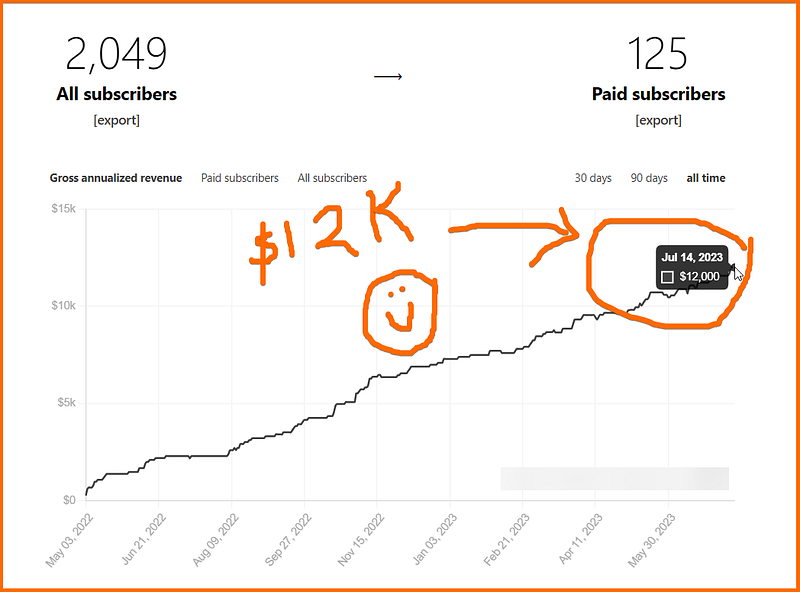
Yesterday I hit $12K in newsletter revenue. It feels so good.
The money is great, but the growth is better.
- 96 weeks of publishing;
- 125 paying subscribers;
- $US12,000 in yearly revenue;
- 184% growth in 33 weeks (that’s 5% per week)
I have been on Substack for almost two years, so this isn’t an overnight success. It’s the growth which makes this exciting. My newsletter revenue doubled last year and is on track to almost triple this year.
The growth I’m experiencing is like getting a 5% pay rise at a ‘real’ job every single week, without doing any more work. It’s insane! (insanely good!)
Same amount of work + more money = scaleable income
Last year I shared lessons I learned on my way to $6.5K in 65 weeks on Substack and gave you a sneak peek into the experiences of other paid Substackers whom I met during an invitation-only Substack “intensive” program.
Definitely check out that article if you want to learn why I started my newsletter, what kept me going during the first few months and what worked for me on my way to $6.5K.
The dreaded plateau
Plateaus are common in newsletter growth. They are the flat parts in the graphs you can see above.
You’ll notice some pretty long plateaus — times when my paying subscriber numbers did not increase —in my revenue graphs. I even had some ‘dips’ last month, times when the number of paying subscribers decreased temporarily.
Those times do not feel great.
The problem with a plateau is that when you are in the middle of it, you don’t know whether your numbers will ever start growing again. It’s scary. My paid newsletter is a niche B2B topic (B2B = ‘business to business’), and so the audience is not enormous.
When I was on those plateaus, I worried that I had reached every possible subscriber already, that there were no more English-speaking food safety specialists who were willing or able to sign up for my newsletter.
I was wrong.

Pushing past the plateaus
There are three things that have kept me going through the plateaus. Perhaps they will work for you too:
(1) Love what you do
If you are writing about a topic that you love for an audience you love, take a moment to reconnect with that joy. It is this joy that will keep you writing even if you think no one is listening.
Write for the fun of it; write for the practice; write to learn about your topic. That way you are growing and improving, even if your subscriber numbers are not.
(2) Get one paying subscriber (who you don’t want to disappoint)
Once you have a paying subscriber you can’t stop publishing or you will disappoint them. You just have to keep writing and pressing ‘send’ no matter how crappy you feel.
(3) Know that giving up too soon limits your $$$
The pressure to keep writing for paying subscribers is tough, for sure, but trust me, it’s definitely worth the effort to persevere. If I had stopped at the first big revenue plateau I met, which lasted for ages and made me feel dreadful, I would have walked away with less than $400.
Here’s that number again, in case you missed it:
If I had walked away during my first big revenue plateau I would have earned less than $400 for almost one year of publishing.
Reminding myself of this has helped me through subsequent plateaus.
Current drivers of growth
Here’s what got me from $6K to $12K.
As you read this list, keep in mind that I already have the basics in place… things like optimised headers and footers, high-quality, consistent posting, and knowing my ‘ideal reader’. They are the basic must-haves to get paying subscribers for a newsletter.
You can read more about those in my post about getting to $6.5K.
(1) Daily posting and interactions on Twitter and LinkedIn
Honestly, I was sceptical that daily social media would move the dial for me. I have been on social media in my professional niche for years and thought I had already reached everyone who was interested in my (not very big) topic. I was wrong.
New people are finding me and my newsletter since I started religiously posting every single day. I assume this is because Linkedin and Twitter ‘like’ me more now, and have decided to show my posts/tweets to more people. In other words, the algorithms are working in my favour.
It took around 3 weeks of daily posting to see the results in my bank account, which was longer than I expected.
(2) Asking subscribers to upgrade to paid very frequently
Asking for upgrades all the time makes me a little uncomfortable. But my long-term subscribers don’t seem too upset by it.
New subscribers need to be asked to upgrade to paid multiple times before they think about getting their credit cards out. In fact, professional salespeople expect to ask a customer to buy six times before they will get the sale.
(3) More infographics and subheadings
An analysis of the $1M+ newsletter Noahpinion found lots and lots of infographics and charts in each issue. These do seem to add perceived value for readers of ‘inform and entertain’ newsletters like Noahpinion and mine. Plus, they break up the text for better readability.
Subheadings also improve readability and are great for readers who like to skim to quickly understand a topic without reading every word. I’ve started using them in even short sections of each issue. It’s difficult to know if this has contributed to growth, but have mentioned it for completeness.
(4) Better preview images
Preview images have a big impact on whether readers will click through from social media. I have really upped my game with preview images in the last few months.
These days, I decide in advance which topic from any issue will be the ‘hero’ topic that I will talk about on social media. Then I choose or create an AI image to fit that exact topic.
AI image creator tools have been a game-changer for me. Compared to sites like Unsplash, AI allows me to always have an image that exactly fits my topic, and it is often faster than searching for royalty-free images too.
(5) Personality and quality
Last year, people were paying for my newsletter to access information they needed for their jobs.
Now, people are paying because they like what I do and want to support my work. That’s a direct result of me showing up with my very best work every single week. Even when I’m not feeling great.
Fans will pay for excellent work. You get fans by showing up consistently and giving them what you promised them week after week. Each week I am getting new fans, and that is what is now driving growth for my newsletter.
What’s next
I’m approaching 100 issues and polling my readers to find out what they want more of so I can make my paid newsletter even better for them.
Meanwhile, I’ll keep publishing week after week. And I’ll let you know how I go.
Want help with your Substack journey? Join my waiting list for one-to-one sanity checks and accountability sessions. Or for simple newsletter growth hacks in your inbox each week, sign up for my free Substack success newsletter.


