
Unpacking a Million-Dollar Substack
2 big takeaways and 7 things you can do to boost your publication

Last month I celebrated one year of paid subscriptions. I’m bloody thrilled to be earning > $10K per year on Substack.
But that’s a far (far) cry from one million dollars.
Also last month, Noah Smith, who writes Noahpinion, posted on Substack’s new social media environment, Notes, saying he had surpassed 10,000 paying subscribers for his newsletter. Ten thousand! Each subscriber pays $100 per year.
Ten thousand subscribers x $100 = $1 million per year from Substack
That’s kind of exciting! 😍
How do you get to $1m on Substack?
I signed up for Noah Smith’s newsletter and started unpacking it piece by piece. Here’s what Noah Smith is doing with his Substack right now.
Post frequency
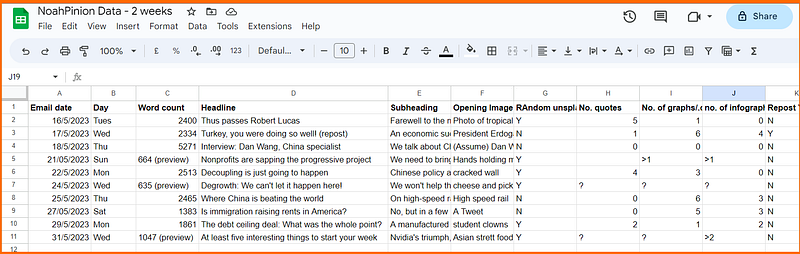
Noah sends 4 to 5 emails per week through his Substack publication, with one email per week for paying subscribers and the rest free. The days of the week vary; the posts come throughout the week but there is no fixed pattern to the days of the week he emails.
As for emailing time, many of Noah’s emails arrive in my inbox at around 8 am my time, which is the afternoon/evening in America. But some arrive at other times of the day.
Post length
The typical word count for each free email is 2000 words.
For paid emails, the free-to-read preview section (above the paywall) is typically around 600 words.
Visuals
Almost every email Noah sends has at least one graph or chart, many have multiple charts and most also have multiple infographics.
Almost every email begins with a full-sized ‘hero’ image, above the text. Around half of these ‘hero’ images are random Unsplash images that are barely relevant to the topic. For example, an email about the passing of an influential economist had a photograph of a tropical island; a post about Nvidia’s triumph had a picture of an Asian street food scene.
Noahpinion’s logo is a random picture of a rabbit. There is a picture of the writer’s face on the publication’s About page and he’s got a good-looking face, although the picture is not a ‘traditional’ professional profile photograph.

Post content and niche
Noah’s posts are really, really good. He brings his own expertise and opinion to everything he writes about. He makes it easy to understand, but still manages to go in-depth on each topic.
The ‘niche’ of the publication is “Economics and other interesting stuff” according to its welcome page. In the two weeks since I subscribed, he’s posted about Turkiye, China, nonprofits, immigration and the (US) debt ceiling.
In the posts that aren’t ostensibly about economics — for example, the other day he wrote about how China is beating the world with solar, electric vehicles and high-speed rail — he still uses his economic expertise when unpacking each topic.
Headers and footers
Noah’s emails to free subscribers do not have anything in the header or the footer.
Post engagement
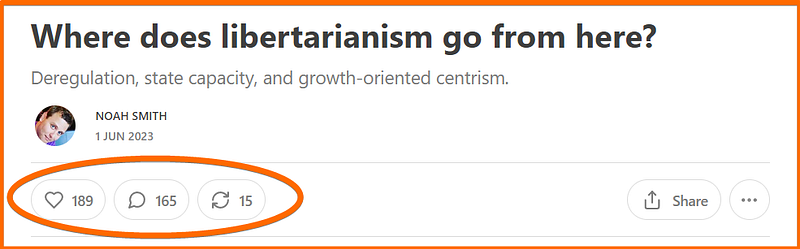
Noahpinion gets good engagement on his posts. For example, after 19 hours, a post he wrote about libertarianism had 165 comments, 189 likes and 15 Re-Stacks.
The commenters are almost exclusively male, and most of the comments seem to be aimed at showing how smart the commenter is.
Comments are open to free subscribers as well as paid.
About page
Noahpinion’s About page is divided into headings which make it really easy for skim-readers to get information quickly. They include “So, what is Noahpinion anyway?”; “Who is Noah Smith?” and “What is Noahpinion’s general outlook, philosophy, and political orientation?”.
The About page also has a little bit of personal ‘this is me’ content, where Noah shares pictures of his pet rabbits and declares that rabbits are underrated pets. It’s fricken adorable.
The About page does not explicitly state who the publication is for. That is left to the reader to figure out.
Subscribe buttons, share requests and ‘Upgrade’ requests
In each post/email, there is one subscribe button and one share button right at the end. That’s it.
In the two weeks I have been a free subscriber I haven’t seen a single nudge or request to go paid.
Paid benefits
Paying subscribers get access to paid posts and the full archive. Nothing more.
The cost is US$10 per month or $100 per year, with founding members paying $420 per year, but not receiving any extra benefits compared to ‘normal’ paying subscribers.
Free-to-paid conversion rate
At the time of writing, Noahpinion had 139,000 subscribers and more than 10,000 paying subscribers. That’s a conversion rate of more than 7%.
Recommendations, referrals and endorsements
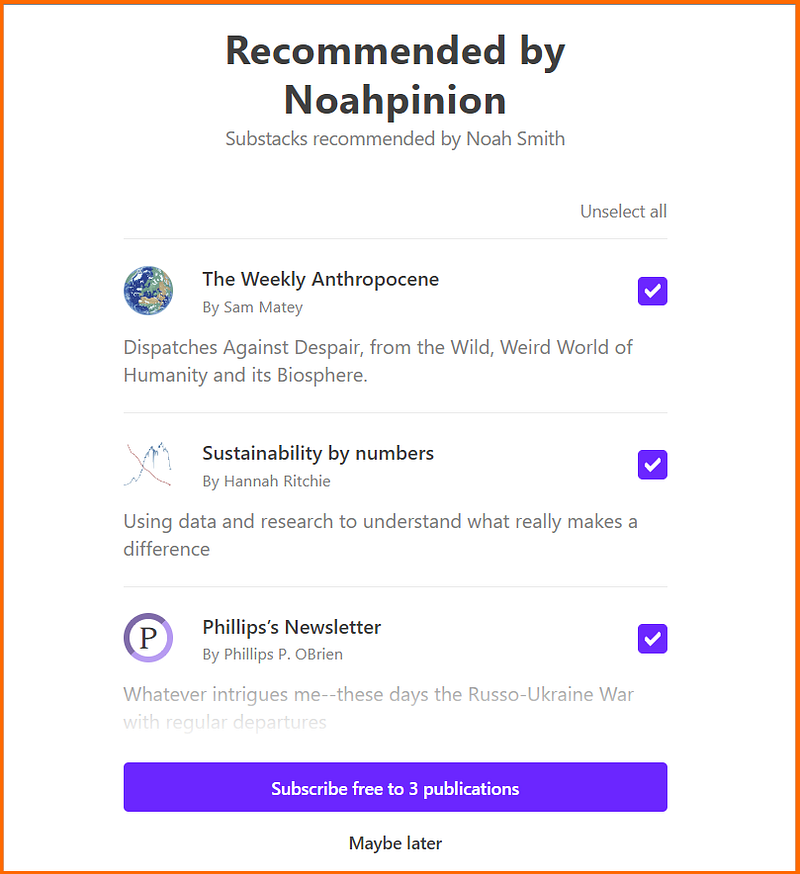
When I subscribed I was prompted to also subscribe to three other publications on the spot. This is the Substack recommendations system.
The Noahpinion welcome page has an endorsement/testimonial by another Substack writer. Just one.
Promotion/audience: Twitter
Noah is on Twitter a LOT, Tweeting dozens of times per day. He shares each of his Substack posts on Twitter. He also engages in multiple conversations on a variety of topics with other people on the platform. He retweets, comments and replies. His interactions are thoughtful, measured and with the occasional hint of gentle snarkiness.
Promotion/audience: LinkedIn
Noah has a LinkedIn newsletter (these used to be called LinkedIn Pulse). He posts the first 400 words of posts to this LinkedIn newsletter, with a button to “Read the Rest” which links back to the full post on Substack.
Many of his recent LinkedIn posts were originally written in 2022, though that is not obvious until you click through to read the post in full.
The Noahpinion LinkedIn newsletter had only 247 subscribers when I checked, and is set up to look exactly like the Substack newsletter, with name, logos, etc.
Promotion/audience: fans and word-of-mouth
People clearly LOVE Noah Smith, they retweet his Tweets frequently. He has 1435 followers on LinkedIn. His Substack has 139,000 subscribers and a healthy proportion of them want to pay for his work.
He was previously a columnist for Bloomberg, writing about economics and has been blogging for himself since at least 2016 according to Wikipedia.
What can we learn from the success of this Substack?
Tall poppy syndrome is a thing
I’m delighted for Noah Smith’s success. His writing is fabulous, and he clearly works very hard on each and every post. He went full-time on his Substack in 2021 and now makes around $ 1m per year from it. It’s so brilliant!
Sadly, not everyone shares my delight in his success. When I asked other Substacker writers if anyone had inside knowledge about Noah Smith and his publication I’m sad to report that many responders were quick to bring him down.
A bunch of writers jostled to explain away his success…
- “He’s a professor of economics of course he is going to succeed if he writes about economics”. (Which is absolute baloney, there are heaps of experts writing blogs that don’t get to $1m);
- “He has 291K followers on Twitter, of course he’s going to succeed”;
- “He is not your average Substack writer” (duh!);
- “It’s easier for a non-fiction writer to grow his numbers because he has a degree in economics”; and even
- “The best way to make a small fortune is to start with a large one”.
To me, that just sounds like a bunch of excuses from writers who aren’t succeeding and want to blame it on the fact that they don’t have economics degrees or massive Twitter followings.

You have to put in the work
We can’t all start our Substack journeys with huge fan bases from writing for Bloomberg. But Noah Smith had to start somewhere. At some point, he had exactly zero followers.
Twitter might not be the nicest place to hang out, but I am willing to bet that at least half of Noahpinion’s readers got to know, like and trust Noah Smith through Twitter. And people are more likely to subscribe to writers they know, like and trust.
Noah puts in the work on Twitter. Okay, he does seem to enjoy it. That doesn’t mean that it’s not hard work.
No matter how many (or how few) followers any of us might have right now, we can all spend time on platforms working to connect with new readers and get our writing in front of new eyes.
Noah also puts in the hard work on every article. They are long, they are deep, they are broad. They are expertly edited and full of incredible charts, graphs, infographics and quotes. Each one represents probably eight to ten hours of research, drafting and editing.
Make amazing content and people will follow you.
Big audiences are good
Okay okay, you knew this already, right?! Big audience = more potential readers.
But think about it. To get to 139K subscribers, Noah Smith needed 291K followers.
To get a large audience you have to be talking about stuff that is interesting to lots of people. The tall-poppy smashers who complained about how easy it is for non-fiction writers are right: if you have a Substack about neo-classical Persian poetry it will be harder to get readers because there are fewer people interested in your topic. Not saying you can’t find 1000 true fans, just saying it’s gonna be harder.
Noah Smith converted around half his Twitter followers to readers. If you only have 20 followers you can expect to only have 10 readers.
Or, to look at it another way: if have less than 1000 followers and you managed to get more than 500 Substack subscribers I reckon you are doing freaking fantastic!
Engagement is not a good indicator of success
In the example I gave above, Noahpinion got 165 comments from 139,000 subscribers. That’s 0.1% engagement rate (tiny!). And the guy is still making $1m.
By contrast, one of my Substack pubs has 172 subscribers and I got 10 comments on my most recent post: an engagement rate sixty times higher than Noahpinion. But it’s making no money. So go figure.
Fancy logos are not required
Noah gets away with having an amateur picture of his pet rabbit as his logo because he is well-known and well-liked outside of Substack. Or does he? I had never heard of him until last month and I am now a fan. I don’t care what his logo looks like; I subscribed because I like his writing and I trust his expertise.
Fancy aesthetics can be a turn-off. In one of my other online businesses, I had an ugly, amateurish-looking online course sales page (note the sign-up tech was not clunky, just the aesthetics). But surprisingly, when I changed the aesthetics so it looked professional and polished my sales plummeted. Turns out my audience was there for my expertise, not my web-design skills. In fact, they trusted me less when my sales page looked too smooth and salesy.
Post visuals matter
After stalking Noahpinion, I have concluded that the ‘hero’ image at the beginning of each post doesn’t have to exactly fit the post topic. It does have to be eye-catching though.
For an inform-and-entertain publication like Noahpinion, infographics and charts (unfortunately) seem to add a lot of perceived value, as well helping to break up the text for better readability. I say unfortunately because finding or creating and captioning infographics and charts adds significant time to post creation and I would rather not do it! (note to self: see above “you have to put in the work” sigh)
Frequency, word count, headers and footers — each to his/her own
Five emails per week and 2000 words per post is a frequency and post length that works for Noah. Would fewer (or more) emails and words move the dial for his publication — or yours — who knows?
The most important thing is setting expectations for your readers, so they know what to expect from you. And then delivering it consistently so they come to trust you and your publication.
As for headers and footers, most Substack writers put them to good use by setting the context of the post, sharing the benefits of paid subscriptions or encouraging their readers to share their work. Noahpinion is succeeding without them, but that doesn’t mean you should neglect them.
Don’t skimp the About page
Your publication’s About page is by far the easiest way to explain your publication to your audience and show them who you are and what you are trying to do — plus, of course, encourage them to join you.
Don’t skimp on spending time tweaking and re-tweaking your About page. Take inspiration from the About pages of successful Substacks, and don’t be afraid to include your own personality, even in a professional publication.
Relationships with readers are everything
Noahpinion is successful not just because its writer is an expert and also very good at sharing his expertise. It is successful because people feel like they know him. And they like him. And they trust his expertise.
They know him, they like him, they trust him
He didn’t start famous. He started as an economics PhD student with zero followers. He got famous by sharing his expertise in an accessible way. And by having genuine ‘conversations’ with other humans, starting mostly, as far as I can tell, on Twitter, then with his blog and finally with his Substack publication.
He continues to have ‘conversations’ every single day. Every Substack post Noah writes includes his own perspective, knowledge and personality. And every Tweet and LinkedIn post he sends has the same mix of knowledge, perspective and personality. This is how readers come to know, trust and like him. This is how he gets new readers and fans — people like me who didn’t know him as a Bloomberg columnist, people who didn’t know (or care) if he was famous.
Noahpinion is a personality-based Substack. Paying subscribers are mostly not paying to read the occasional paywalled post, but are paying to support and show appreciation for a writer they know, like and trust.
Your Substack does not have to be a personality-based Substack the way Noahpinion is, but it must have the trust of its readers if you want it to succeed.

What to do now
If you want to emulate Noahpinion’s success, it’s never too early to start building your audience. Bigger audiences equal more potential subscribers.
You can also make some tweaks to your Substack publication and process based on what you have learned. I’m going to be making tweaks to my publications to incorporate what I’ve learned by unpacking Noahpinion.
Here are my action points:
- Don’t worry about logos;
- Do spend more time promoting your Substack (and/or yourself);
- Don’t stress about choosing the right ‘hero’ images;
- Do spend time making your About page awesome;
- Don’t worry about engagement metrics, they are not a predictor of financial success;
- Do feel confident that some readers are happy to pay just to support a writer they like, and don’t need a lot of extra benefits;
- Remember: getting to $1m takes a tfruck-ton of work!
If you want to earn money on Substack, sign up to my newsletter and get accountability and help to grow and succeed https://pubstacksuccess.substack.com/


