
9 Ways to Change Hard Behavior Using This Million Dollar Method
#1 Identify the bright spots…
Have you ever thought about why it is hard to make a lasting change even the change is good for you? Change is always hard because of the conflict between the two sides of the human mind. There is always a tussle between the rational and emotional mind, which we need to align.
Let me show you how you can do it using 9 simple ways, mapped with a 3-step method. This method has been taken from the book “Switch” by Dan and Chip. This book is one the best books I have ever read about changing the hard behavior of people.
Let’s begin to understand this.
3-Step Method
To bring a lasting change in yourself, teams, or in the corporate, below three steps are essential.
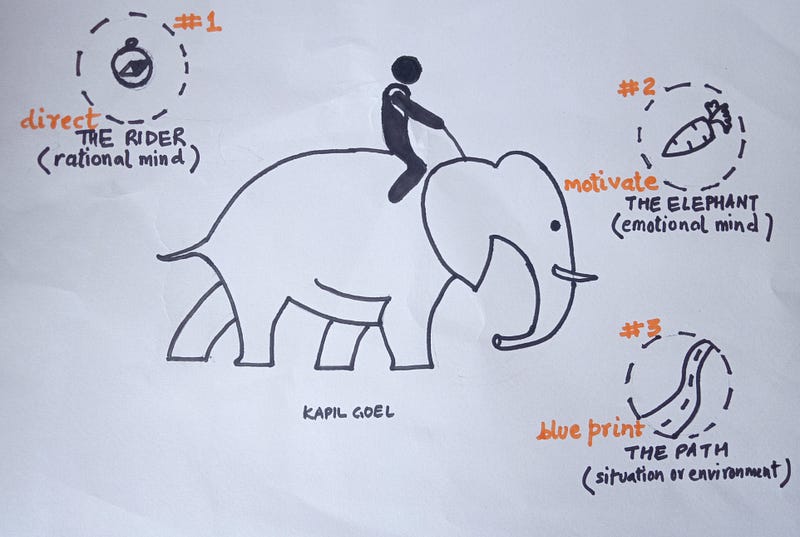
Step 1: Direct the rational mind — provide a crystal-clear direction and specific details on the change.
Step 2: Motivate the emotional mind — make the people feel the problem and pain.
Step 3: Blueprint the path — show the path clearly and create a good environment to thrive.
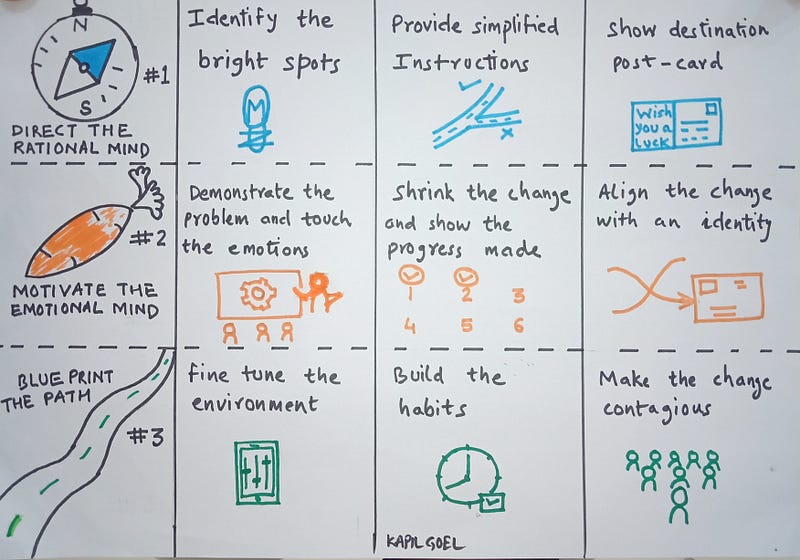
I am now revealing you the 9 different ways to make an effective and lasting change in people’s lives. You can use one or more ways based on your needs.
Each step of the method is having 3 ways to change.
Direct the Rational Mind (1st step)
1. Identify the bright-spots and replicate
Find out what’s already working for you and ask how do I get more of it? Our rational mind is designed to see the danger and make us alert. First, it looks for the problem than the solutions, which is natural. You need to re-direct the rational mind to accentuate the micro wins and make it solution-focused. You can apply this technique to anyone.
Example of a change at scale
One of the children’s NGO had introduced new eating habits to 2.2 million people in Vietnam villages. They didn’t use any educational programs for the villagers. They replicated the local success from a few villages and scaled it up using community-building events across 65 villages.
Being an Agile Coach, I try to establish a smaller success with one team and later scale up with the rest of the teams in the organization. Change is much easier to replicate by using existing wins.
Few tips on the personal development
- I am in the flow of writing during early mornings, so how can I replicate the flow into readings?
- I am good at waking up early, so how can I sleep on time?
- Look at some of your articles which got a huge success and replicate a similar style with other articles.
2. Provide simplified instructions
The rational mind demands clarity to support the change. Providing clear and simple instructions help people adapt to it.
This can be used in personal space or even at the workplace, to induce changes.
Example of a hard change
Young CEO of a logistics company converted a loss of 80 million into 24 million profits. He introduced simplified rules to follow by all the employees, which had reduced the chaos and forced them to think about new ways of cost savings. They got focused in alignment with the proposed rules by the CEO.
Let’s take another example of a person following her health goal (to reduce 50 pounds). She has no clue about food nutrition and the type of exercise in the beginning. To avoid the confusion and frustration, you need to provide clear instructions to her.
Bringing the clarity (what exactly to do..) to yourself will help to achieve your goals easily.
Clarity dissolves resistance — Dan Heath and Chip Heath
3. Show destination post-card
This excellent approach helps to find out, where are we going and what will be the end state looks like when we reach the destination.
The rational mind stops the analysis when it knows the clear destination of the work. It will then figure out how to reach the destination using SMART goals or any other way.
A vivid destination postcard engages the rational and emotional mind of a person. Together these minds look like a unicorn and make the intent stronger.
Example of destination post-card using vivid catch-cry
British Petroleum (BP) has tripled its success rate using near impossible vision. BP was getting 1 productive oil hole, out of 5. They used a catch-cry “no more dry holes”. This compelling vision has made employees to follow the oil exploration backed with strong data and analytics. They finally reduced the odds of producing dry holes and stacked up their global ranking.
I have seen many successful people who use vision boards to achieve their most ambitious goals. They made it dynamic and vivid using their pictures along with their dreams.
Destination postcard: pictures of the future that hard work can make it possible — Dan Heath and Chip Heath.
Engage the Emotional Mind (2nd step)
1. Demonstrate the problem and touch the emotions
To build the momentum for the change, show the problem as-it-is, and awake the emotional mind. Working with an analytical mind alone won’t bring a lasting change.
To awake the emotions, you can ask what I can do to make people realize the problem and its associated pain.
Example of let people feel the real problem
The manufacturer’s total cost of purchase was reduced by $1 billion, with the power of demonstrating one of the purchased item. An engineer came forward and displayed 424 sample gloves with the cost (varying from $3 to $17, for the same glove type). During the demo, divisional managers got hooked up with the pain of money being wasted. They took instant decision to change the purchasing process.
Another example, being an agile change agent, my job’s success is dependent on the changes to make the organization leaner and high-performing. I present the problem as-it-is to the leaders and teams. Once they realize the pain, they change themselves.
Knowing something isn’t enough to cause the change, Make people feel something — Dan Heath and Chip Heath
2. Shrink the change and show the progress made
An experiment was carried by
A car wash company that has distributed two types of loyalty cards to their 300 customers. Set (A) of 150 customers got the card which required 8 stamps to get a free car wash. Another set (B) of 150 customers which required 10 stamps to get a free car wash, but set B with two stamps already there.
In both the cases, customer needs to get 8 car washes done to receive one free car wash. After a few months, they analyzed that 34% of the customers from set B had gone to earn free car wash, whereas only 19% from set A.
This shows that one way to motivate people is to point out that they are already on the journey to reach their destination.
Another example is if you want your teenager to clean his room and finds it difficult to motivate for his existing wins, then tell him to clean for the next 5 minutes, in the end, appreciate him for the partially cleaned room.
This is like giving the stamps as a reward and he can get motivated to do more.
3. Align the change with an Identity
For the deep-rooted behavior, you need to work with the people to uplift their thinking from the source by aligning the expected change using a new identity.
Let’s understand this with an example
A Brazilian company employee submitted 134K (145 ideas per employee) innovative ideas. Implementing a few ideas reduced 35% of the total consumed energy in the organization. They signed up an innovative contract with their new hires and provided a platform to register their innovative ideas. New hires were designated as inventors. It was like aligning the change with people’s self-image as inventors.
Blueprint the path (3rd step)
1. Fine-tune the environment
Tweak the environment to shape the behavior. Communities and people require an environment where they can work easily.
Here are the examples of tweaking the environment
- Supermarkets keep the milk counter at the end so that the shoppers can pick-up more items while walking between, milk and billing counter.
- Companies set up huddle points on each floor with the meeting rooms on a different floor. This will force the employees for just-in-time informal collaboration.
- 1-click Amazon shopping along with auto-scan of OTP increases the probability of finishing up payments and shopping behavior.
Similarly, if you want a fruit salad, daily in the morning, pick up the fruits which are easily accessible and quick to peel off. My choice will be to pick up a banana over a pineapple.
To form the new habits easily, you need to create a frictionless environment, where people can take actions, which are easier to execute than thinking about it.
Create a downhill slope and give them a push, remove some friction from the trail and shape the path — Dan Heath and Chip Heath
2. Build the Habits
Place the trigger to take action and pick up easy habits first.
Here are a few tips
- Keep your Gym kit ready on the previous night. This will trigger the action, and increase your odds of going to the gym every day.
- Pickup existing habits like having a coffee and associate a new habit you wanted to build.
- Asking your friend to pick you up, is a much easier habit to build, than actually going to the gym the next morning.
Habits are behavioral auto-pilots — Dan Heath and Chip Heath
3. Make the change contagious
We unknowingly replicate the behavior of people around us. It is easy to change when everyone else is doing it.
Here are the two examples
- Wearing a mask by everyone in the global change during COVID-19. Many people have adopted this change by looking at others. This change is as contagious as a virus.
- In India, we have a practice to drop-off our footwear outside the temple. Asking people to put off the footwear in the order is a hard change. This change can be simplified by making the first few footwear in the order and rest all will follow it.
There are a few easy change tactics I am using to coach agile teams. Before I improve the team’s behavior, I look for one or two people exhibiting the right behavior and coach them to help others.
Push the right behavior in front of others and others will follow it.
Take-Aways
Use 3 step method is any situation to maximize the impact on the change.
Step 1: Direct the rational mind
- Identify the bright-spots and replicate
- Provide simplified instructions
- Show destination post-card
Step 2: Motivate the emotional mind
- Demonstrate the problem and touch the emotions
- Shrink the change and show the progress made
- Align the change with an Identity
Step 3: Blueprint the path
- Fine-tune the environment
- Build the Habits
- Make the change contagious
Caution: Use these 9 listed strategies based on the situation and context.
I am leaving out a few links related to motivation and behavioral shifts; you may find them useful.


