
9 Important Tips on Passive Real Estate Income for New Landlords

How easy is it to manage Passive Income Rental Properties? How much work does it really take for passive real estate income?
Are you looking to be a new landlord? Have you ever considered looking into passive income rental properties but are worried about the amount of work that you would put into it?
I am a DIY landlord with two rentals. I have a full time job completely unrelated to real estate or rental properties and I property manage them myself out of state. (Not short term Airbnbs). What I am trying to say is, if I can do it, then you can too.
In this post, I want to share how much effort it takes me on the day to day. And 9 tips for new landlords to make your life easier.
Just because passive real estate income has the word passive in it, it doesn’t mean that it requires absolutely no work. There is always maintenance and upfront work required when it comes to rental property. There are real estate investing platforms like Fundrise that are truly passive, but rental properties are not that.
Also- like, hi. Houses, condos, townhouses are not cheap! Like wtf- how did basic shelter become so expensive during the pandemic. Ok, I digress. Let me continue as if you already own your unit and you are contemplating renting it out.
So good job for doing your research!
Passive income rental properties require work and coordination, especially when you are preparing to rent out your rental property. It also requires a bit of money because it’s not cheap to fix up your place unless you know how to do it yourself (I do not).
However once you get through the initial set up, then I think it is fair to call it “passive” real estate income. For the majority of the time, the work it takes to keep it going is minimal. Of course there are always some hiccups down the road, and that is to be expected, especially for new landlords!
The current day to day
So how much does effort does it take for my passive real estate income? Last month one of my renters reached out to me. He is in the process of subletting and asked for photos, it took me less time to find my old listing and send him the link than it does for me to create my instacart grocery order (like way less time).
It isn’t always this easy tho. In the past year, here are some issues that I have dealt with when it comes to real estate passive income. If I had to think about my entire rental lifetime, it would be a much longer list.
- Plumbing issues- the toilet flusher stopped working
- Termite tenting- my HOA decided to tent the entire building
- Light flickering
- Lease reassignment- one of my tenants asked if he could move out and replace his tenant. I allowed it with income, credit score and background check requirements. As well as approval from the roommate.
- Outside storage unit broken into
- Lease Renewal with flexible terms
You might be thinking, what? This is not passive! The term, passive real estate income is a lie!
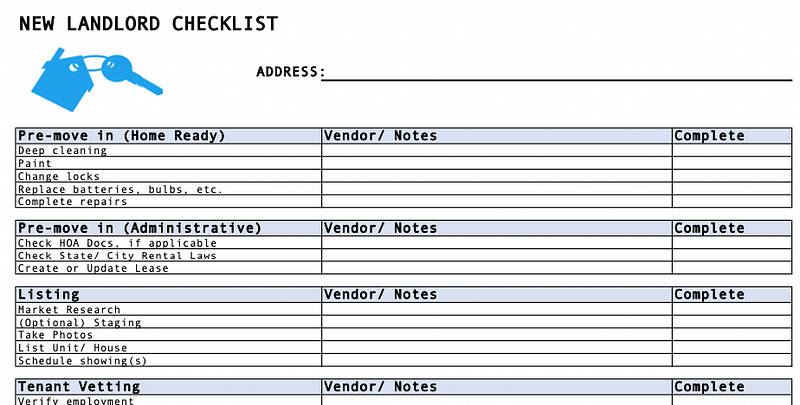
This list may look long, but it really isn’t much effort. I also have a Checklist for New Landlords to make your life easier. (You’re welcome haha).
Tip 1. If you have an HOA for your passive income rental properties, use their preferred vendors. This includes insurance, handyman, plumbers, etc. The preferred vendor will already know the property and know the HOA property manager, especially when figuring out who pays the bill.
This is also helpful because new landlords don’t have your own vendor list yet, so asking your HOA property management gives you a good list to start with.
For my rental, the plumbing issues maybe took less than an hour total to coordinate with my tenants, call my preferred plumber (same as the HOA’s preferred plumber), talk to the plumber and ensure it got fixed.
The termite tenting was set up by my HOA, but I had to make sure that my tenants went to the explanation meetings and understood all the food bagging requirements. I also provided a credit since they were unable to live in their apartment for 3 days.
The light flickering literally was me talking to my tenant and buying new bulbs.
The lease assignment took a bit of time. I had to create a new document that re-assigned the lease from one tenant to another, which I did using Rocket Lawyer. Creating the document, making revisions, sending it to my tenants for review took a few hours total.
For the outside storage unit that was broken into is accessible from the alley. I had already communicated to my tenants to not store valuables in here because it is outside and can get broken into. Luckily they had renters insurance to cover this (as required in the lease).
The lease renewal took a bit of time too. I spoke to both tenants to understand their situation. Check out the post, Landlord Life: I increased rent by 19% and over $500 while keeping a great relationship with my tenants to see what I did here.
Yeah- but how much time does your passive real estate income really take?
I wish I had kept track of the ongoing day to day landlord tasks, but I haven’t. I just know March took about 2 min to send my tenant the listing with photos.
February took 10 min to facetime my tenant on how to replace a lightbulb for an unusual light fixture. And maybe another 10 minutes to find the bulbs on amazon and send it too. I am estimating here.
In January, it totalled maybe 5 hours to create a new lease renewal contract, review, talk to my tenants and get it signed. It required a bit more discussion with my tenants than normal because they wanted additional flexibility.
December or November, I don’t think it took any time that I can remember. I truly think the ongoing part is the easiest bit and is truly passive real estate income.
Now for the harder bit- Initial Set Up takes more time
The work it takes to set up your passive real estate income is more time consuming and I try to fly home for this part (since I live out of state). There are a few different areas to get your passive income rental properties ready.
Getting Move In Ready
The “getting ready” part of it which includes cleanup, repairs and upgrades, paint, replacing things like lights, fire alarms, batteries, etc. Basically getting it ready to show and move in. I did not do any of this myself and hired different people to do all of this.
Tip 2. Write down your your paint color, special bulb measurements, window sizes, etc. that are in your rental. If something breaks while your tenant is living there and needs to be replaced, repainted or fixed, it is nice to already have this information rather than trying to figure it out each time.
When cleaning, don’t forget things like cleaning the dust off of ceiling fans or the tops of the fridge (like I did.) The insides of fridges, ovens, dishwashers just to name a few.
Don’t forget window sills, inside all of your cabinets etc. Think about if you moved in, how would you feel if you found little bits of the previous tenant. Ummm gross.
Admin and Compliance
Then there is the administrative/compliance part of passive income rental properties.
Tip 3. You need to read through your rental, landlord and tenant laws in your state. Some states protect landlords, others put more emphasis on tenant rights. Some places have requirements for providing interest on the deposit or separate bank requirements. It is important to do your research. Here is a site from Nolo has overviews of different tenant and landlord laws in different states.
Do you live in a complex with an HOA? If you are trying to rent out your house, then you are probably ok. But if you have a condo or a townhome, then you probably do.
Tip 4. Check your HOA CC&Rs and other documents to see if there are any rental requirements. I’ve seen rules that require you to live in the unit for 1 or 2 years before allowed to rent it out. I’ve also seen ones that limit the number of rentals to be 30% of total units and will require you to be on a waitlist. One of my HOAs require rentals to be 30 days or longer to prevent short term AirBnb type rentals. Be sure to look through this for all of your passive income rental properties!
You will also need to create a lease. And be to include things that are required in your state law. If this is too intimidating, that is ok! You can higher a lawyer in your state to help you with that.
Tip 5. In your lease, include a requirement for the tenant to have renter’s insurance, because your insurance only covers the property that belongs to the landlord (Walls, floors, cabinets, appliances, etc.). It doesn’t cover stuff that belongs to the tenants. I recommend you put in a renter’s insurance requirement for all of your passive income rental properties.
Showing your unit
Back in the old days when I used to list my place on Craigslist, I had paper applications that I would give to people at the showings. (Omg, am I 100 years old? Yes, but trapped in a 30 something year old body).
Tip 6. Now I just list everything on Zillow Rental Manager, and I recommend you do too (much easier for new landlords!) Zillow handles the background check, credit check and application. And the great thing about Zillow is that they also own Trulia and Hotpads, so your listing is posted on all 3 sites. It is also good for the renter because with one application fee, they can apply to multiple places. In the past, people had to pay about $30 for each place they applied for. This makes your life way easier!
Tip 7. After you get your place as pretty as can be, do in-person and virtual showings on Zoom. Virtual showings really increase your applicant pool because it can include people who are worried about covid, busy people who don’t want to drive to your place, and people out town or out of state. In the past, when showing an open house or by appointment, I got a lot of cancellations or No-Shows. But with Zoom, that number has dropped. Amazing… thanks technology!
After you get a tenant
After you get find a tenant, then most of your hard work is done! But don’t start slacking off now. You will have to do a walkthrough to make sure that you and the tenant is aligned with what the house looks like!
Tip 8. You will also have to set up payment, and my tip to you is don’t accept checks for your passive income rental properties! You can set up Zelle, payments through Zillow, Venmo, direct deposit. But checks can get lost in the mail, and is a hassle for both you and the tenant.
Do you like extra credit? Of course you do, that is why you are reading this entire blog post about passive income rental properties.
Tip 9. When somebody moves in to your rental, have a new move-in gift for them. It is such a treat that they are not expecting, and it leaves a nice impression on their first day!
To Summarize
Are passive income rental properties really passive? Can you really do it by yourself?
Yes to a certain extent. The ongoing day to day stuff has been pretty easy. This changes depending on your unit and how well it is maintained, but for the most part I hardly hear from my tenants.
The initial set up takes more time. You have to get it move in ready, make sure your paperwork is all in order, show your unit and find a good and reliable tenant. Each one of those tasks may seem like it is scary, but when you break it down (and hire good people) it isn’t so bad.
This is a lot of stuff to remember. That’s why I created a Checklist for New Landlords that you can download for free to help you keep track of all of your tasks and make sure you have everything covered.
Here are the tips for passive income rental properties:
- Tip 1. If you have an HOA for your passive income rental properties, use their preferred vendors.
- Tip 2. Write down your your paint color, special bulb measurements, window sizes, etc. that are in your rental.
- Tip 3. Read through your rental, landlord and tenant laws in your state.
- Tip 4. Check your HOA CC&Rs and other documents to see if there are any rental requirements.
- Tip 5. In your lease, include a requirement for the tenant to have renter’s insurance
- Tip 6. List using Zillow Rental Manager.
- Tip 7. Do in-person and virtual showings on Zoom for your passive income rental properties.
- Tip 8. Don’t accept checks.
- Tip 9. When somebody moves in to your rental property, have a new move-in gift for them.
The passive real estate income that I will be earning this year will be paying for my wedding. Although I wouldn’t say they are truly passive, they are well worth the effort. I hope these tips help you in the future!
Check out some of my other posts:
Want to see more about investing? Check out: What is the best robo-advisor?
Trying to learn about credit card debt? Read: How to Easily Squash $14,000 in Credit Card Debt


