
Landlord Life: I increased rent by 19% and over $500 while keeping a Good Relationship with my Tenants
In 1.5 years, I increased rent by a lot. But I did this while maintaining a good relationship with my tenants. Here are the steps so you can too.
If you are DIY Landlord like me, the idea of increasing rent to people you like can be really tough, especially when you have great tenants. (Shoot, why do they have to be so good?!) I recently increased rent in one of my units, the highest ever due to the recent inflation and market increase. Increasing rent can be tricky. You want to maintain a good relationship, but you aren’t a charity either.
I live in Chicago and have a couple condos that I lease out in Southern California, where I am originally from. I don’t own multiple buildings with tens of units, I just lease out the two and have a full time job. Real estate has been good to me, I’ve have renting them for quite some time. So I want to share my steps on how I increased rent.
One more thing, this is not a how to “squeeze every possible penny from your tenants” type of explanation. If that’s what you’re looking for, you can stop right here. The steps below are for an increase that is fair or close to market price.
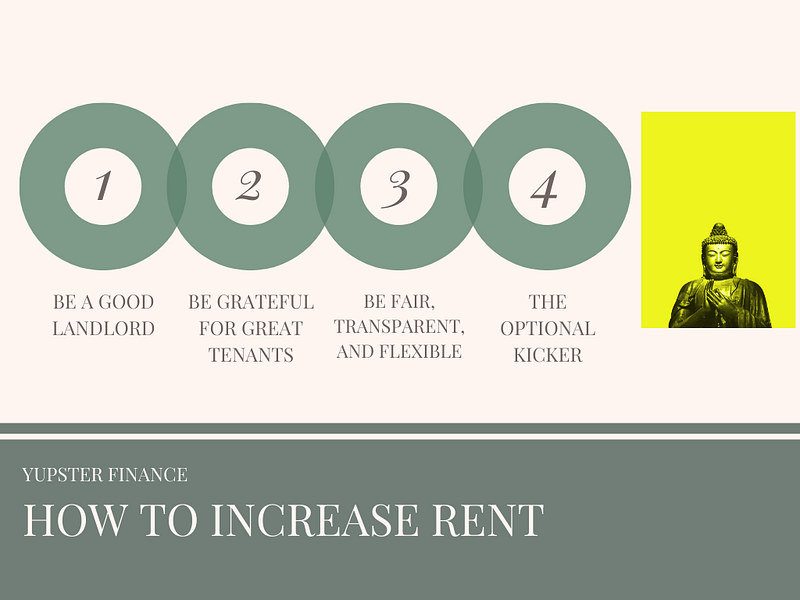
Step 1- Be a Good Landlord
This is the most important step in the process. You have a year (or however long your lease term is) to build trust and a positive relationship between you and the tenant. The better your relationship is, the more receptive they will be that you aren’t some money hungry p.o.s. So during the year unforeseeable issues can come up, how you behave matters.
A leak? An appliance breaking? Even a simple noise complaint. The way you handle these situations are important because they will know the kind of person you are. And the way they see you will reflect in the following year when it comes time to increase rent.
It’s like when you like and trust your doctor, you are more likely to listen to them (and less likely to sue them). Treat your tenant like how you would treat a friend of your aunt’s. You don’t have to be best friends with them, but you want to treat them well so it doesn’t come back to you.
Here are a couple of examples of how I do this.
I respond to the tenant within a couple of hours (unless it is at night with the 2 hour time difference). This is so easy and small, but makes a big difference! When you were a renter, how many times have you submitted your request, and then have to follow up a week later to confirm that it was received? It’s like- hey, nobody cares about you. You are a number and that is the way it is. Make sure your tenant feels like a human and not a number.
Another more substantial example: Over the summer, my condo building decided to finally undergo termite tenting. My unit a couple years before had an issue with termites so I was glad that this was finally happening. (My paranoid brain was worried that my real estate rental will crumble and implode).
Although I was happy about this, termite tenting has a lot of requirements. The tenants had to bag their food, attend mandatory meetings, follow additional requirements for plants, and vacate the premises for a few days. Per the lease agreement, all I was required to do was not charge them rent for the few days that they were unable to live in the unit.
And if this happened to me, I would just stay with family or friends for a few days. But my tenants moved to the area from out of state at the beginning of their lease. They had been in the area for less than a year during COVID times, so I wasn’t sure if they had people they knew well enough to couch surf.
Therefore, in addition to not paying for those 3 days of rent, I credited them an additional $175 so that way they could find a hotel in the area if needed. If they pocketed the money, then fine, good for them. But I was able to show that the tenants are more to me than just money.
Step 2. Be grateful for Great Renters
This is cheesy, I know. But I mean it, like have you ever had a bad renter? (Ok, I have been renting out my units for 10 years, and I haven’t had one that I considered bad.) But I have heard horror stories.
People not paying rent regularly. Checking on your rented unit, only to find it completely trashed with holes in the wall, cigarette burns on the floor. The place smelling like a frat house. Going through a painful and expensive eviction. If you have a bad renter, they can make your life a living hell. So be grateful when you have one that pays on time and is clean most of the time.
The more grateful you are, the better you will be able to accomplish Step 1. So show and express that gratitude.
Here is how I expressed gratitude this when I got new tenants. I gave them a little goody bag when they moved in. Since they moved from out of state, I got them a SoCal tourist book that I purchased from a local bookstore. I got them a gift card from a restaurant that is walking distance from their unit. A local newspaper so they can get the feel of what was happening in the area. And a handwritten card thanking them for choosing my place.
You can argue that I was just ticking things off the box, but for these tenants I was truly grateful. There was a slow leak discovered when the last tenant moved out. It unfortunately took longer than I would’ve liked to get it fixed because I had to wait for the HOA’s property management to work on it. And the incoming tenants were understanding and a pleasure to talk to. (I also credited them a small amount for the inconvenience.)
I thanked them for that, and then they thanked me for being the kind of landlord that makes sure that a leak and any potential mold is cleaned out and drywalled quickly. It was a lot less stressful than it could have been.
Step 3. Be Fair, Transparent and Flexible
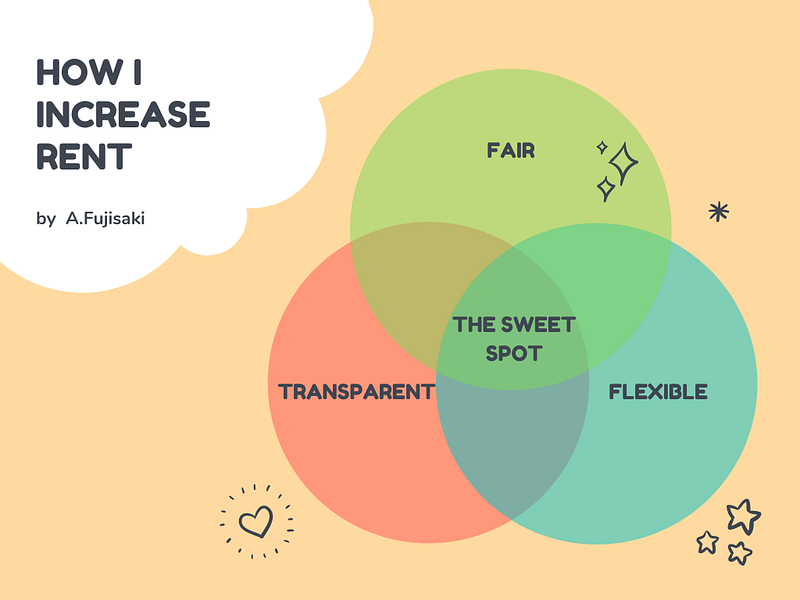
Fairness
When people feel like they are being ripped off, they often search for something better. If you found out that your coworker with the same role and experience got paid 15% more than you, how would that make you feel? You would probably brush up your resume, update your LinkedIn and start applying. If you want long term tenants (which most of us do), it is better to be a fair and good human being.
Transparency
I don’t know how other people increase rent, but often times a rent increase could feel like somebody just pulled a number out of their ass and poof, that is your new rent. People like to know where these figures come from. What is the market value for the area, how much was inflation for the year, did the HOA increase?
You of course, don’t have to do this. But I have found that when you do, tenants are more understanding because it provides the feeling of fairness. And thus you are able to maintain a better relationship.
Flexibility
Sometimes tenants need a little wriggle room in the contract, and you have the power to give it to them. In fact, sometimes it won’t cost you a penny and it can even be better for you! For example, I have had tenants ask for month to month, and I told them I cannot do that (I live out of state, and like to do the renting out myself), but will allow month-to-month from May to August. Why May to August?
Because nearly 70% of annual moves happen between Memorial Day and Labor Day, which means the remaining is split between the other 8 months. By doing so, you can rent out during the peak rental season.
I’ve also had it where at the time of renewal, one tenant was thinking of moving out in 3.5 months, and the other was looking to stay. I first offered a 4-month term or a 1 year term with different pricing, but the tenant roommates wanted different terms. In order to maintain harmony between the two, I came up with the following: A one year lease with the option after 4 months to cancel, replace 1 tenant, or continue the lease.
The rental amount stayed the same so it wasn’t an issue of which term was cheaper. And both tenants were happy with this solution.
Look- I get that this isn’t your job to solve any roommate drama. But thinking outside of the box and coming up with solutions is not a bad touch, especially when you raise the rent a chunk (which I did). And I care about my tenants. They are proactive, smart and pay on time so I was happy to do it.
Fairness - Transparency - Flexibility - Here’s how I did it:
In this example, since they were thinking between 1 year and 4 month term, I showed them a list of the estimated market rent for the unit per month ranging from $3400-$3800, then I showed their generous discount of $3000 (like I said, I like them), and how it calculated to their monthly rent amount. Instead of giving different prices for the
Step 4: The Optional Kicker
If your tenant comes back and asks you for a bigger discount, you can say no, or you can agree/ accept part way. And man oh man, if you give them an additional discount, a little goes a long way.
My tenants asked for an extra $100 per month off, and I agreed to $50. They were STOKED. Which is amazing because I had raised all together 19% and over $500 per month in less than 1.5 years. (I followed all rental laws).
I left happy because I raised the rent by a lot, and they left happy because they got a discount on top of their discount. The two roomies maintained harmony because the contract was flexible. And we were all winners, which is how a good negotiation should be.
To Summarize…
The difference between great renters vs. bad renters is huge. When I have great tenants, I hardly ever think about them, because I don’t have to think about them. And how amazing is it that they pay for your mortgage (and then some), while the value of your property is also increasing (maybe it won’t forever but it has for a while). Whereas if you have bad renters, it is extremely stressful. The constant follow ups for money can be exhausting and the property damage that can be done is enormous.
You can see that the bulk of this post was more about being a good landlord (Step 1) and being grateful (Step 2) rather than the How-Tos in increasing rent (Steps 3 and 4). But I truly believe that in order for Steps 3 and 4 to be successful you really need to first complete Steps 1 and 2.
Want more?
Check out yupsterfinance.com!
I invested $6000 using SoFi, Ellevest, Fundrise, Wealthfront, Betterment, and the S&P500. For the most recent update, check out this post here: January 2022 Investment Update- A New Winner!
Are you interested in renovating your place? I just did in 2020. Check out how much it cost. These are the Actual Expenses of my condo renovation!