
Dear Conservatives: It’s Time to Drop the Abortion Issue
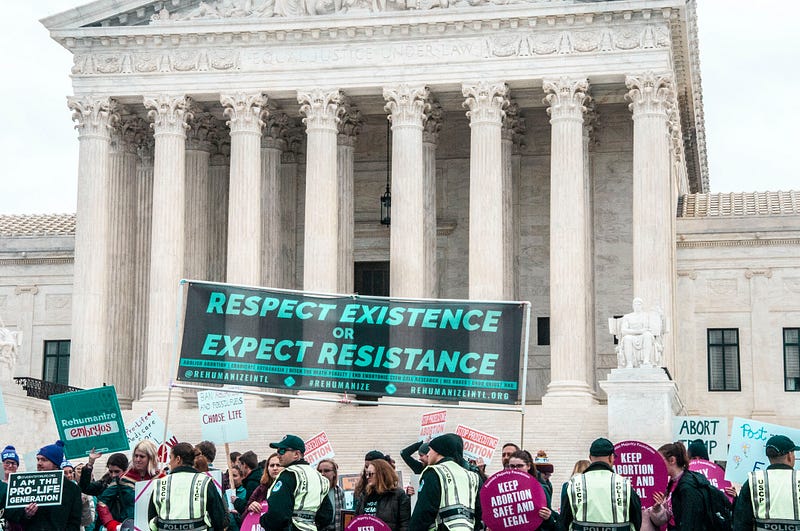
Donald Trump’s first presidential campaign should have ended on October 7, 2016 when the Washington Post released a recording of Trump’s now infamous “grab ’em by the p***y” line. At the time, I expected the conservative evangelical friends, family, and churchgoers I’d grown up with to rebuke the would-be president, to finally draw the line at using his status as a celebrity to commit sexual assault. But I quickly learned that they all felt something bigger, something infinitely more important was at stake: Roe v. Wade.
“We can’t take our eyes off the Supreme Court,” I heard, in one form or another, over and over in the days that followed. Many on my social media feeds freely admitted to not liking Trump personally but felt compelled to support him in hopes of electing a man who would finally orchestrate the undoing of the landmark 1973 decision legalizing abortion nationwide.
Monday’s SCOTUS decision proved they were wrong.
To be sure, Trump’s nominees — Gorsuch and Kavanaugh — played their part, voting with the minority to uphold the Louisiana law that would have closed all but one abortion clinic in the state. But as in a number of cases preceding June Medical Services LLC v. Russo, the fundamental right to an abortion prevailed.
Nevertheless, as Election Day approaches, I suspect I’ll hear, yet again, a similar refrain among conservatives regarding their decision to cast a ballot for Trump: “We may not like him, but he’s our only chance to stop abortion.” Thus far, however, Trump’s first term has proven him inept at carrying out the ideological goals of his base.
Nearly 50 years post-Roe, it’s time to drop the matter as a voting issue.
Abortion Will Never Be “Illegal”
In the weeks leading up to Trump’s election in 2016, I also learned of a basic misunderstanding among many conservative voters regarding the Supreme Court’s role in determining abortion rights. To be clear, the Court rules on the constitutionality of existing law. It does not write or pass laws on its own. Only an act of Congress, then, could make abortion completely illegal in the United States — and that will absolutely, unequivocally never happen.
If it could, it would have been tried in early 2017 when Republicans controlled both chambers of Congress and the White House. But a federal ban on abortion is so far-fetched, neither the president nor conservative lawmakers breathed even a whisper of such an idea. Plus, the ban would have been challenged in court and most certainly struck down.
Criminalizing abortion (or restricting its access) can only occur at the state level. The role of the Supreme Court, then, is to decide whether to strike down or uphold state laws, which, I feel silly reminding you, only apply to that state.
That means conservatives’ best-case scenario on abortion would be to overturn Roe v. Wade, then pass abortion bans in the statehouses they control. But even if that wildly unlikely scenario came to fruition, I suspect conservatives would be disappointed to discover just how little of an effect it would have on the national abortion rate.
Most Abortions Don’t Happen in Deep-Red States
One of the biggest challenges for the pro-life movement is that only ultra-conservative states, where abortion rates are fairly low anyway, are able to successfully pass anti-abortion laws.
Of the nine states that attempted to criminalize abortion last year, six had abortion rates below the median and all but one had rates below the national average.
In other words, even if the Supreme Court overturned Roe v. Wade and upheld state laws banning abortion, conservatives would basically be legally prohibiting a practice they had already culturally prohibited.
Now, as someone who’s pro-choice, I firmly believe in fighting for the women of states like Missouri, Mississippi, and Kentucky to have access to legal and safe abortions, but if as a conservative, you think overturning Roe v. Wade will result in a meaningful reduction in the number of legal abortions performed in this country, you’re dead wrong.
Take, for example, Utah and Arkansas (two of the nine states that passed anti-abortion laws last year), whose abortion rates rank 40th and 32nd in the nation, respectively. Of the few abortions that do occur in those states, these new laws only prohibited those that occur after 20 weeks, which affects less than 1.2% of abortion procedures, according to the CDC. Restrictions with similar timelines were considered, though ultimately failed to pass, in states like Florida and Minnesota.
Even so-called “fetal heartbeat” laws that typically ban abortion after 8 weeks would still permit 28% of abortions in the United States (not that SCOTUS would ever allow these laws to stand).
Absent an outright federal ban, conservatives who want to meaningfully diminish the number of abortions performed in this country would need to ban the procedure prior to 13 weeks (when 91% of abortions occur) in center to left-leaning states where both abortion rates and the raw number performed are higher.
Absolutely nothing, including SCOTUS overturning Roe v. Wade, indicates they will ever be able to do so.
The Legal Precedent is Firmly Established
And if the data isn’t discouraging enough, it is highly, highly unlikely SCOTUS will actually ever overturn Roe.
Although, as with Monday’s decision, there have been a number of close, 5–4 votes in abortion cases, the Court has never allowed any laws to stand that present an “undue burden” to women seeking an abortion. And with the legal precedent so firmly established, it will likely never overturn or dismantle Roe in the way conservatives seem to hope.
The Court has consistently struck down laws that would have resulted in meaningful reductions in the number of abortions performed.
Of the dozens of abortion cases that have come before the Court in the last 50 years, conservatives have only been able to limit state and federal funds for abortion procedures (Rust v. Sullivan, Webster v. Reproductive Health Services, Harris v. McRae), require informed and parental consent (Planned Parenthood of Southeastern Pa. v. Casey), and ban so-callled “partial birth abortions” (Gonzales v. Carhart).
But attempts to require doctors to protect the life of a fetus if it’s deemed “viable” (Colautti v. Franklin), have admitting privileges at nearby hospitals (Whole Woman’s Health v. Hellerstedt, June Medical Services LLC v. Russo), or perform the procedure only in hospitals after the first trimester (City of Akron v. Akron Center for Reproductive Health), as well as require women to obtain consent from or notify their husbands (Planned Parenthood v. Danforth, Planned Parenthood of Southeastern Pa. v. Casey), have all been ruled unconstitutional.
The Court has consistently struck down laws that would have resulted in meaningful reductions in the number of abortions performed. Only a majority of, to use conservatives’ words, far-right “activist judges” who are willing to trample over the principle of state decisis in order to restrict abortions would let such laws stand. Even with a second term, Trump isn’t likely to make that happen.
Strict Abortion Bans Lack Public Support
Nevertheless, you might still think, with another Trump term, that there’s a chance of packing the Court with those kinds of judges. But if you’re thinking to yourself, “Maybe if Roe v. Wade is overturned, pro-life legislators would be energized enough to pass more anti-abortion laws,” I’ve got some upsetting news: you’re not winning the culture war here.
In the nearly half-century that Gallup has tracked the issue, no more than 20% of respondents have ever supported a complete ban on abortion. And the share of respondents who think abortion should be legal in any circumstance has been steadily growing since hitting a low in 2009. Even if lawmakers in purple states wanted to pass abortion bans or statistically significant restrictions, they’d face a seriously uphill battle pushing them through, as most voters would be unlikely to support such restrictive measures.
Ultimately, though, I know this writing will likely fall on unwilling ears. I’ve already written about how the pro-life movement began as a cover for opposing ’70s and ’80s integration laws — and, today, I’m not sure much has changed.
While I’m sure many conservatives, as individuals, earnestly believe in the fight to stop abortion, the officials they’ve elected to represent them (yes, even Trump) know that that cause is lost, the issue is moot, and that they will never be able to infringe on the right to an abortion, for the vast majority of those who want one.
Any ballot cast in belief of the contrary is a wasted vote.