
The Pro-Life Lobby isn’t Righteous. It’s Racist.
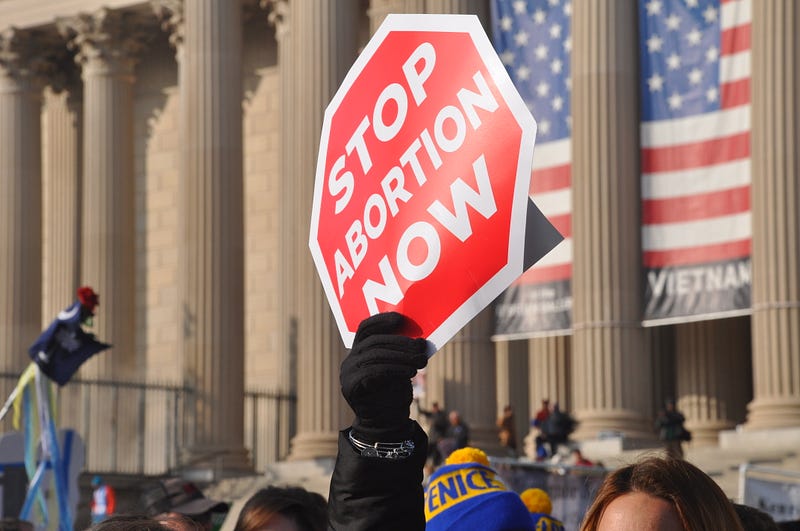
With a conservative majority now on the Supreme Court, those hostile to abortion rights have set their sights on overturning the landmark Roe v Wade decision making abortion access a constitutional right. Last week, the Alabama governor signed legislation outlawing abortion completely, unless the woman’s life is threatened or the fetus has a lethal anomaly. It’s now the most restrictive abortion law in the country, surpassing the “fetal heartbeat” laws of states like Georgia and Mississippi. Likely thinking themselves safe from an unfavorable court ruling in Washington, nine more states have passed or are considering similar hard-line limitations on a woman’s right to an abortion.
Proponents of these measures tend to rely on the idea that unborn fetuses are legally (and spiritually) equivalent to human beings, which they predicate on their religious beliefs. The pro-life lobby in America, however, has a much more insidious origin, whose motivations may not be as righteous as they’d have you believe. In fact, the conservative religious movement responsible for the creation of the pro-life lobby was actually born out of racial resentment, which it continues to perpetuate throughout its messaging today.
Despite their instance that God would want us to protect the rights of the unborn, there currently is not, nor has their even been, a religious consensus on the matter. Pew Research Center data from 2018 demonstrates this diversity of thought among the Christian community: Catholics and American Baptists are evenly split, evangelicals (Southern Baptists, Mormons, Church of Christ, etc.) are largely against it, while Methodists, Presbyterians, and Episcopalians tend to support it.
This lack of consensus has been consistent throughout history, as well. According to an article published in the U.S. National Library of Medicine, the Roman Catholic Church began debating the ethics of abortion in the 7th century (this is 600 years after Christ, by the way) in order to distinguish themselves from the pagans that allowed it at the time. In the 13th century, famed philosopher and theologian St. Thomas Aquinas declared that a fetus does not possess a “rational soul” until the body is developed. But then, in the 16th century, as its positions on sexuality in general started sounding increasingly like The Handmaid’s Tale, the Roman Catholic Church decided abortion was a sin worthy of excommunication.
But even in recent memory, Christian leaders (including the evangelicals!) fervently supported abortion access. In 1967, as several states began tightening their abortion laws, church leaders founded the Clergy Consultation Service on Abortion with the express goal of helping women obtain “legal and illegal abortions from licensed medical professionals.” By 1971, the group had over 2,000 ministers in its network across the United States and Canada.
In 1969, Christianity Today magazine, an evangelical Christian periodical, published an article titled “A Protestant Affirmation on the Control of Human Reproduction.” While the authors regard the fetus as a sacrosanct human life, they propose to allow abortion in instances that “safeguard greater values sanctioned by Scripture,” including “individual health, family welfare, and social responsibility” (emphasis mine). On one hand, I’m sure we could debate all day about what they meant by those terms, but it seems clear that they didn’t simply mean rape, incest, and risk to the mother’s life. Their inclusion of “family welfare and social responsibility” made justifications for abortion, in a religious sense, much more lenient.
And finally, when Roe v Wade was decided in 1973, evangelical leaders like W. Barry Garrett of the Southern Baptist Convention responded by saying, “Religious liberty, human equality and justice are advanced by the Supreme Court abortion decision.” And W.A. Criswell, pastor to the famous televangelist Billy Graham, said, “I have always felt that it was only after a child was born and had a life separate from its mother that it became an individual person.” So the reaction to Roe v Wade was not one of universal disgust by the evangelical community. At the time, evangelicals respected the diverse, nuanced views their congregations held on abortion.
Even among the most conservative Christians, the abortion issue used to be a matter of conscience, a matter of freedom and religious liberty, and above all, a matter of choice.
Today, though, modern pro-life leaders try desperately to rewrite this more embarrassing moment in their history (as they did when Jonathan Dudley published an op-ed titled “When evangelicals were pro-choice”). The evangelical leaders — Mark Galli and Albert Mohler — who criticized Dudley’s rendering of the historical record hold fast to the idea that the formation of the Religious Right (and the subsequent pro-life lobby) wasn’t politically motivated. Rather, Galli claims, their initiatives resulted from “moral convictions and deepening awareness of the number of lives being cast away.” Galli, of course, provides no evidence for this claim.
While this revisionist history might make them feel better about their present situation, it simply isn’t the case.
Around the time Galli would have us believe American evangelicals were feeling morally convicted to oppose abortion rights, they were also fighting to keep black students from attending their private colleges — a reality that makes it a bit difficult to claim moral outrage with a straight face.
In an article for Politico, Dartmouth professor and historian of American religion Randall Balmer describes the process through which evangelical leaders created what would come to be known as the “Religious Right.” Prior to 1979 (a full six years after the Roe v Wade decision), evangelicals weren’t politically organized. They were not the cohesive voting bloc conservatives can depend on today. But Paul Weyrich, conservative activist and co-founder of the Heritage Foundation, recognized their potential to seize political power.
“The leadership, moral philosophy, and workable vehicle are at hand just waiting to be blended and activated,” Weyrich wrote in the mid-1970s. “If the moral majority acts, results could well exceed our wildest dreams.”
For years, Weyrich had tried (and failed) to “activate” this “moral majority,” using issues like pornography, prayer in public schools, the proposed Equal Rights Amendment, and, yes, even abortion. And while there were certainly some evangelicals who opposed abortion (remember, they were divided and largely silent on the issue when Roe happened), it didn’t seem an important enough issue to make the backbone of their politics. That is, until the IRS revoked the tax-exempt status of several prominent, private Christian colleges that refused to admit black students.
This was the moment conservative evangelicals became politically organized — not when Roe was decided, but when their schools were forced to integrate three years later.
In 1970, the IRS denied tax-exempt status to any school that engaged in racially discriminatory admissions practices. The IRS ruling was upheld the following year in the Supreme Court case Green v Connally. This captured the attention of popular evangelical leaders like Jerry Falwell (founder of Liberty University), whose own “segregation academy” was targeted by the IRS under the new ruling.
Falwell’s Lynchburg Christian Academy, though, didn’t seem to put up as much of a fight as Bob Jones University in South Carolina, which stood by its claim that the Bible mandated racial segregation (whereas Falwell pivoted to the argument of “religious freedom” — sound familiar?). The school’s founder, Bob Jones, Jr., fought the IRS for years until, in early January 1976, their tax-exempt status was officially revoked.
This was the moment conservative evangelicals became politically organized — not when Roe was decided, but when their schools were forced to integrate three years later.
Weyrich finally saw his opportunity to activate the moral majority in favor of conservatism. But it wouldn’t have been practical (particularly not anywhere outside the South) to make preserving racial segregation the backbone of their activism. Instead, evangelical leaders capitalized on the rising rate of elective abortions post-Roe and the success of three pro-life Senate candidates in Minnesota and Iowa to goad fellow evangelicals into the political arena.
By 1979, in the run-up to the presidential election, Falwell founded the Moral Majority political action committee, with the issue of abortion at its center. His efforts are credited with delivering the White House to Ronald Reagan (who then decided to defend Bob Jones University and its racial practices in a lawsuit decided by the Supreme Court in 1983).
Today’s evangelicals may not find it a pretty history, but the record is clear. Because Christians have been divided on the abortion issue for centuries, it was impossible to organize them around an outright moral claim against it. Instead, preserving racial segregation became their catalyst. They masked it as moral outrage for protecting “the lives of the unborn,” but had the IRS left white evangelical colleges alone, they probably wouldn’t have thought twice about the unborn.
But, alas, that was 40 years ago — which isn’t actually a long time — and I can hear the conservatives who are, miraculously, still reading arguing that the “moral majority” has changed. Now, it really is about protecting the lives of the unborn. Race is not a factor. But, sadly, that may still not be true.
That racial prejudice might be a factor in contemporary white American’s opposition to abortion didn’t occur to me until I came across Chuck Konzelman and Cary Solomon’s Unplanned— a film based on the life of Abby Johnson, who quit her job at Planned Parenthood after witnessing, through an ultrasound, the supposedly gory abortion of a 13-week-old fetus.
In the film, Johnson is depicted as having assisted doctors with abortions for multiple patients, all of whom are white. It isn’t until Johnson encounters her first black patient that, after two years in the industry, she decides enough is enough. According to Johnson, of course, this had nothing to do with the woman’s race and everything to do with having had to use an ultrasound to facilitate the abortion and seeing the fetus “fight for its life” (which is ridiculous because fetuses don’t possess the capacity for consciousness necessary to recognize that their “life” is at stake, let alone fight for it).
But here’s where her story gets interesting. On the day Johnson quit her job, the day she claims to have witnessed this gruesome, life-changing abortion, the only black woman listed on the Induced Abortion Report Form was six weeks along, not thirteen. Additionally, none of the abortions performed that day would have required the use of the ultrasound.
Despite evidence to the contrary, Johnson has maintained the veracity of her story, arguing that Planned Parenthood doctored the Induced Abortion Report Form in some larger conspiracy against her. To me, it seems more likely that she simply fabricated her story — or, at least, embellished a true one. But in some ways, whether it’s true doesn’t matter because, if it is, it’s still significant that Johnson found a black woman’s abortion so disturbing she quit her job after two years of aiding the procedure. And if it’s false, it’s even more significant because it represents something so deeply ingrained in the consciousness of white pro-lifers that she selected it as a detail to include in her phony narrative.
Now, I understand that racism being implicit in the pro-life lobby, especially as evidenced by characters in a film production, will be a tough pill for folks on the right to swallow. I’m sure, among other things, they’re thinking, “What’s racist about believing life begins at conception?” But to diminish our political realities to mere policy disputes oversimplifies the complicated ways in which identity politics actively shape our political thinking.
What, for instance, is racist about being against the Affordable Care Act? Ideally, nothing, except that researchers at Brown discovered public opinion on health care reform is polarized much more by racial attitudes when framed as an initiative by Barack Obama than by Bill Clinton (both Democratic presidents). I imagine, though, that those against Obamacare likely defend their position with economic or other sociopolitical reasoning, despite research indicating that, subconsciously, racial resentment is at play.
Public opinion on welfare, as another example, shouldn’t be racially informed either. Policy disagreements about Medicaid, SNAP (food stamps), and housing subsidies should be largely economical. And, yet, research shows that whites tend to support welfare programs only when they know it will support other whites. In another study, when whites were exposed to images of people of color, particularly African-Americans, as the recipients of welfare, their support of those programs plummeted.
While abortion isn’t a form of welfare, it is the government allowing people of color to improve their economic fortunes — and, historically, white people haven’t approved of that.
Based on the variety of available evidence, it seems safe to say that racial resentment may be lurking beneath our otherwise purely intellectual policy disputes on a number of issues. And given the aforementioned history of the pro-life movement, in addition to the data on abortions (particularly, who receives them), it wouldn’t surprise me to know that racial resentment is at play here, too.
While abortion may not be a form of financial assistance, being unable to afford a child is the number one reason women cite for seeking it. Additionally, according to the Centers for Disease Control and Prevention, black women are five times more likely and Hispanic women are more than twice as likely to get an abortion as white women. So although they’ll say it’s not a racial issue, whites pro-lifers seem to abhor a policy used primarily by blacks and Hispanics to significantly mitigate financial disaster. While abortion isn’t a form of welfare, it is the government allowing people of color to improve their economic fortunes — and, historically, white people haven’t approved of that.
To be clear, none of this is to say that every pro-life individual is fueled by racial resentment. Similarly, opposition to the Affordable Care Act or an increased welfare state may be held by plenty of folks who aren’t racially motivated. Nevertheless, the research is clear. We shouldn’t indict pro-lifers on an individual level (even 38% of blacks believe abortion should be illegal in all/most cases), but we should be rightly suspicious of the pro-life lobby as an organized political entity, especially one with racist origins that remains dominated by white leaders.


