
8 Whatsits Every Writer Should Use
Plus maybe a few others


We all like to call ourselves writers, those of us who attempt it. I call myself that at least twice a week, just in case nobody else notices. Even as a kid I thought I was a writer. That was before I went to the Great Mountain of Academia and discovered eight secrets to becoming a writer of English. I think Miss Gearhart talked about them when I was a high school sophomore, but I didn’t hear her. I didn’t hear her because Becky Roediger sat in front of me in my sophomore English class and smelled of Estee Lauder and Dial Soap and had strawberry blonde hair and tight sweaters.
When I went off to the foot of the Big Mountain, I told the Academic-in-Charge — an Ichabod Crane-shaped fellow with luxurious silver hair and a neck scarf (drama department)— I wanted to be a writer. He snorted and shook his magnificent pewter head dramatically while handing me several forms to fill out, and told me to go get in line at the trail head marked with the blue arrow. That was back in the days when you had to do things “in-line” instead of “on-line” and different colored arrows marked different trails. I followed the winding Blue Trail across the mountain for four years… give or take. Before I left the Mountain, I asked the Last Academic, “Can I write?”
She leaned against an ivory tower, scratched her nose wart, arched her uni-brow and frowned academically. “Them what can, do; them what can’t, teach,” she said. It was a cliche, but I figured she’d know.
So, all the witches and warlocks, trolls and gnomes who lived on Mount Academia sent me off to teach English to high school sophomores. And I took with me those eight whatsits I’d learn along the way to impart to them… them sophomores.
Those magic things are called parts of speech and I will reveal them to you here so you can save yourself a lot of time, money, and brain-washing by skipping the Big Mountain. I can’t really speak for languages outside of English. I got off trail once on that metaphorical mountain and, in a cannibus haze, wandered into a French class. Some time later, I wandered out having magically acquired 8 hours of college credit. However, I don’t remember how many parts of speech they use, like a lot of things I don’t remember about the Sixties. Knowing the French, they probably don’t either. The Germans, on the other hand, being more efficient, use fewer, maybe two or three. They take eight or so and combine them into one word, e.g., rindfleischetikettierungsüberwachungsaufgabenübertragungsgesetz whose English translation is “the law for the delegation of monitoring beef labeling.” You can fact check me on that. I guess high school sophomore German teachers would call that part of speech an
artiprepennounichverben.
And the Chinese! God only knows how many parts of speech they have… or maybe He doesn’t.
Where were we? Ah, English parts of speech. In this treatise, I’ll use an acronym in some places for Part(s) of Speech: POS.
Side note: Acronym has been nominated several times to become a POS. It has been under consideration by the World Teachers Federation (WTF) since 1939, CE and has been growing in popularity. However, its inception has run up against militant opposition for many years by a group calling themselves the Undaunted Society Harrassing Ignorant Natterers Misusing English (USHITNME). It’s rumored a fringe group calling themselves Language Monkeys Against Overreach (LMAO) has repeatedly mocked USHITNME, but nobody in the discipline takes them seriously.
Please stay awake and put away your cell phones.
I know this is shaping up to be like one of your high school sophomore English classes, but stick with me, and I’ll give you three bonus POS at the end.
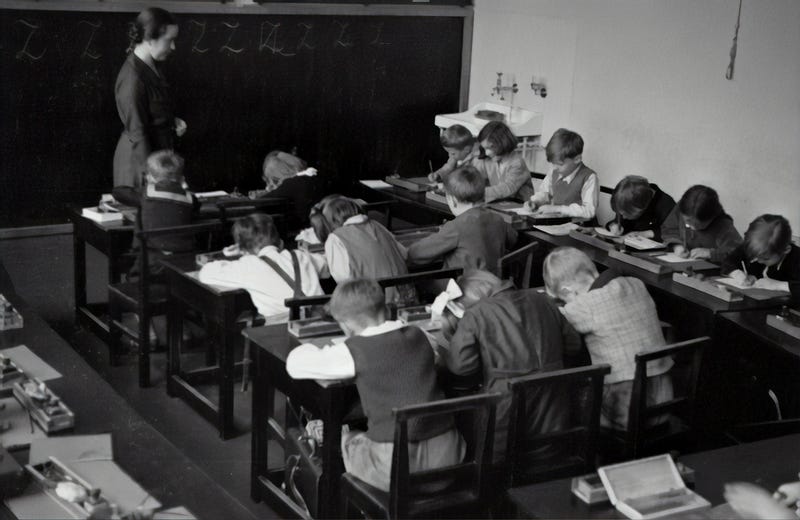
Noun
Nouns are words that describe a person, place, or thingy. Examples: baby — Hey, baby. Sup? dumpster —My brother-in-law, Milo, is a dumpster in search of a fire. wrench — Darnell, hand me the thingy.
Nouns also come in your proper and improper categories. Proper nouns name a specific person, place, or thingy and are capitalized: Darnell — Darnell, hold my beer. Walmart — Ima wear these undersized leopard yoga pants to Wally World. Craftsman — Darnell, hand me that 5/8ths Craftsman thingy. No, the Thingy, not the whatsit.
Improper nouns don’t deserve the same respect and are therefore not capitalized: dumbass — Darnell, you a dumbass. moron — Milo, you a dumbass moron. pants —Once seen, you can’t un-see undersized leopard yoga pants on an over-sized woman... or man.
Pronoun
Pronouns take the place of nouns so you don’t have to write nouns over and over. This is helpful if a noun is long, especially German ones. There are gobs of pronouns, which have seen recent growth since the PC police got a hold of them. But we’ll only examine those recognized by the silent majority.
Conventional pronouns come in three genders: manly, feminist, and neutered. There are several types: personal — Dolly Merlene here, she’s my half-sister-cousin from Arkansas. possessive — Dolly Merlene says she wouldn’t mind being my wife-sister-cousin. indefinite — I don’t want anyone touching anybody the rest of the trip or all of you are walking. reflexive — Myself would like for yourself and herself and itself to shut up. interrogative — Which one of you farted? relative — If Dolly Merlene is your half-sister-cousin, who’s your daddy? demonstrative — Oh, hell yeah. That dress definitely makes you look fat.

Adjective Adjectives describe nouns: Joe Biden and Donald Trump walk into a bar. Bartender says, “One Corpse Reviver and one Pornstar Martini with an orange twist.”
Verb
Verbs come in two colors: Action and state-of-being, active and passive. Verbs in your writing should be 97% action and 1% state-of-being. The other 2% are undecided. Action verb — The superhero smushed the unsuspecting bystander like a handful of mashed potatoes in a food fight. State-of-being, Passive verb — “Whoa, dude, I am like so wasted. It is like time was yesterday. I love you, man.”
Adverb
These words describe verbs, other A-words, and adjectives. They specify the where, when, why, and how something happened just like journalists are supposed to do. Also like journalists, they are undesirable and should be avoided at all costs. Editors — former run-of-the-mill journalists who’ve long since gone insane — hate them and will vociferously question your intelligence, ancestry, and moral turpitude when you use them. I risk being cursed even bringing them up. But, hey, I’ll gladly take one for the team.
Conjunction
This is a minor POS. They’re joiners. Not like join the Marines or USHITNME, but phrases and stuff. They can come in handy. Yet — Bigfoot is big, yet not a Yeti.
Preposition
These are small words for which you can use a shortcut gesture in charades. You put them in front of nouns or pronouns to show space or time relationships. Also, end of sentences is a good place to put them at. Into, at — Einstein said when you go into space you go into time, because that’s where it’s at.
Interjection
Interjections can surprise you. They do it by using an exclamation mark. Unlike other POS, they stand alone, mainly because others don’t want to be around them. They’re obnoxious. Speaking of unlikable POS, editors don’t like them either. Bastards!

Bonuses
As promised, here are your 3 bonus POS: Articles Quantifiers Numerals
Do with them as you wish, because a few editors said I had to keep the piece under 5000 words, so I can’t elaborate. The bitches.
Hope you enjoyed the read. I like to write humor because I’m not a serious writer like Stephen King or John Grisham or Dr. Suess. I would welcome your visit to my Website. Some of my Medium contributions:

Besides humorist, I like to call myself a storyteller and novelist, because that’s what I do. Click image above to visit my website where you can read excerpts from my novels.