
8 Rules for Success on Medium which you really Shouldn’t Follow
Or How No One Knows How to be Successful on Medium
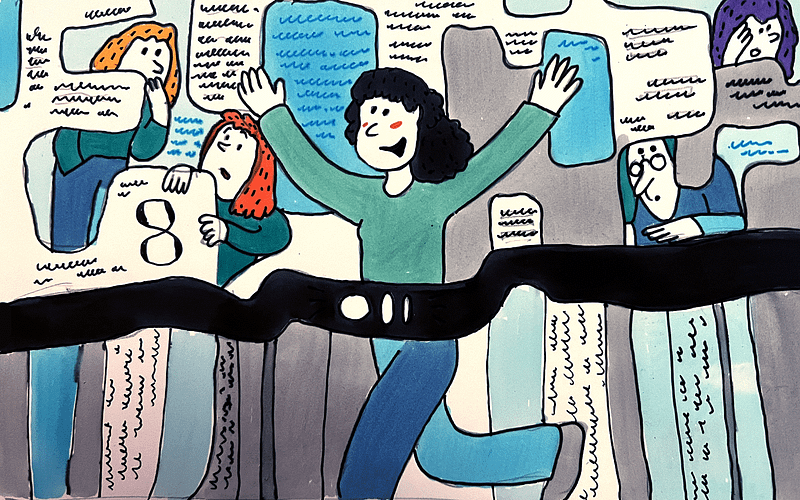
A fairly decent portion of writers on Medium write mostly or solely about how to write on Medium. Some are well-meaning and have a lot to say that could be very useful or even invaluable for both newcomers and old hands. Some are all legerdemain and smoke and mirrors, their greatest trick being making others believe they know what they’re talking about.
This article is about the writers who write about writing on Medium, hence, I suppose this is second order meta — meta metastasising if you will.
I don’t usually write meta articles. In fact, I never have. Which is not to say that I never thought about it or planned to do so, but rather, that I didn’t because I didn’t and now I am. And the fact that I am is partially out of curiosity and interest, and also because I have a lot of content almost good to go but not quite ready. And so, I make my first foray into meta.
1. Don’t Follow my Rules
I don’t have a legion of followers — I have approximately 80 which are in a constant state of flux — 2 steps forward, 1 step back, 1 step forward, and 2 big, fat steps back. I know no more than anyone else across the entire fabric of Medium about how to be successful on Medium. No gazillion followers, no mighty deluge of views or reads breaking the banks of the river systems of online content.
If I have any legitimacy at all, it begins and ends with the power and persuasiveness of my words and thoughts, with a small dash of eloquence thrown in to spice it all up.
I do know one thing for sure though, which is even true for those neck-deep in views and followers with thousands upon thousands lining up to wolf down their content — no one knows enough about success to be able to tell you exactly how to be successful.
2. No one knows How to be Successful
No one knows enough about success to tell you how to get there yourself.
How do I know this to be true? The reasons are threefold.
First, there are no objective standards for assessing the quality, or lack thereof, when it comes to art. I use the term loosely here and include fiction and non-fiction, film, painting, poetry etc.
For sport, there is for sure a subjective dimension which relates to touch or movement or style or some other ineffable quality. But there very much IS a big bag of the objective.
Lionel Messi is the best football player of all time because of his goals and assists per game, how little he loses the ball, how many successful dribbles he dazzles opponents with, and a whole host of other metrics that have been maintained at cosmically high levels over the breadth of his career. There are people who talk about his never leading Argentina to a world cup victory, but this is simply a subjective seal of approval that certain people are intent on forcing into the conversation. The stats speak many decibels louder than such arbitrary nonsense.
It is not so for the world of writing.
Why is Noam Chomsky so much more widely read than John Mearsheimer? Why is the internet littered with Slavoj Zizek when few know who John Gray is? Why is Di Vinci’s Mona Lisa known by school children everywhere and lauded across the world whilst Bosch’s Garden of Earthy Delights is a transcendent pleasure that one only comes to know later in life?
No one knows exactly why. There are no sure-fire means of assessing the whys and hows. It is not because some figures are irrefutably superior in some manner or other than some others. No one knows, including the artists themselves. Which leads me to my second point.
Just because you are successful doesn’t mean you know how you came to be successful. And few are the highfliers who shout down from the rooftops to their adoring masses, ‘It was luck, 100% luck’ or ‘God, how the hell did I wind up doing so well in life? I have absolutely no idea’.
Wildly successful people in the majority of cases don’t know how or why they ended up being so successful. Not only this, but humans are frightfully and fatally afflicted with a tendency to overestimate their will and agency when it comes to consequences. When good things happen, we tend to think we had a large part in them. When bad things happen, we like to outsource causation and culpability to other people or supernatural forces like God or Fate.
When good things happen, we tend to think we had a large part in them. When bad things happen, we like to outsource causation and culpability to other people or supernatural forces like God or Fate.
At the same time, citing luck or the help of others or being born into a prosperous family or systemic advantage cheapens our achievements and tarnishes what we want to see as being the inevitable culmination of our great efforts and prodigious talents. I have never read of a billionaire who said they were just lucky (I would love to read about one who attributes their success mostly to luck; post in the comments if you have such an example).
Conversely, they usually talk about grit, sacrifice, long hours, entrepreneurship, foresight, a certain hard-to-come-by combination of traits and qualities. Of course, all these things are important, but how many millions ticked all these boxes and didn’t end up on the Forbes 100?
Lastly, look at the most influential writers on Medium, what do they write about and how do they go about it? There is a staggering divergence in both style and content.
Some write meta articles. Some are self-help. Some about the environment. Some are doomers. Some are far more light-hearted. Some write longer paragraphs. Some have decided that henceforth a single sentence constitutes a whole paragraph. Some are awash with visuals and fancy graphics. Some are austere and almost spartan.
Diversity abounds among the most successful writers on Medium because there is no single path to success and no one knows precisely how to get there.
3. Write a lot and Read a lot
Immersion and repetition are essential for a person to get better at whatever it is they wish to do. It really doesn’t require much thought — if you want to do something well, do it a lot.
It really doesn’t require much thought — if you want to do something well, do it a lot
Talent is a vague notion at best, a bit like the human soul or free will. Some people seem to have a certain talent in an especial field, but mostly it’s a fuzzy indeterminate concept that people kind of lazily point to when they see someone do something well.
Hard work, immersion and repetition will make you look talented in whatever you do in life. This doesn’t mean you’ll be successful necessarily, but it does mean that you’ll get good at whatever is your thing.
4. Be a female Vampire Bat
Both humans and female vampire bats practise reciprocal altruism (the practice is less pronounced for males) — which is essentially giving or doing something in order to receive something later. It isn’t anything at all like unconditional love, it is fundamentally conditional. In fact, true altruism is pretty hard to find, just like a truly moral act.
In female vampire bats, reciprocal altruism takes the form of the regurgitation of blood to give to bats that haven’t been lucky enough to find a source of blood on the night’s hunt. After two nights without blood, a vampire bat will die of starvation, so it really is a life-and-death situation.
If a bat reneges on its social duties, it will not receive blood from others and may risk becoming ostracised from the group.
On Medium, you really should engage with people who engage with you. You should maintain relationships with those whom you get to know and those who show a genuine interest in your work.
I very often see writers explicitly seeking engagement, only to see in the comments their complete failure to engage with those who took the time to read their material and do the one thing the author sought out. This is both disrespectful and a rather poor long-term strategy.
You should definitely not sell out your values and cosy up to folks whom you have a fundamental disdain for. Nor should you waste your own time, and the author’s, sifting through material that is of no interest to you, attempting to muster all your nous and cunning coming up with well-crafted, but ultimately dishonest and counterproductive, responses.
But play the game, and that game is called reciprocity. It is essential to our species and you will never succeed without it. Don’t get excommunicated, be a smart vampire bat.
But play the game, and that game is called reciprocity. It is essential to our species and you will never succeed without it. Don’t get excommunicated, be a smart vampire bat.
5. Mix it up
No one knows the specific shape of success, all its lines and contours. And who cares about success if it’s all a tortuous grind? Have some fun, mix it up, experiment in the name of growth and entertainment.
Jump into fiction. Delve into non-fiction. Challenge yourself to use a broader vocabulary. Rein yourself in and force yourself to be more direct, more succinct. Use more visuals and graphics. Use fewer visuals and graphics and pretend you’re writing scripture.
Mix it up, fuck around, experiment with form and content, learn a little, and branch out.
6. Don’t Sell your Soul
Don’t sell your soul for followers or views or reads or whatever.
Experiment as per the previous point. But don’t if you really don’t want to.
If long articles with long paragraphs and bags of research are your thing, then go for it. The final part of my series on suicide is 34 minutes long and has 40 likes. I don’t expect anyone apart from the hardiest and most curious and/or some people close to me to ever read it. But I learned a lot writing it, about such a sad and solemn subject and how it manifests in different countries and among different demographics, and also about writing itself.
To those who promise success if only you prune your content to precise specifications, preening before the hallowed masses waiting desperately for you to deliver the good word according to …. , — I say bollocks.
Would I write something of the same length tomorrow, nope. Would I write something like that again, maybe. And if not, I would and will use it in a book.
To those who promise success if only you prune your content to precise specifications, preening before the hallowed masses waiting desperately for you to deliver the good word according to …. , — I say bollocks.
The other problem with selling your soul for views or followers or likes or apple pie is that it’s hard to sell a disingenuous avatar of yourself over time without something bursting at the seams and the whole thing crashing down on top of you.
Have you ever tried to lie and get away with something over an extended period? I haven’t in any serious sense and even then it was impossible. I have seen others do it and they tend to tie themselves up in knots as they try to weave and spin their way out of trouble.
People forget their own lies rather quickly. Then they need to invent new ones to extricate themselves from the inconsistencies. And the whole thing goes round in a circle as the person gets ever deeper into their own self-made quagmire and they slowly lose sight of themselves.
Be yourself, it’s difficult being someone else, and you won’t like what looks back at you if you try.
7. Have Fun
Have fun when writing, reading, thinking, learning and growing. If it isn’t fun, then you shouldn’t be doing it. I don’t mean you should be convulsing with paroxysms of laughter from the pit of your stomach at every single turn, but rather, that the experience should be a net positive and bring something genuinely pleasurable to your life. If it’s a torture, maybe you need a break. If it’s a torture ad infinitum, unremitting and unrepentant, to put pen to paper as it were, maybe it’s not for you, or at the very least, not good for you.
8. Don’t Follow my Advice or the Advice of Others
Just in case you forgot about the first, don’t take my advice. Nothing’s written in stone. If something resonates, great. If something doesn’t, take it in your hands, rip it to shreds and be done with it.
Same goes for the rules, advice and tips of others. No one knows the language of Babel. No one knows the sure-fire does-what-it-says-on-the-tin recipe for success. No one knows precisely how they got to where they are at their time of writing. And if they say they know beyond all doubt and can get you there too, well, then you know you’ve got a shyster on your hands.