
7 Unusual Deaths of Prominent Historical Figures
From shoving comb up in a man’s “pride” to getting a dead man’s bite.
Life comes with a spoiler — everyone dies in the end. Well, but some deaths are so unusual that a person sinks not only in confusion but in fascination. Life is a game that many historical figures didn’t play safe or maybe it was just destiny.
This article covers 7 real death stories which will leave you questioning did it actually happened. Let’s dive straight into these stories:
1. Morris death from shoving a comb up
Gouverneur Morris, an American statesman, was a founding father of the United States. He wrote the Preamble to the United States Constitution and became better known as “Penman of the Constitution.”
In 1816, he experienced a urethra blockage, resulting in great trouble urinating. Instead of approaching doctors, which this fine wealthy man could, he went for the DIY.
Indeed it was an unimaginative attempt of clearing the blockage. He inserted a whale bone’s piece as a homemade catheter into the penis. It, of course, did not work.
Instead, his actions caused him several injuries inside his urethra, infecting other parts to an extent resulting in death.
The weirdest experiment was carried out in history, distinguishing the founding father as one of the unluckiest people. He passed away in the same room where he was born.
2. Lincoln shot himself in proving his case
Clement Vallandigham (1820–1871) was known for rejecting popular opinion. Serving two terms in the US House of Representatives and leading Copperheads, an anti-war Democrats faction, earned him quite a name during the civil war.
But in1863, Vallandigham was court-martialed as he was charged with sympathizing with US rebels. Exiled, the guy headed to Canada, where he ran for governor of Ohio. He lost.
A year later, he returned to the US, and authorities didn’t bother him much. Speaking for black and suffrage got him a respectable role as a lawyer — little did he know, in the very occupation lay his death. Angels of death caught him in the Ohio courtroom in 1871 during a trial when he mistakenly shot himself in the stomach.
Vallandigham was fighting for Thomas McGehean, who was charged with shooting someone during the brawl. Demonstrating the whole process through the pistol, Vallandingham accidentally shot himself.
The poor guy who wanted to save the life of his defendant mistakenly took his own life. He didn’t know the pistol was loaded thus acted out the whole scenario his client experienced in front of the courtroom. His mimicking of drawing motion helped his client to acquit but at the cost of his own life.
3. Death from a dead man’s bite
Sigurd Eysteinsson, better known in history as Sigurd the Mighty (died 892), was a ruler of Orkney and the Shetland Islands in Scotland. He was a cruel conqueror who annexed Northern Scotland. His extensive conquest earned him the title of “the Mighty.”
During his Northern Scotland conquest, he incurred a strange death where he challenged Mael Brigte, the king of Moray, for a 40 man each side battle.
Upon which, Mael Brigte, who owned a large protruding front tooth, agreed. Cheating, Sigurd brought an army of 80 men and thus defeated the scots. Sigurd enjoyed the chance of beheading Mael Brigte — the dangerous head, which Sigurd later tied to a horse saddle, as a trophy.
Rounding up the men, Sigurd celebrated the victory; little did he know that his trophy symbol would take his own life. Sigurd was severing from left to right in the rough terrain, during which the large protruding front tooth of Mael Brigte’s head gave a deep cut onto his leg.
Interestingly, the cut became so inflamed it infected Sigurd’s entire body, causing his death. Lesson: cheating doesn’t give long-term success — an insanely strange end from a dead man’s tooth.
4. Edmund had iron sides, sadly not iron butt
Like father like son? Not always. Edmund Ironside (circa 993–1016) was England’s king who did not adopt the behavior of the worst England king — his weak father.
Edmund was titled as the ironside not only for the strength of his character, and massive invasion but because he actually was protected with iron sides. Danish settlers around the region occupied Northern England and raided several areas, conditioning they would only stop when given Danish Gold.
Upon seeing their increased demand, several massacres took place between danish settlers and the Ethelred army. In 1016, Ethelred died, and Edmund came to the throne, becoming England’s king — little did he know that his rule would be short-lived.
Right after the seven months of the rule, Edmund had a strange death. The “Ironside” on November 30th, 1016, went to answer the call of nature, not knowing that an assassin waited for him in the cesspit. Edmund sat for doing his business. The killer stabbed a sharp dagger up his butts, leaving the weapon in the king’s bowel. The assassin escaped.
Despite getting the protection of iron around his sides, poor Edmund met with an awful fate from his death, from the bottom. Lesson: nothing in this life is protected.
5. The ghost story of West London
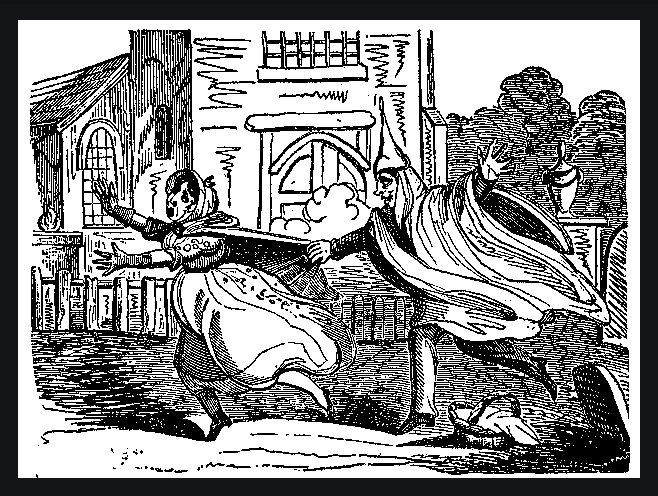
In the year 1803, the Hammersmith district in West London experienced different rumors of ghost sightings. People believed the ghost to be of a person who had recently suicided in the churchyard. To prevent discomfort for the souls who committed suicide, they were not buried in the ground.
There was a picture which people associated with the ghost: It owned a tall height and white attire. The description further expanded where one also had horns and wore eyeglasses. Several witnesses began complaining about the sightings, creating widespread panic.
Not only did they meet with the ghost, but one had tried attacking them as well. In response to the growing chaos, people began equipping themselves with several arms.
The night of January 3rd, 1804, was sad. Francis Smith, an armed citizen, was on patrol when he struck a bricklayer Thomas Millwood, who was on the way to his house.
Unfortunately, Millwood was clad in the clothing required for his profession: a white shirt, apron, and pants. Francis Smith, who was on patrol during the night, mistook Millwood for the haunting Hammersmith Ghost thus shot him. Millwood passed away instantly.
Smith, when presented in front of the jury, was convicted and sentenced to death. Still, the punishment later transformed into a year’s hard labor as Smith was shot under unconventional circumstances.
As far as the Hammersmith “ghost” story was concerned, then the mystery unraveled: An elderly shoemaker used to wear the disguise for pranking his apprentice — not cool, as the cost of such prank was the life of an innocent.
6. Valerian turned an imperial footstool
Emperor Valerian was a Roman ruler from 253 to 260. With power comes the enormous responsibility and risk of life. Valerian took an awful turn when he decided to expand the empire to Persia.
To cater to Persia, he, with an army of 70000 people, marched and fought the Persian king Shapur I in the battle of Edessa. Valerian was miserably defeated thus he tried for the peace talks — little did he know that peace talks were just a trap for seizing him. Valerian was captured and turned into a slave, having to face awful humiliations.
Shahpur did not let go of the opportunity of insulting the existence of Valerian — he was used as a footstool for mounting on the horse. Valerian offered a massive ransom as compensation for his release to escape from the undignified life, and this exchange angered Shahpur even more.
Instead of giving the offer a second thought, Shahpur made Valerian drink molten gold. Valerian died. Shapur’s cruelty didn’t end there as he ordered Valerian’s corpse to be flayed, skin dyed and showcased at a temple.
7. Courage of “John the Blind” dragged him to death
This is an incredibly inspiring story where John of Bohemia fought the battle despite being blind. He had lost his eyesight ten years before his death in a war. This strong warrior was one of the most celebrated ones, as he fought across Europe — from the Mediterranean to the Baltic.
Despite losing his sight, he did not stop. The super warrior turned into the King of Bohemia in 1390 when his father-in-law died without any male heir. Inheriting the kingship through his wife, he took charge of the land until his death.
John of Bohemia had fought many battles across Europe against England, Russia, Austria, and Hungary. During one such war, he lost his eyesight in 1336.
John shared a strong bond with France that when King Philip VI of France asked help against the English army, he didn’t give a second thought. Despite being blind, John met with the French’s monarch, and they together went to chase the England king. Both the armies met in the Battle of Crecy on August 26th, 1346.
John the Blind commanded a significant fraction of the French army. By ordering an army man to tie their horses together so at least he could strike one slash of sword against the English, John surfaced his excitement. He wanted to satisfy his honor of actually participating in the battle.
His plan didn’t go well. Unable to calculate the proximity with the enemy, John invited his death and of his companions. Soon he got cut off by the enemy, and his companions were also slaughtered. Lesson: Bravery to another level.
More from the author:
References used in the article:
https://www.wearethemighty.com/mighty-history/viking-sigurd-mighty-killed-skull/
https://www.military-history.org/feature/royal-deaths-john-the-blind.htm
https://news.westernu.ca/2016/11/sad-stories-deaths-kings-revisiting-englands-real-game-thrones/


