
7 Things you Need to Know About Oasis Network (ROSE)
Oasis Network is a layer 1 blockchain that promotes data privacy and user confidentiality. Thanks to its high throughput and secure design, the Oasis Network intends to power scalable solutions on DeFi and data privacy.
In this story, I am going to explain 6 things you better need to know about this project. For more info, you can also check the official documentation of the project here.
#1–Design Goals
Here are 5 design goals of the Oasis Network Blockchain:
- Flexibility: system parameters are easy to modify (e.g. constraints on ParaTime nodes).
- Extensibility: new components can be added easily to the current architecture (e.g. new ParaTimes).
- Scalability: transaction throughput is guaranteed to increase, once the network starts to grow.
- Security: the architecture enforces security policies, mainly through performing computations in private.
- Fault Isolation: problems in one component (e.g security breaches or performance issues) do not affect other components.
#2 — Design Principles
Here are 3 design principles of the Oasis Network Blockchain:
- Modular Architecture: each ParaTime is an isolated module. Furthermore, consensus and smart contract execution layers are separated.
- Simple Consensus Layer: the consensus layer is only responsible for validators committee management operations such as token balance transfers, staking, delegation, etc.
- Independent ParaTimes: each ParaTime is running independently. Therefore, at the ParaTime level, dedicated security, performance, or external requirements can be implemented.
#3 — Architecture
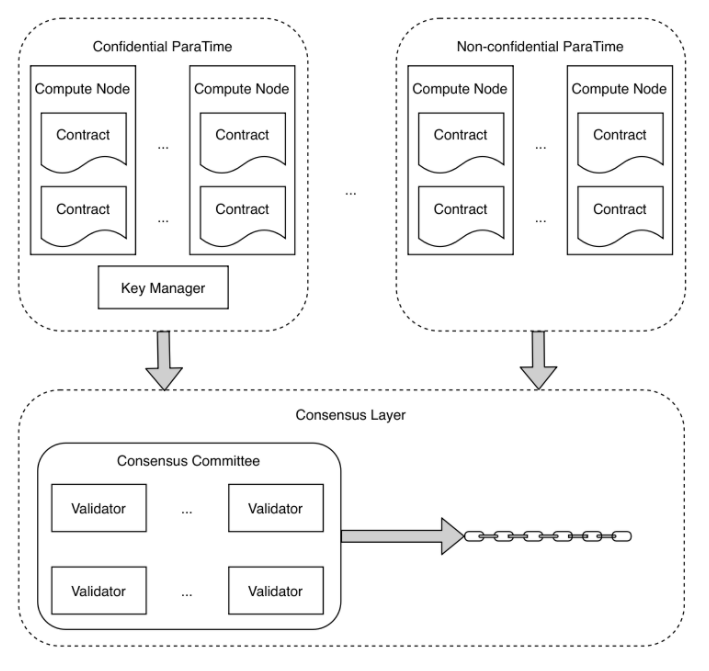
Oasis Network has 2 main layers:
The Consensus Layer is responsible for:
- accepting values from clients (ParaTimes).
- writing transactions (submitted by ParaTimes) into the blockchain.
- validator and ParaTime committee selection.
- handling consensus operations.
- handling native tokens operations (e.g staking).
The consensus layer is a simple BFT / Proof of Stake blockchain, powered by the Tendermint BFT consensus model.
ParaTimes Layer is responsible for:
- defining smart contract execution environment.
- defining semantics for the interfaces it exposes.
- defining mechanisms and parameters for verifying contracts execution.
- implementing confidentiality measurements for smart contracts execution.
There are two types of ParaTimes. In TEE-based ParaTimes, the computations are confidential. Therefore, a “Key Manager” is needed for encrypting states before saving them. In FHE-based ParaTimes, no “Key Manager” is needed because such ParaTimes only operate only on encrypted data.
#4 — Discrepancy Detection
Discrepancy Detection is a mechanism in Oasis Network to enhance security and offload the computation from larger pools of nodes. It has the following main steps:
- A compute committee is selected randomly from the whole population and is assigned computation tasks.
- Committee members perform computations, get results, sign them and pass them to discrepancy detectors (via a gossip protocol).
- If the results received from computation nodes are discrepancy-free, detectors will pass them to validators for consensus. If there is a discrepancy, the results are marked as disputed, the resolution phase will be started, and the corresponding compute nodes will be penalized.
Under this mechanism, committee size will be much smaller than conventional BFT models without sacrificing security.
#5 — Parallel Runtimes
Oasis Network blockchain enables the execution of parallel ParaTimes. Each ParaTime has an interface through which it can communicate with the consensus layer. ParaTimes can also communicate with each other using Inter-Blockchain Communication protocols (IBC).
- Private Computation Runtime: TEE model is used to support efficient execution of confidential smart contracts.
- Non-Confidential Computation Runtime: computations are verifiable. However, there is no encryption in the smart contract state.
- Smart Contract APIs: bindings to smart contracts written in different languages (e.g Rust, Solidity)
#6 — ROSE Token
ROSE is the native token of the Oasis Network Blockchain. It has three main utilities:
- transaction fees
- staking
- delegation at the consensus layer
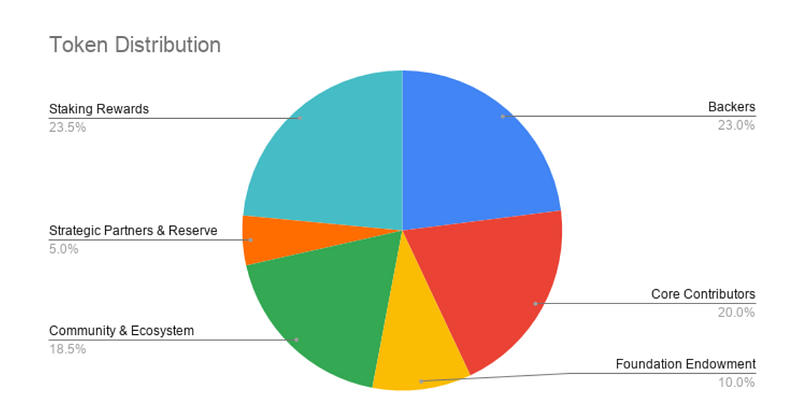
The maximum supply of ROSE token is 10 billion tokens. This supply will be distributed among 6 groups of people over time:
- Approximately, 2.3 billion tokens (23.5%) will be used to pay Staking Rewards over time.
- 23% of tokens were sold directly to Backers, before launching the mainnet in 2018.
- 20% of the tokens were distributed among the Core Contributors of the project.
- 10% of the tokens were allocated to the Oasis Network (Foundation Endowment).
- 18.5% of the tokens were (or will be) distributed by Oasis Network, as developer grants, or community incentives to Community & Ecosystem.
- 5% of the tokens are dedicated for Funding programs and services provided by key Strategic Partners in the Oasis Network.
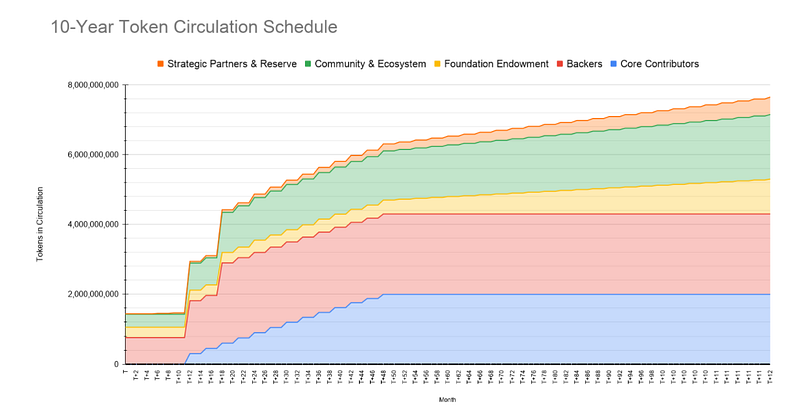
At the time of launching the mainnet, only 1.5 billion tokens out of the max supply of 10 billion tokens went into circulation. According to the Oasis Network roadmap, the remaining tokens will go into circulation over a 10-year schedule (see the following image).
#7 — Staking Mechanisms
Users can run validator nodes on Oasis Network and earn staking rewards. By design (Cosmos Tendermint), the maximum number of validators is 110. The top validators will be elected according to their staking weight, with the minimum 100 tokens defined as a threshold.
The staking rewards will be somewhere between 2%–20%.
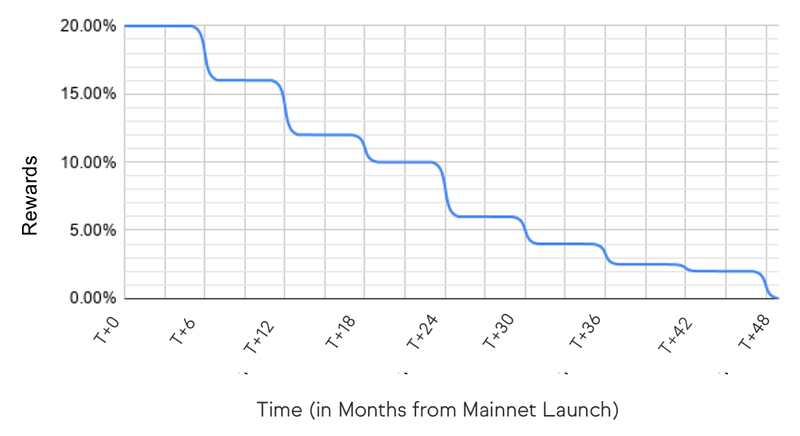
To be eligible to receive rewards, each participating node should at least sign 75% of blocks in each epoch. In case of double-signing, the network will slash the minimum stake amount (100 tokens) and freeze the node. The network also has an approximately 14-day unbonding period. during that interval, staked tokens are at risk of getting slashed for double-signing and do not accrue rewards.
This article is for informational purposes only. It should not be considered Financial or Legal Advice. Not all information will be accurate. Consult a financial professional before making any major financial decisions.
If you enjoyed this content and feeling generous, please consider supporting me by donating to my ETH wallet:
0x1779c21F79D3F1e63960990818B5bF03e89CbfFE
If you are interested in reading my similar posts in the future, please consider joining medium with my referral link. If you sign up using my link, I’ll earn a small commission and you will have unlimited access to the content from all medium writers. That way, you will support me and your other favorite writers on the platform. Thanks.


