
7 Things You Need to Know About Cosmos (ATOM)
Tendermint consensus model, Hubs & Zones, Inter-Blockchain Communication, ATOM token, and more!
Cosmos is one of the leaders of the “Blockchain 3.0” movement. Implementing scalable and sustainable “Interblockchain Communication Protocol” is the main focus of the project.
In this story, I am going to explain 7 things you better need to know about this project. For more info, you can also check the official documentation of the project here.
#1 — Tendermint
Tendermint is a consensus protocol and interface used for managing Cosmos Blockchain and building applications on top of it.
In the Tendermint consensus model, each node has voting power. This voting power is determined at genesis, or programmatically by the blockchain. For example, in PoS applications (e.g. Cosmos Hub), the voting power is determined by the amount of staked tokens.
Nodes with positive voting power are called validators. Validators are in charge of confirming blocks (hence building a chain of blocks). In each round of generating blocks, a validator (proposer) is chosen according to her voting power. She then proposes a block. Finally, the other validators vote to accept this newly created block or move on to the next round.
The Tendermint consensus model has been proven to have a very high throughput (transaction per second). For example, in an experiment conducted by Cosmos, up to 64 nodes were distributed across 7 datacenters on 5 continents. In the following image, you can see the tps vs. blocksize of different configurations.
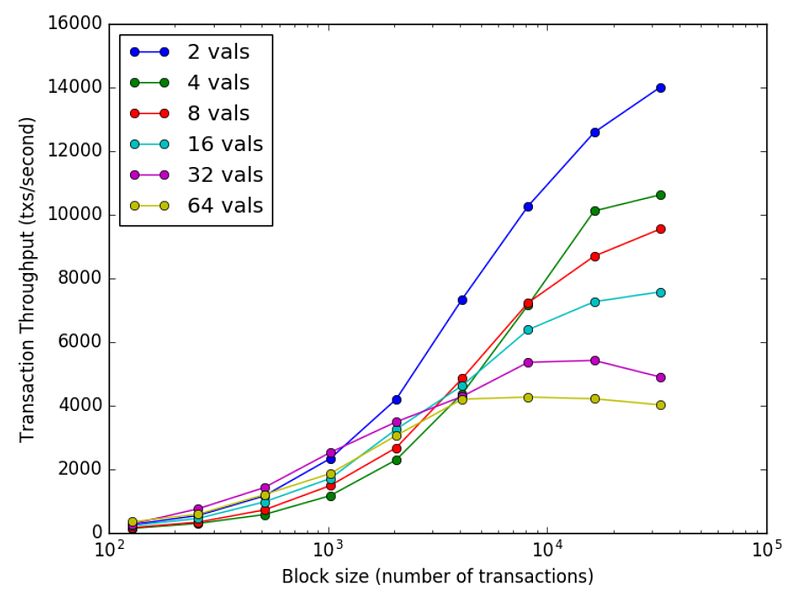
Tendermint consensus can process thousands of transactions per second with minimum commit latencies.
Here are some other cool features of Tendermint:
- It offers “ Light Clients” which makes it suitable for mobile or IoT-based applications.
- It Prevents common attacks thanks to the features such as long-range-nothing-at-stake double spends.
- It is coded in a program called Application Blockchain Interface (ABCI). Using ABCI, blockchain applications can be programmed in ANY language.
#2 — Hubs and Zones
For making blockchain interoperability possible, Cosmos is using two concepts called “hubs” and “zones”.
Hubs are central ledgers of the whole Cosmos system. In simple words, hubs are the bridges between different blockchains (zones). For example, if you want to move tokens from one zone to another, a hub will supervise the whole process. This is done by a special IBC packet called a “coin packet”. The security of the hubs is guaranteed by a globally decentralized set of validators.
Zones are independent blockchains. From the Hub’s perspective, a zone is a multi-asset dynamic-membership multi-signature account that can send and receive tokens using IBC packets. Hubs are not in charge of verifying or executing transactions committed on other zones. It means it is the responsibility of users of each zone to send tokens to zones that they trust.
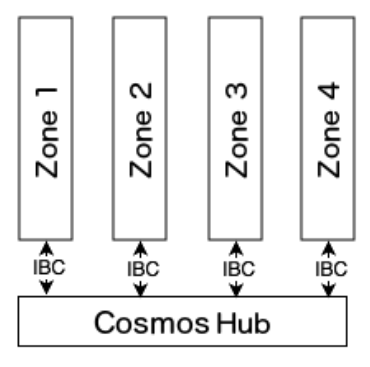
Finally, it is worth mentioning that each zone can become a hub itself. If that happens, we will end up with an acyclic graph.
#3 — Inter-blockchain Communication (IBC)
As mentioned in the last section, Cosmos is not just a single blockchain. It offers blockchain interoperability. In other words, using Hubs, the different blockchain can communicate with each other. In order to make this happen, two types of transactions are used:
- IBCBlockCommitTx: allows a blockchain to prove to any observer of its most recent block-hash.
- IBCPacketTx: allows a blockchain to prove to any observer that the given packet was indeed published by the sender’s application, via a Merkle-proof to the recent block-hash.
In the following image, you can see a simple communication scenario between two zones (Zone 1 and Zone 2) via a Hub.
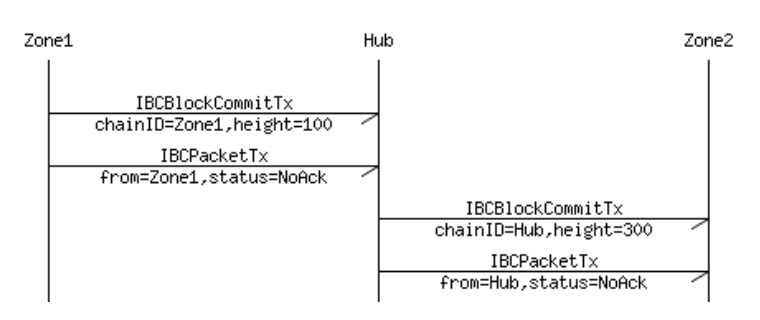
In the above scenario, Zone 1 sends IBCBlockCommit and IBCPacket transactions to the Hub. Once received, the Hub sends its own version of IBCBlockCommit and IBCPacket transactions towards Zone 2.
#4 — Use Cases
Cosmos blockchain offers several use-cases:
- Distributed Exchange (aka the Cosmos DEX): Inter Blockchain Communication model of Cosmos will allow the users to move/swap their tokens between different zones (blockchains).
- Bridging to other Cryptocurrencies: privileged zones can act as the source of a bridged token of other cryptocurrencies.
- Ethereum Scaling: Ethereum contracts can be launched in different zones. Then, thanks to Tendermint’s high throughput, and IBC packet mechanics, higher performance on the Ethereum blockchain can be achieved.
- Multi-Application Integration: Cosmos zones run arbitrary application logic. Therefore, they serve as blockchain-backed versions of enterprise and government systems, and can
- Network Partition Mitigation: in the hubs/zones model, each zone can be run independently. Therefore, the network will be partitioned and voting power will be distributed at the zones level.
- Federated Name Resolution System: Cosmos enables the name registration functionality at the zone level. Each zone can register its domain name (e.g. .com, .org), and start to govern the registration rules internally afterward.
#5 — ATOM Token
ATOM is the native token of the Cosmos blockchain. It has three main use cases:
- It is like a license for holders to vote on proposed changes.
- It is a staking token (through validation or delegation).
- It is used for paying transaction fees.
On Genesis day (Q4 2017), ICO of the ATOM happened and initial tokens were distributed as follows:
- Interchain Foundation(ICF): 10%
- All in Bits, Inc. (AIB): 10%
- Initial Donors: 5%
- Pre-Fundraiser Donors + Fundraiser Donors: 75%
Since genesis day’s fundraiser, the top validators started to validate and secure the Cosmos ledger, and delegators are able to delegate their ATOM tokens to validators. In return, both groups are receiving ATOM tokens as rewards. According to Cosmos:
Initially, 7% of atoms will be inflated every year and distributed back to the bonded and active atom holders (validators and delegators) for their work validating and securing the ledger. This value will adjust over time to incentivize at least 2/3 of the atoms to be bonded.
#6 — Validators
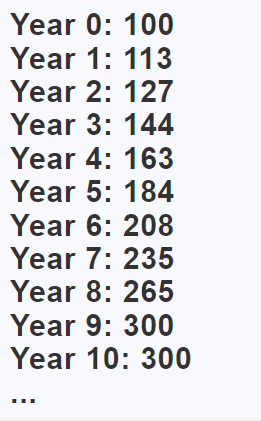
Initially (at genesis day), the Cosmos hub started to run with 100 validators. This number will increase at a rate of 13% per year for 10 years. Therefore, it is estimated that by the year 2030, the network will be secured by 300 validators.
Anyone can become a validator at any time if the size of the current validator set is below the maximum allowed number of validators. Otherwise, the amount of proposed bonded ATOM tokens by the validator should be greater than the ATOMs held by the smallest validator. In the latter case, the smallest validator will be removed from the set, and all ATOM tokens of this validator (and her delegators’ ones) will enter the unbonding state.
Any malicious activity from validators (e.g. double-sign at the same height and round) will cause slashing of validators’ staked ATOM tokens.
#7 — Incentivizing Hackers
There is an interesting feature in the Cosmos Hub to secure the network. According to this policy, anyone can submit a transaction to the network saying that a specific validator has vulnerability issues. The process is as follows:
- The hacker submits a
ReportHackTxtransaction saying: “validator X got hacked. Please send bounty to this address”. - After hack confirmation, the validator and corresponding delegators will become inactive.
HackPunishmentRatio(default 5%) of everyone’s atoms will get slashed.HackRewardRatio(default 5%) of everyone’s atoms will get rewarded to the hacker’s bounty address.- The validator recovers the remaining ATOM tokens by using his backup key.
This is an exceptional feature to ensure that validators do not have any security breaches.
This article is for informational purposes only. It should not be considered Financial or Legal Advice. Not all information will be accurate. Consult a financial professional before making any major financial decisions.
If you enjoyed this content and feeling generous, please consider supporting me by donating to my ETH wallet:
0x1779c21F79D3F1e63960990818B5bF03e89CbfFE
If you are interested in reading my similar posts in the future, please consider joining medium with my referral link. If you sign up using my link, I’ll earn a small commission and you will have unlimited access to the content from all medium writers. That way, you will support me and your other favorite writers on the platform. Thanks.


