
7. Rubik’s Dimensional Cube
Perhaps already widely known, but the word simple comes from the word simplex, a noun that can be used as the opposite of complex. Simplex means one-fold, and when taking a sheet of paper and folding it once, it becomes obvious why we call something like that simple. The word tells us also that some of our ancestors envisioned a piece of paper and folded it once. They realized that this was simple.
Amazingly, the folded sheet of paper has an inside and an outside. And when opened, there is a spatial reality of parts of the paper being close to the viewer and some parts being removed, farther away from the viewer. Some parts of the folder are up and some parts are down. A simple one-folded piece of paper is already three-dimensional.
Equally astonishing is the fact that folding a single sheet of paper comes with the option to choose which of the two sides ends up on the inside and which one on the outside. There are two ways to create an inside with neatly folding a sheet of paper once, and the fold can be made in two different directions.
In this blog structures of the spatial kind are examined. Some people have a knack for dealing with spatial realities, but not everyone is equally good at it.
— — -
Fold a piece of paper twice, and the outside of the paper is basically one half of one side of a sheet of paper. Three-quarters of the sheet ends up being folded inside. One half of one side becomes visible when we open up the paper once, and the remaining two halves of one side, basically the back side of the sheet, becomes visible when we open the remaining fold.
How awkward our words when an entire story needs to be told about something as simple as opening up a piece of paper that was folded twice. Imagine the length of the story, when describing opening up a piece of paper that was folded four times. No use for going into that here, because things can get complex rather quickly that way.
What can be expressed in a simple manner is that unfolding a piece of paper constitutes a development. The word development sounds like we are building upon previous experiences. Yet the word hints at our taking away layers, rather than adding layers. Developing is the opposite of enveloping. We therefore say that a story unfolds, and not how it gets folded more.
— — -
In a previous blog, the tetrahedron pyramid was discussed as an incorrect construction. It is not that it cannot be created, but one of the three positions portrayed at the bottom of the tetrahedron contains a double feature melded into one.
A good example is found with man, woman and child with ‘human being’ appointed in top. Where two of the bottom positions are expressed with gender in mind, the third is presented in a neutral manner. It is as if a sheet of paper got folded neatly once, but the second fold involved only a section of the sheet and not the whole sheet. To have each of the parts be an entity of the same order, boy and girl should be expressed as two separate entities, collectively replacing the singular child, thus creating a regular pyramid.
There is no system in which three diverse entities of an equal kind exist. There can be two entities of the same order: parent and child, for instance, or male and female. As discussed, there can be four entities of the same order as well. Yet the only correct way to have three diverse entities of the same order occurs when adding a negative: man, woman, no children. The third position is understood as a negating equal and this occurs therefore at the abstract level only.
In actuality, there are no three diverse entities of the same order, and organizations managed-by-three are known to be quite the task.
— — -
When looking closely at any aspects mentioned by humans to exist in threes, something peculiar always becomes visible. One can say gas, fluid, and solid, but these are three stages, not three different entities of the same stature. Plus, plasma can get added to the set. Equally, a chair with three legs needs to be recognized as being a single object; it does not come in threes.
Other familiar examples are coach, business and first class, but a fourth category could have been added just as easily. Next to the three primary colors, there is also black and white. Meanwhile with past, present and future, only one of them is really present.
Three dimensions are said to deliver our spatial reality. Yet by using Rubik’s Cube it can be shown that there is something peculiar going on here, too. Just like we count to ten because of our ten fingers, humans have declared the dimensions to be three-fold because of who we are.
— — -
Though other spatial objects can be proposed, the cube is universally seen as the visual expression of spatial dimensions. Six equal fields form the outside of a cube, and each specific field can be declared to be left, right, up, down, front, or back. Let’s take a closer look at a Rubik’s Cube to see if there are other ways to declare the spatial dimensions.
When placed on a table, a Rubik’s Cube has three layers of small boxes that can get turned sideways around a center. Each layer contains nine of these small boxes, except for the box in the center that contains the turning mechanism, hidden out of sight. With 26 exterior boxes in total, the dimensional options can get explored better than with a simple cube.
First off, each of the six directions of our three-dimensional world can be declared to be a side of the cube, with a total of nine boxes per field. Because many of these boxes have more than one side, let’s simplify this and appoint just the center box per field to represent the same six directions of left, right, up, down, front and back. So far, everything fits the familiar three-dimensional explanation.
— — -
Rubik’s Cube has eight corner boxes. The corner boxes distinguish themselves from the other boxes by having three sides, with each of the three sides a differently colored sticker on it. It should be effortless to imagine an internal line from one corner to its opposite. With all four top corners internally aligned to the four bottom corners, straight through the center, a system with four spatial dimensions is declared. In the image below, each of the four dimensions has half a red and half a green section.
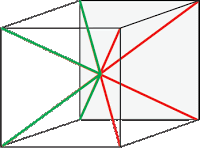
Notice how there are no good words to easily describe each of these relative directions: up-front-right, up-front-left, down-front-right, down-front-left, up-back-right…. you get the drift. The Western human brain hasn’t worked much with the spatial four-dimensional system, and so we never invented easy words for them.
In human culture some folks do work with eight points, for instance, in Buddhism and Hinduism. Mandalas are sometimes portrayed with eight aspects.
Still, it is difficult to envision four spatial dimensions in our day-to-day lives. Hold a picture of the entire earth in your mind, and place a cube around it. The eight points of the cube are now all sticking out equally, away from the globe in the middle. This way, it should be easier to envision the system with the four dimensions; perhaps this helps with realizing that in our day-to-day lives we live on the surface of that planet, feet safely on the ground, but warping our overall spatial understanding nevertheless.
— — -
Let’s review the pyramid once more to further investigate our spatial understanding. We can say that there are four horizontal directions to a pyramid: left, right, front and back. To complete the set, the top can be declared as up. One direction has seemingly gone missing from the six pack: down. Naturally, the four directions at the bottom of the pyramid can collectively be seen as the expression of down. Yet this works only if one climbs the entire pyramid until the four corners become visible. That way the pyramid does not block the view itself of one or two of its corners.
The big picture with all five pointy directions is available while looking down from one lofty position only: the top of the pyramid. As mentioned, etymological claims are made that the word pyramid translates into: one (1) that comes forth from height.
The pyramid is an excellent example of three dimensions. If so desired, one can see four dimensions in the pyramid as well. The sloping edges of a pyramid, going up from bottom to top, come in four, not three. In the image repeated below, the edges of two pyramids are shown as red and green.
Following this setup, the entire cube can be envisioned as having six pyramids tightly packed inside, all of them having four sloping edges. As mentioned, two are highlighted in green and red. The remaining four pyramids inside the cube all have two red and two green sloping edges. From the corners, the edges all point towards the center of the cube. Instead of having the three dimensions point outwardly, we can state that their collective directions point inwardly, and that the eight corners declare space to be four dimensional, pointing outwardly.
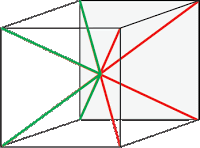
Instead of declaring this a 4D system, let’s name the dimensions viewed this way the Pyramid Dimensions, so the distinction is immediately clear.
Before investigating another option to create a different dimensional perspective, let’s point out that the pyramid is the tool for the Structure of Everything. One needs to be able to move away from 3D thinking and recognize that the Structure of Everything exists at the pyramid-dimensional level.
Just like the tetrahedron pyramid contains an innocent flaw, 3D contains a flaw of melding two aspects into one. Let’s keep this simple and state that the 3D system does not declare the directions of two people standing on our planet on opposite sites, for instance, one person in Korea and one in Argentina. Their heads point in opposite directions. This information is not delivered in the 3D system. The six pyramids in the cube do deliver this.
— — -
Three dimensions are simply perfect for any daily circumstance. Yet like with a magician’s trick, not everything is visible. Still, we do not need to learn the Pyramid Dimensions by heart either. They only need to be understood to understand the big picture. So, let’s move away from both systems now and look at yet another dimensional option.
The simplest structure for another dimensional system would be the dual structure. Yet, as seen with the binary system, this is not the easiest system to use. In the binary system, there are two components: 1s and 00s, but it gets complicated quickly, because there is more than one 1 involved. The 1 that is ‘the one’ is not that obvious in the binary system, and from a systematic approach it is more correct to distinguish many 1s, rather than just the one.
Believe it: it is possible to create a system that has two dimensions only. The simplest form of anything spatial is a field. For example, a drawing on a piece of paper can be seen as the simplest spatial visualization available to us. But let’s discuss first why the dual format is the simplest format.
— — -
A system with two dimensions is the simplest because, when trying to imagine just a single direction, the only place available to draw this one dimension is in our minds, not in our reality; there is simply nothing in real life that is one-dimensional. Remember Einstein who said we need to declare our reality the simplest way possible, but not any simpler. The single fold of simplex is a first requirement; it should not be any simpler.
Review, for instance, a single dot on a piece of paper. The dot is already two-dimensional, width and length. If you wish, one can state that even a dot or a drawing must have a minute amount of thickness, and is therefore always three-dimensional.
Our mind can accept spatial realities that in reality do not occur. This is highly beneficial. For instance, we can imagine the five directions of a pyramid without needing to climb the solid structure. In our minds, we can look straight through the solid building blocks as if we were born with super powers. In our minds, we can look around corners. But we need to recognize the powers of the mind when they blind us, accepting something for real that isn’t.
— — -
Back to the binary-dimensional structure. After folding a piece of paper once and thus having two spatial fields in our hands, we can open this up like a folder or book. Hold it sideways and a ‘V’ becomes visible that has depth to it, just like a folder or book. The one-folded piece of paper, the ‘V’ has depth.
Instead of a ‘V’ imagine an ‘X’ from the same side-way angle, representing two sheets of paper crossing each other midsection. Two fields viewed as one system create together a correct and complete binary-dimensional system.
Note how this ‘X’ appoints all eight corners that were distinguished in the cube. But note especially how there is no indication of anything three-based in this setup. With two fields, four half-sheets are sticking out from the middle of the X, and next we move up immediately to eight pointy corners.
Having a hard time seeing the ‘X’? Then spread out the fingers of both hands, and move your hands together until all fingers are interlocked at the bottom. It’s almost like praying, but then with all fingers spread out, the angles of both hands at 90 degrees. Place your thumb nails on top of each other, positioned close to the center of the X. Keep those fingers spread, while checking out the depth of the two-field configuration.
Important to note (but kind of complex to write down and therefore to follow) is that there are three unique positions to view this binary-dimensional system. The crux in the center of all fingers can be aligned from bottom to top. This occurs, for instance, when placing your interlocking hands on a table, pinkies on the bottom. The crux is then aligned straight up. The other two options occur when first twisting the hands sideways, with the alignment then occurring from left to right and, after twisting it some more, the other alignment from front to back.
This crux-alignment follows the 3D system. How this X works for the four pyramid-dimensional alignments as first presented in this blog is harder to write down because we never invented easy words for each pyramid-dimensional direction. I’ll leave it up to you to check that the ‘X’ can be situated in four distinct alignments just as well.
— — -
Must we see space either as a two- or four-dimensional reality? Nothing is holding us back from seeing it this way nor is there a demand that we must use something different than the three-dimensional format commonly used today. Yet being able to construct a different spatial system shows how there is not just one format and one format only. Just like zero in the binary system delivering the freedom to create other numeral systems, adding a single fold to a single piece of paper, or more than one, allows us to work with different spatial systems. There is no singular standard, except for the sheets of paper getting ready to be folded.
— — -
The natural forces as presented in this blog come in four: electric force, magnetic force, weak nuclear force and strong nuclear force. Collectively they create a gravitational field that, when the amount of matter is right, will point inwardly to a specific direction. Like a pyramid, the four forces will have no other option than to escalate into a single direction.
Is gravity a force all by itself, or is gravity a result that came to be, nothing but the synergy of the other forces? The prevailing scientific idea is that gravity is a force by itself. In this blog, we investigate further whether this must be the case.
— — -
Imagine a cylinder filled with water, containing silver slivers. With a wooden spoon, stir the water so it swirls around, lifting all slivers. Next, let the stirring water die down by itself. What is fascinating is that the slivers will have sunk to the bottom of the cylinder already before the water has fully calmed down. On the bottom, in the center, a heap of silver slivers has collected themselves, despite the water still moving about.
What has happened is that when the movement slowed a bit, the silver slivers continue to move about, including some of them now also getting close to the center of the swirl. At the center, there is no specific movement, just like the eye of the storm is without wind. The slivers getting caught at the center will sink to the bottom. Long before the water has stopped spinning, all slivers will have been collected in that one spot.
Imagine the solar system before the sun started to shine, but after the most turbulent moments had subsided. There is a slowing of speed, because the fine materials of the original state become a drag. The floating matter is now slowly collecting itself at the centers of maelstroms, eddies and what not in the disc of gas and dust of our early solar neighborhood. Most of this matter ends up being collected in the center, our future sun.
The more matter collects in a single spot, the stronger the gravitational field of forces will do its attractive work, particularly on the collected matter. The slowed-down spin of the whirlpool ends up becoming the spin of the collected matter.
— — -
How do collective gravitational fields work? First, it is good to remember that matter does not exist at a spatial standstill. All matter arrived from the Big Bang and therefore has an on-going speed, even when we may not immediately realize this is truly happening. The solar system today is still speeding away from Area X, the spot in the Big Bang/Big Whisper where our solar-system matter originated. This is a separate spatial movement next to the one of earth’s spin, the earth circling the sun, and the solar system coming along in the Milky Way’s large circling movement.
Let’s use the four-dimensional spatial setup, and place one cube around the earth and one around the moon. If these two bodies were simply floating away from Area X in a collective straight line (which they are not), then the two cubes would be ‘touching’ each other in the same spot all the time (which they are not).
In this setup, the matter of both bodies would have a combined center that is then like the center of stirred water in a cylinder, or the eye of a hurricane, an area of relative stillness. Sooner rather than later, both bodies would end up at this location, becoming one.
Since it may be difficult to comprehend this image, let’s use as example two boats floating on a lake on a still day. The two boats are both moving in the same direction and with the same speed; the lake is tremendously large. The boats are found in each others vicinity, otherwise the desired outcome would not occur.
Both boats have a length to them, and the wakes in the water will start up from the front of the boats. The wakes occurring between both boats experience some reinforcement and cancellation of their magnitudes. This altering of the movements creates a directional tendency for both boats to float towards one another until they touch; there is no reinforcement or cancellation occurring for the wakes on the outsides of both boats. That’s why their initial vicinity is important, because the wakes’ influential effects are noticeable only in close proximity.
The spatial reality of our speeding away from origin Area X can be seen as the lake in the example above. Since the condition is not met that no other movements disturb the outcome for earth and moon, these bodies will fortunately not collide and become one. Yet the gravitational eye of forces that exists between both in the collective movement away from Area X is enough to command the tides.
Currently, the term space-time is used to express the outcomes we see. A better (but not nicely sounding) term would be Collective Passage Framework. It indicates the passing of (plural) masses through space over time, but the reason for the outcomes are with the action of the boats; the water is the passive component. The forces that are associated with masses in space (when in close proximity) create the effects.
— — -
People fight over space, not because of the character of space, but because of the character of matter. No matter exists where other matter exists already (and leaving both entities of matter internally intact). An altered state occurs therefore inherently with matter. Not only was matter created first in the altering process of the Big Whisper, but over time other matter will have altered or influenced the specific outcome yet again.
Perspectives can differ, and perspectives can alter outcomes. In politics, to mention a complex setting that contains many perspectives, one can recognize a power struggle over many matters. Yet before addressing any matter, the decision how to decide a subject matter is often made beforehand. The chosen decision structure can influence the outcome.
If there is just one spot (for instance, the single seat of a royal ruler), then the fight for that one spot may be most intense. History has shown us brothers fighting to the death of one of them to establish the successor. The potential for further escalation is inherently present when there is just a single spot: there is either a win or not, and other options are not considered. We can say that bloodshed is the most extreme outcome of the single seat of absolute power.
We also have powers of the inclusive kind, most clearly expressed in the version of representative democracy, such as found in places like Sweden and Spain. Sweden, for instance, has just one house and one house only — no president. Though this collective inherits the same amount of power as held by a single ruler, all seats are now fairly dispensed according to the outcome of all votes. I do not know of any bloodshed associated with this form of proportional democracy, because all voters end up being represented by their actual choice.
— — -
Systems differ in character and nature. Each system has its own outcomes, its own pushes and shoves. Considering all systems, we must come up with something special to capture all systems.
The single Structure of Everything is a bit complex to hold in our heads. It cannot contain a singularity unless it hangs in the air, something visualized well in a pyramid. The material outcomes we find at the bottom are diverse, because all are based on their own specific character and nature.
Matter cannot occupy space twice, and a little dance by the earth, the moon and the sun helps avoid a bloodshed sky; smart — because in reality there is an abundance of space.
— — -
In this blog our three-dimensional reality was hijacked by a pyramid-dimensional experience that in turn got hijacked by a binary-dimensional system. It doesn’t really matter how we view space, because space is readily available with no end in sight. Rubik’s Cube makes it simple to entertain even a 13-dimensional system, though using it would be complex.
Matter takes up space and matter can battle other matter for dominance of that space, often resulting in an altered state. Our universe contains a diverse amount of structures. With plasma, matter can be declared a different state next to solid, fluid and gas. And so the story unfolds further about our exciting and fundamentally diverse universe.
In the next blog, there is some further digging to do structure-wise, subatomic in nature, and we’ll uncover more perspectives about our origin.
— — -
This blog is part of the series The Big Picture — It’s Surprisingly Simple. Introduction:
- Bicycles and the Big Bang
- As Above, Not So Below
- Cyclopes and Pyramids
- God Almighty and the Big Bang
- Gravity and the Secret Inside the Pyramid
- Black Holes or Black Eyes?
8. Origin
— — -
Delivery based on The Proof of Nothing, published by Penta Publishing (2000) and In Search of a Cyclops (2003), internet publication.
— — -