
7 Powerful Habits to Make Better Use of Time
‘Change your 24 hours and you will change your life’ Eric Thomas
‘Change your 24 hours and you will change your life’ Eric Thomas
Time management is life management.
I wasn’t up at midnight this New Year’s Eve, wandering around with a bottle in hand, waiting for fireworks because I know what misspent time feels like. I’m sure you do too. Deadtime: like a hangover, when you know you can’t get much good done, and you just exist. Divided time: when you don’t have a focus and different thoughts drift about free-range in your head, usually finding ways to argue with each other. Without handling time well, we can lose the sense of control and meaning, and with it our self-esteem and confidence dip. Instead of being the policeman directing traffic at a major junction, your mind becomes another drunk/lost kid hanging out the passenger side of his best friend’s ride…
You get to choose the life you live — first you think: what are your goals, your values, your beliefs; then you create and they become your reality.
We are Conjurors.
But we’re not fools. We’re all so used to such a barrage of promises and claims and advertising slogans that we don’t believe our own thought campaigns easily — not unless we live them. Our thoughts become things only when we manage time and make every 24 hours the building sites of our values.
Habit 1: The Morning Hours
Getting up early to make an uninterrupted start on your purpose is what gives you purpose. For me, it’s writing. Maybe for you it’s writing too, or making a business, or managing a team, or raising a family, or working for a cause — whatever it is, it’s only really you and not just a fantasy, if you are there every day, before everything else, to work on it. To chip away at it every morning while the world sleeps.
‘Work harder on yourself than you do on your job.’ Jim Rohm
Prove to yourself that you are working on yourself by being up and giving your best hours to what you want. Don’t just wake up and slip into the action of your life, direct it.
Your goals may sometimes seem difficult to reach but what’s not difficult is to be there in the morning, most mornings, and work on them. Respect the process more than the product. Time more than money. You don’t need to write anything mind-blowing or even good today, you just need to be there writing for an hour and you’ve contributed an investment to who you are and what you value.
Believe that the results will come (money/success) but that even if they don’t come in that form, you are creating your happiness.
‘What’s important is not what you get, but what you become… you attract success by the person you become.’ Jim Rohm
Your morning habit starts the day off. Find your purpose, work on it in the morning and you’ll reap the rewards:
1. You’ll have purpose and meaning to your life
2. You’ll accumulate results and success
3. You won’t be interrupted — you’ll get time to focus and flow
4. It feeds the rest of your day — after one focused and meaningful hour you’ll be more effective in your next tasks
5. Better to be up early and preparing for the day’s success than to bed late, where less productive habits are easier to slip into.
Habit 2: Time Chunks
The morning writing hour is the first time chunk of the day. It’s the one you can control most easily. It sets me up with the mindset that I get to choose what I do with my life and most importantly, that I get to choose what I think. How to respond.
Chunking time is crucial for mindset. In the first hour, I’ll write and only focus on writing. Later, when I set aside half an hour for planning a project at work, I’ll do that and just that. Later, when I do exercise for half an hour, that’s what I’ll do and what I’ll think about. Later, when I read stories to my son, I’ll do that with full presence of mind.
The divided mind is your enemy. To be walking around at work feeling hassled about some project but thinking about how to improve an article you wrote, or worrying about your son’s behavior, or thinking about going on holiday — that mindset gets nowhere and is the essence of stress.
The beauty of time chunks, and living by them, is that you are focused on one thing at a time. Decide what is important to you and which time chunks you need and there is no cause for stress or anxiety in your life. That public speech you have to give next week could stress you out if you thought about it passively — but you’re putting an hour a day into it for the next week and that is enough time to do your best, so you’ll only think about it during that productive focused hour. The fact that your writing is not getting a lot of money is a cause for concern if you think passively about ‘writing’ — but let that thought just be a tiny fraction of your writing hour and see what can reasonably be done about it. Strategies instead of stress. Pigeon steps rather than an intimidating big dream or big anxiety.
Each time chunk is like a river running through your mind, full of life and energy — you don’t want to pollute the river with waste products from other jobs and worries. Chunk time and tell your thoughts that the right time to think about anything important will come but in time chunk X you only think about X.
Habit 3: Transition and Energy Boost
Tim Denning says that transitions drain energy so he likes to do the same thing all day — write or edit or research. For a lot of us, with many demands on our time, transitions are things we need to manage. The biggest transition in my day comes when I get home from work and have the evening before me with my family. this is a time when it could be easy to flop onto the sofa and watch TV or slip into bad habits — you’re not in public anymore after all. Like the morning, then, this is the time you can show yourself that you work harder on yourself than your job. I do this exercise with my son (* years old) every day when we get back. We do a 30-minute High-Intensity-Training routine with short bursts of intense effortful exercise. 35 seconds exercise: 25 seconds rest, with a 2-minute break in between the first half (10 exercises) and the second (10 exercises).
We listen to YouTube music videos (we like Disney songs most days) — listening to Let it Go is a good reminder that whatever happened in the work-day is done now and it’s time to refocus. He’s always happy and smiling through it and it’s a nice bonding thing as well as getting us both energized to do work and practice things in the evening. It gets us focused on time again after the time-drifting that tends to happen in the afternoon at work/school — 35 seconds can seem surprisingly long when you’re doing lunge jumps.
Habit 4: Weekly Planning
To stay within your time chunks you need to believe that there is an overall plan that is adaptable to change and that will work. Like a soldier on the field of battle, you need to have faith in your leaders. You need to think there is a plan which will work and you are just part of it –
‘Yours not to reason why,
Yours but to do or die’ Lord Alfred Tennyson
To have a plan you need to make a plan. You’ll need a chunk of time to make one every week. Every Sunday afternoon, I take myself off from my family for an hour or so and make my weekly plan. Stephen Covey makes the case for everyone having their Weekly Planning Session in the 7 Habits of Highly Effective People. Each week, he suggests that we think about our priorities for the week, what events/deadlines make this week different from others, what routines are going well, and what changes in routines would be beneficial?
Every morning, after writing, when I get to work, I look at the weekly plan for a few minutes: I think about my priorities for the day and sometimes make a bullet point list of things to try and get done. This keeps me purposeful at work amongst the energy of other people and the range of demands and tasks that come up. I know what I want to do, and I’ll balance that against what comes up.
The point with these plans is that having one is important — the process is more important than the product. You want to get these drawn-out quickly and roughly — perfect is the enemy of good. You get to do this every week so you can always make changes, improvements, backtrack on wrong paths chosen — but do it in your planning hour and then follow the new plan. Trial and error. Fail forwards. Like everything, you’ll get better at it.
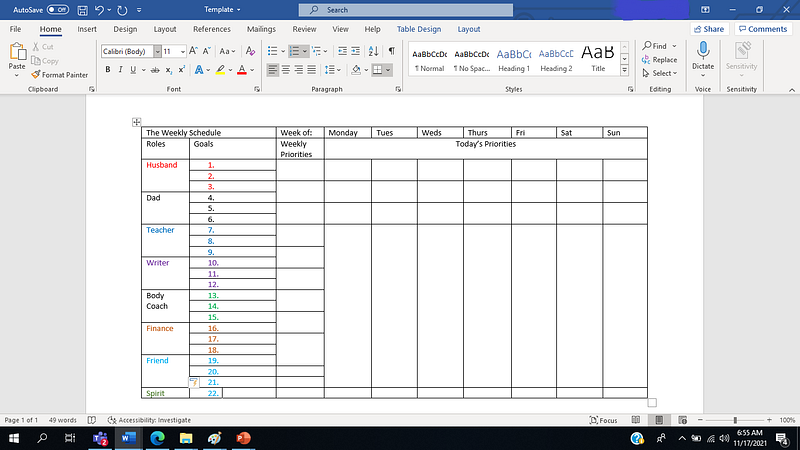
To make a Weekly Plan, you’ll need to know what you’re about: what are your values or aims? Weekly planning became possible for me when I decided on the 8 things in life that were important to me. With these decided, I can plan how to make progress on each one each week, then dividing up time becomes straightforward. I set myself 3 targets/priorities for each role every week to try and make sure I’m edging myself forward and being attentive about all these areas in my life.
So my weekly planning template looks like this:
Habit 5: The 5 Year Rule
“The two most powerful warriors are patience and time.” Leo Tolstoy
All of this depends on working to a long time frame. Trying to write great articles, or build a business, or lose weight in a month is stressful: Trying to do it in five years is relaxing — you have plenty of time. you don’t need fast results. You can focus on process not product. To see that big stretch of time before you lets you know that you need to be in good shape in every way — relaxed, healthy, committed, skillful — you need to gradually and calmly go about getting better and better. 5 years is a good stretch — whatever your purpose is, you can make enormous strides in five years. I never try to plan the five years themselves because I trust that in two years I’m going to be so far ahead of where I am now that my plans would be redundant. Trust to time and consistency.
Valuing the process and not the product is easier when the time frame is long — you let yourself off the anxiety of expecting immediate results. I’ve been writing on this platform for a while, for example, and it’s easy to get impatient with the statistics and revenue until I consider that it’s only been 6 months, out of five years — maybe in another 6 months or a year I can think about that again and review.
We want to achieve mastery of what we do. We want to make something really good. If success comes before you’re really good at what you do that’s going to cause you problems too. Five years is time enough to realty practice, reflect, and develop something strong.
Habit 6: Relaxation Time
Success is your happiness and you want to feel it everyday. Treat yourself with time every day. Give yourself some time, probably in the evening, to relax. Watch something good on TV/a movie with your friends/family. Listen to music. Do stuff that isn’t productive just to let yourself know that you’ve had a good day and you deserve to relax and enjoy some of your time. Feeling like the cat that got the cream for an hour each night will stop you burning out and will help you wake up the next morning keen to get going again.
You can schedule regulator activities to make sure you stay relaxed and get the rewards of life today rather than permanently suspending it for some great golden day down the line.
Habit 7: Sleep Routine
This has been covered by a lot of people and it is pretty obvious but super important: you need 8 hours+ sleep every night. You should be winding down your day in that last hour before sleep, relaxing, dimming lights, reading — sleep powers the whole system, you need a full recharge! For more details of why sleep is so important and how to get it, take a look here.
Final Thoughts
“It is not that we have a short time to live, but that we waste a lot of it. Life is long enough, and a sufficiently generous amount has been given to us for the highest achievements if it were all well invested,” Seneca.
‘Life is long if you know how to use it,’ Seneca says.
Too often, though, especially in youth, we squander it. We treat it as if it will never run out and don’t value the use we could be making out of each hour. We can seize those hours and make them work for us. We can run our days instead of being run by them. Knowing what we want and value we can find time every day to make small improvements and though we will still pass through the seasons on life — the dying darkness of winter, the limitless potential of spring, the fading beauty of autumn, and the glorious successes of summer — throughout them all we can be building, accumulating, improving and giving ourselves meaning and our shot at success.
By planning how we use our limited time we can become a person who attracts success. As we grow used to using time, we can take away some of the scaffolding of plans and schedules and learn to live in the moment, relaxed, flexible, and open to the world around us, confident that we use our time wisely to build the things we love.


