
7 Highlights From the Presidential Eulogies at the John Lewis Funeral
Former Presidents Clinton, Bush, and Obama eulogized the deceased Congressman and civil rights activist.
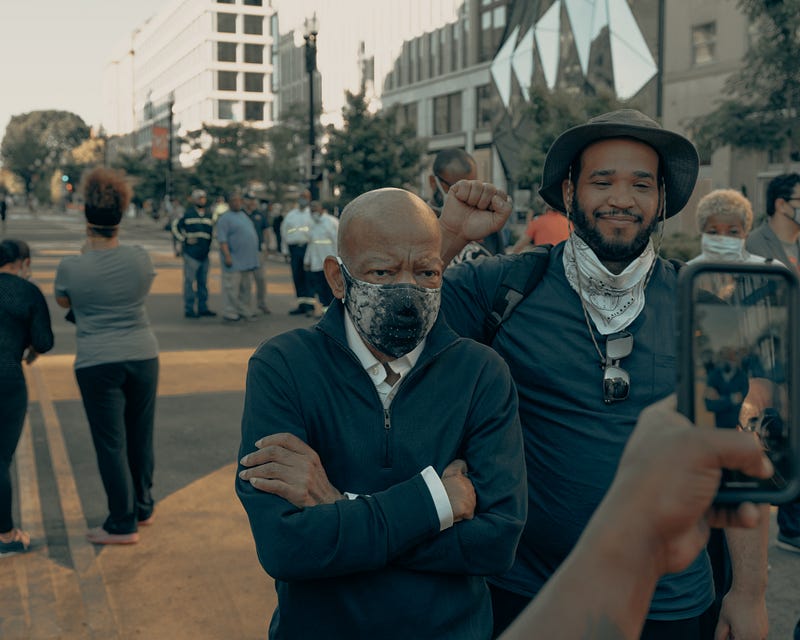
Yesterday, former Presidents Clinton, Bush, and Obama eulogized John Lewis during his funeral, held at the Ebenezer Baptist Church in Atlanta, Georgia. From the same pulpit that once featured a young reverend named Martin Luther King Jr., they remembered John Lewis.
Below are seven highlights from their speeches. You can watch the funeral service here. And you can read an op-ed John Lewis wrote that he instructed the New York Times to publish on the day of his funeral.
President Clinton:
“I think it’s important that all of us who loved him remember that he was, after all, a human being, a man like all other humans, born with strengths, that he made the most of when many don’t, born with weaknesses that he worked hard to beat down when can’t, but still a person.”
No human being is perfect — we are all fallible. John Lewis had a strong sense of self-awareness; he knew that he had a unique ability to stand up for what’s right, and rather than shy away from that challenge, he embraced it wholeheartedly until his dying breath.
President Bush:
“John Lewis always looked outward, not inward. He always thought of others. He always believed in preaching the gospel, in word and in deed, insisting that hate and fear had to be answered with love and hope.”
John Lewis valiantly fought for his neighbors and his country. He risked his life multiple times and literally sacrificed blood, sweat, and tears in the pursuit of love and hope. He turned his strong inner sense of purpose and meaning outward to help those who sought love and hope.
“Listen, John and I had our disagreements, of course, but in the America John Lewis fought for, and the America I believe in, differences of opinion are inevitable elements and evidence of democracy in action.”
You don’t have to agree with everything that the ‘opposition’ says. As President Bush said, productive disagreements fuel democracy. We’ve collectively eroded our ability to see beyond our differences and seek agreement, both at the governmental level and in our civic culture.
Membership in a political party should be just that; it should not prevent civil discourse and hard-fought compromise that ultimately serves the best interests of the American people. There’s a reason the Constitution makes no mention of political parties and why George Washington warned against political factions in his farewell address.
President Obama:
“And that same year (1961), just weeks after the Supreme Court ruled that segregation of interstate bus facilities was unconstitutional, John and Bernard Lafayette bought two tickets, climbed aboard a Greyhound, sat up front and refused to move…Imagine the courage of two people Malia’s age, younger than my oldest daughter, on their own to challenge an entire infrastructure of oppression.”
Obama noted that it’s often easy to reflect on such episodes in highlight and view the eventual outcome as inevitable. That couldn’t be further from the truth, particularly when you consider the circumstances of John Lewis’s activism. In this excerpt, he’s referring to the initial Freedom Rides of 1961, when Lewis and his fellow activists tried to integrate buses.
Predictably, however, the young black men faced brutal beatings from a mob of white people — including members of the KKK — who carried all sorts of makeshift weapons. When they were attacked at Montgomery in May 1961, Lewis was beaten to the point of unconsciousness, while Lafayette and other activists escaped death by jumping over a wall and fleeing the scene.
They knew what was on the line. Their courage and sacrifice propelled the civil rights movement, and today we see the spirit of their actions renewed in the form of millions of Americans taking to the streets to protest injustice and hatred.
“And yet as exceptional as John was, here’s the thing. John never believed that what he did was more than any citizen of this country can do. I mention in the statement that day John passed, the thing about John was how gentle and humble he was. And despite this storied, remarkable career, he treated everyone with kindness and respect because it was innate to him, this idea that any of us can do what he did, if we’re willing to persevere. He believed that in all of us there exists the capacity for great courage. That in all of us, there’s a longing to do what’s right.”
This quote echoes back to the quote from above by President Clinton. John Lewis didn’t see himself as extraordinary; he saw everyone as equal and believed that we all want the things that he spent a lifetime fighting for. The difference between John Lewis and almost everyone else was that he bravely and consistently acted upon that longing to do what’s right.
“He knew that every single one of us has a God-given power and that the faith of this democracy depends on how we use it. That democracy isn’t automatic. It has to be nurtured. Has to be tended to. We have to work at it. It’s hard. And so he knew that it depends on whether we summon a measure, just a measure of John’s moral courage to question what’s right and what’s wrong. And call things as they are.”
As Americans, we often take for granted that we live in a thriving, stable democracy. President Obama has repeatedly urged us not to forget the struggle and sacrifice required to maintain a democracy like ours. Democracy has to be nurtured and tended to, like a plant or a baby. It does not grow and prosper automatically.
John Lewis exemplified that struggle, and a great way to honor him would be to safeguard our democracy and keep it alive and well. As we face threats to our democracy and our civil society, this message has never felt more important.
“That’s where real courage comes from. Not from turning on each other, but by turning towards one another. Not by sowing hatred and division, but by spreading love and truth. Not by avoiding our responsibilities to create a better America and a better world, but by embracing those responsibilities with joy and perseverance, and discovering that in our beloved community, we do not walk alone.”
Many people say the country feels more separated and divided than it’s felt in a while. We see distressing headlines every day highlighting those divisions. But in the face of struggle, there’s an alternative path: to leverage those differences for good, to embrace the responsibility of creating a better world, to stand united rather than apart.
As I wrote last week, John was arguably the greatest living American; he is inarguably one of the most powerful lions to have ever walked the Earth. He was a man full of pride, principle, and purpose; a man full of courage, commitment, and conviction; and thus a man worthy of respect, admiration, and eternal honor.
Rest in peace, John. We will miss you dearly.


