
I Met John Lewis. We And The Planet Will Miss Him Dearly.
Being in the presence of such towering greatness is a memory I’ll forever cherish.
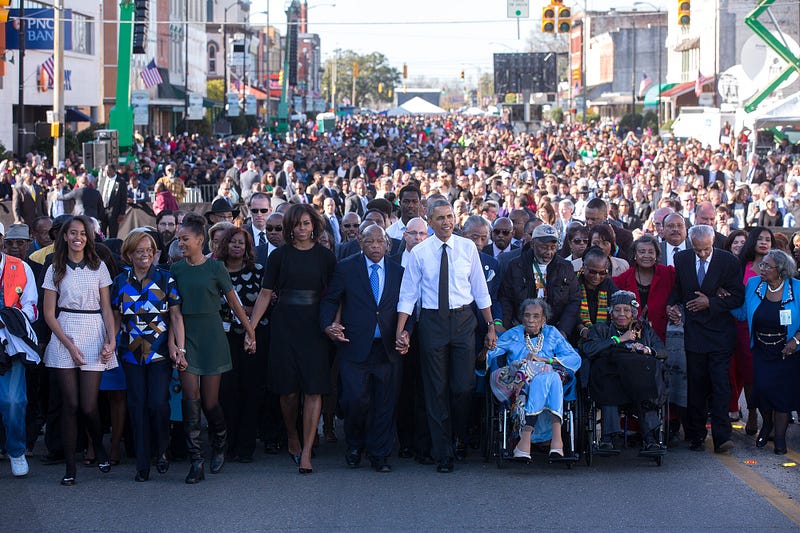
Three years ago, my family and I were in Washington D.C. enjoying the sights, sounds, and stifling summer humidity of our nation’s capital.
We were walking around a neighborhood near the U.S. Capitol when we saw a small scrum of people nearby. It quickly became clear a VIP was in our midst: none other than civil rights icon John Lewis.
John gracefully gave us a bit of his time. My brother explained that he was about to start a summer congressional internship with one of John Lewis’s colleagues. We all expressed our profound respect and admiration for him. John wished my brother the best of luck, thanked us for our encouraging words, and went on his way.
As usual, he had some good trouble to get to. He was unsurprisingly down to earth with us, but as a human being, he was above just about everyone else.
I’ll Never Meet Another John Lewis
I had forgotten that I met John Lewis until recently, when I lamented his passing with my family. I’m ashamed of that — an encounter with such a giant should have left a much firmer imprint. I can’t recall ever meeting a human being as brave, passionate, and impactful as him. Being in the presence of such towering greatness is a memory I’ll forever cherish.
John was arguably the greatest living American; he is inarguably one of the most powerful lions to have ever walked the Earth. He was a man full of pride, principle, and purpose; a man full of courage, commitment, and conviction; and thus a man worthy of respect, admiration, and eternal honor.
They say you should never meet your heroes. I fervently disagree. I’m glad I met one of history’s greatest heroes, a man so singularly and firmly devoted to justice and peace that he risked his life, his comfort, and his health. Repeatedly.
Upon his death last week, I found yet another reason to admire John Lewis: he spent decades fighting for the planet.
John Lewis Fought for the Planet
I’m also embarrassed to admit that until his passing, John’s record of environmental legislating evaded me. I regrettably did not know that he made lots of good trouble regarding environmental justice. The last living speaker from the 1963 March on Washington spent decades advocating for a cleaner, healthier world.
In 1992, he worked with then-Senator Al Gore (who now leads the Climate Reality Project) on the Environmental Justice Act, which sought to “prohibit the construction of new hazardous waste facilities and targeted the 100 worst environmentally sensitive areas in the country.”
Unfortunately, the bill didn’t go anywhere, but he continued to propose environmental legislation over the following 28 years he spent in Congress. Last year, he introduced H.R. 5167, the “Creating Opportunities in Research for Environmental Justice Act of 2019.” You can review his environmental record here; it’s yet another facet of his titanic legacy.
None of this should be surprising. John was routinely ahead of the political curve — he did things before they were popular or widely accepted. That’s not to diminish those who are currently fighting for environmental justice. Nonetheless, John deserves particular praise for fighting for causes because he believed in them and knew they would help everyday people rather than help his political standing or his reputation.
The man found himself in handcuffs at least 45 times. He made good trouble.
John Lewis Challenged the Fallacy That Growth and Sustainability Are Incompatible
When Donald Trump withdrew the U.S. from the Paris Agreement, John Lewis eloquently summarized his misgivings, saying “I do not agree with the dark vision of America’s future the president described that pits accepting responsibility for our environmental impact against the economic stability and vitality of our country.”
There’s a lot of power in that observation. Economists, financiers, and other observers who share a myopic interest in promoting economic growth at all costs often detract from the environmentalist creed by arguing economic vitality and environmental stability are mutually exclusive.
That could not be further from the truth. A warmer world will cost us dearly, both explicitly and implicitly. In contrast, a sustainable world will benefit us all — economically, morally, equity-wise, and otherwise. It is incumbent upon those of us who care about the planet and the human beings who inhabit it to ensure that John’s words turn into real actions that keep the planet stable.
The burdens of a warmer world of course fall disproportionately on the disadvantaged, oppressed, and marginalized peoples of the world, both here in America and elsewhere. Those who maintain power and wealth have in particular recklessly fouled our air, polluted our water, and littered our earth in their pursuit of economic growth, political partisanship, and intentional oppression.
John spent his life fighting for the underdog. He knew well that the same forces — discrimination, classism, etc — that burdened Black people also burden much of the world.
We Do Not Live on This Planet Alone
I often refer to the following Ernest Hemingway quote: “The Earth is a fine place and worth fighting for.” John Lewis saw the Earth as a fine place but one with imperfections and barriers that prevented far too many of its inhabitants from fully enjoying its bounty. He fought valiantly and unyieldingly for this planet and for the people who inhabit it. For that, he is a titan.
I’ll end with a beautiful quote from the man himself, a critical insight that eloquently speaks to the responsibility we share to protect this planet.
“We do not live on this planet alone. It is not ours to hoard, waste or abuse. It is our responsibility to leave this world a little more clean and a little more peaceful for all who must inhabit it for generations to come.”
I couldn’t have said that better myself. I’d expect nothing less from the fiery kid from Troy, Alabama who became an enduring symbol of courage, hope, and progress. This article doesn’t do the man justice; only real progress would.
Rest in peace, John. We and the planet will miss you dearly.


