
#7 — Artistry and Elemental Magic
What is it that we really value?
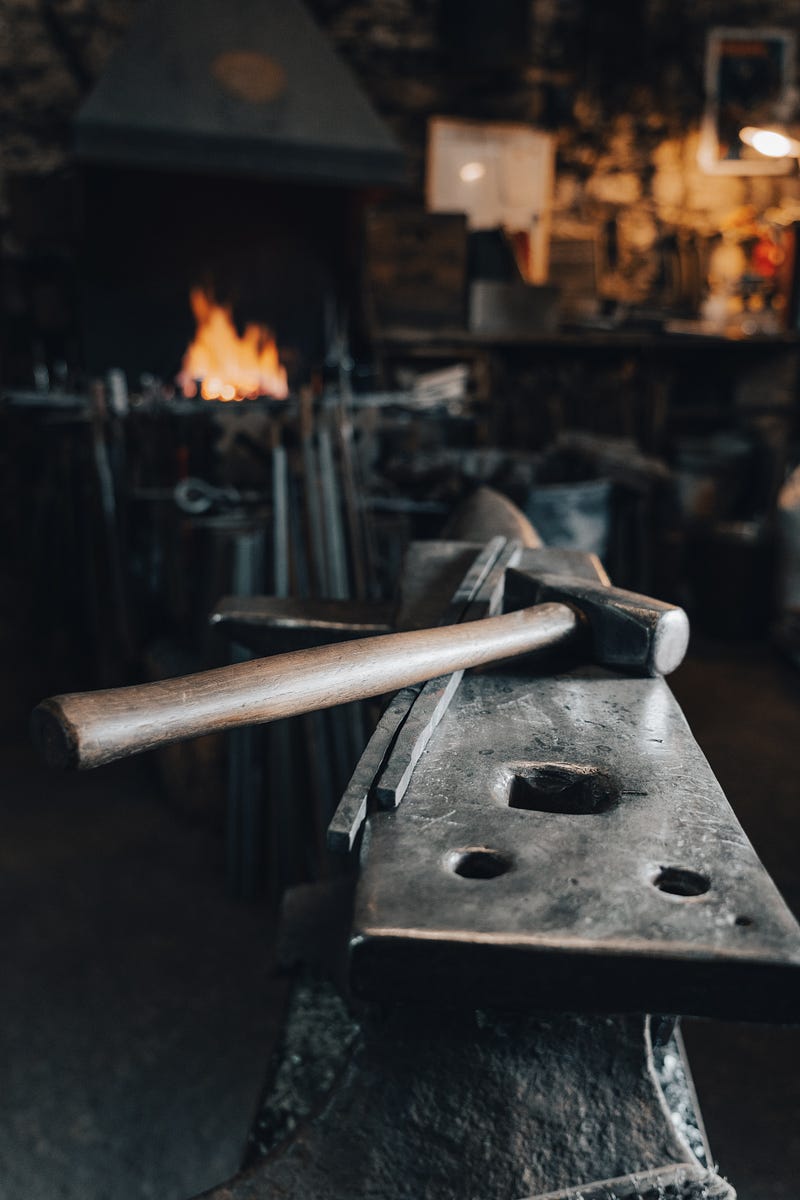
The first strike brings forth a rain of sparks, tiny bolts of light in the deep shadows of the forge.
Each fall of the hammer, carefully placed in a steady rhythm, counts out a ringing song against the anvil. Every time the smith moves to turn the steel he lets the hammer fall against its surface, refusing to let the motion stall even as he adjusts the placement of his work.
And he must go quickly. It has only been seconds, half a minute at most, and the glow of heat is already fading fast. He has only a moment before he must return the ingot to the coals, place his hands upon the old crank bellows to raise the flames again.
The shaping of steel is an elemental thing. A blending of alchemy, magic, and the sweat of hard labor. To take an idea, the notion of a design from the mind’s eye, and transform it into something solid and present and tangible. It’s an old art form, one nearly forgotten.
It is often thought that the use of machines makes life easier. And there is truth in that, in convenience and speed and saving cost. But in giving up the power of creation so easily, one risks losing touch with the process. The sacrifice that comes with giving up time, strength, and energy. The power of imagination.
From times far past, when men did not even know how to dig for iron, they found it in peat bogs. From the glimmering of rainbow ripples, oil slicks on the surface of the ponds, they would sift through silt for pyrites. A thousand years ago their foundries were but small mud brick kilns, fanned by hand, and a small clay crucible full of glass and ground charcoal.
Strengthened by burnt bone, turning weak and crumbling peat iron into rippling crucible steel. Folded slowly upon itself, over and over again. Building from something fragile and brittle into a beautiful river of rippling light. A sword made this way would command a high price. Too high for any but the wealthiest to pay. The man who could make it would be a man worthy of great respect.
Not so anymore. When a sword is a display item. When crafting it is as simple as pouring metal into a form, casting it and polishing it. No artistry involved. Though…the knowledge is starting to come back.
People like the smith are taking the time to learn. How long ought the blade be? What is the purpose of a fuller? How does one measure a tang, or balance the hilt? They’re learning that the best blades are not all one steel, but a blend of two. With a softer core for bending, and a harder exterior to keep a better edge.
And not just swords, but all things of iron. The world is coming back around, coming to appreciate the artisan’s work again. A hand-forged signpost, or a railing. Decorative hooks for hanging plants, or hinges for a gate. We are coming to value effort and skill once again. To remember why this trade was once so beloved.
The honor of working with one’s hands, of returning to the roots, grasping history in one’s own palm. Taking the old and blending it with new ideas, creating a new style, a new era. Not just forging objects, but forging remembrance. Picking up the discarded embers of the past, and fanning them back to brightness. Feeding the flames and passing the torch along.
I spent my childhood watching this smith at work. Listening to him talk, lecture and sketch out ideas for me to see. I watched him make knives, repair tools, and build decorative things on commission. I watched people’s eyes light up when they saw his work.
I learned from watching him. People can appreciate objects made by a machine. But they will truly love a thing when it’s made by someone’s own two hands.