
30 Super Cool Facts About Space That You Probably Didn’t Know
Static on analogue TVs is the afterglow of the Big Bang, Buzz Lightyear once went to space, and much more
When it comes to the world of facts, there are a few facts as cool as those related to space. Here are 30 of the coolest.
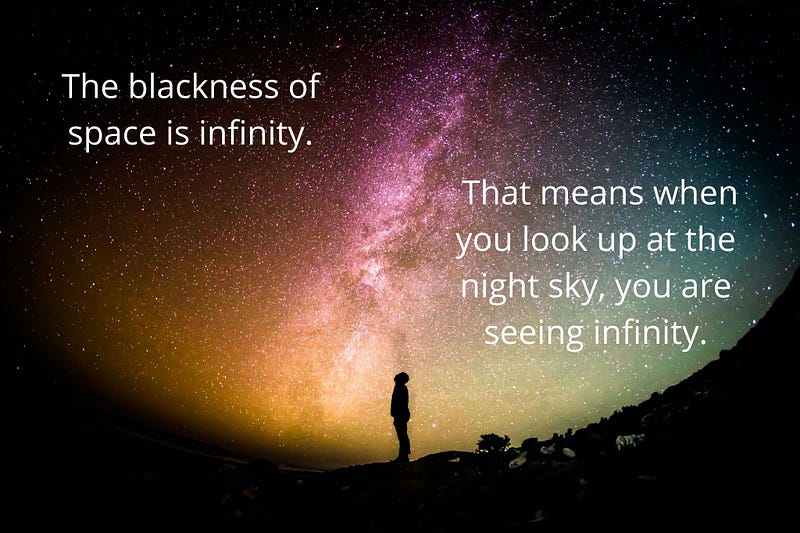
The blackness of space is infinity, meaning when you look at it, you are seeing infinity. The stars in the sky are so far away, and the light takes so far to reach you, it means when you look at them you are seeing the past. That means when you look up at the night sky, you are both seeing infinity with your own eyes and the past.
If you were on Jupiter, the sounds you would hear would be a bit like if you were underwater. Neptune also has water-like sounds, with the sounds being like ocean waves. Despite the peaceful sounds, due to the toxic atmospheres and the fact that both planets are gas giants and so have no solid surface, a visit to either would be anything but relaxing.
If you get two pieces of metal that are perfectly smooth and have corrosion-free surfaces, and you take them into space and press them together with some force, they will fuse together into one piece. The process is called cold welding.
On analogue TVs, if you tune your TV between the stations, a small percentage of the static that you would see is actually the afterglow of the Big Bang.
The sun is big to us, but in truth it’s tiny. UY Scuti, the largest known star in the universe, has a solar mass of 5 billion suns. That means that the sun could fit into it 5 billion times. Ton 618, the largest known black hole in the universe, has a solar mass of 66 billion suns, and if you include its nebula, it is 320,000 light-years wide, the size of two Milky Way galaxys. To truly put this into perspective, 1.3 million Earths can fit into the sun. That means if the Earth was a marble, you would need 85.8 quadrillion marbles to fill a space the equivalent size of Ton 618 (one quadrillion has 15 zeros).
If you were sat in a spaceship and right next to you a spaceship exploded, you would hear nothing. In an environment with an atmosphere, when we speak, air particles vibrate and collide with each other, causing the vibrations to pass between those air particles. If the sound is loud enough to cause enough vibrations, the sound will reach our ears and we will hear it. That means our ears work by detecting vibrations of air particles — as do all our sound detection systems. However, because space is pretty much an empty vacuum that has essentially zero air, sound has no means of travelling which means space is completely silent. So truly, if you’re in space nobody will hear your screams, not even you.
It’s impossible to directly smell space for obvious reasons. But it is believed that it does have a smell, and a succession of astronauts have described space as having a rather pleasant metallic-like smell, with some even likening it to walnuts, brake pads and rather crazily a burnt steak. Though the consensus is burning metal with an odour of ozone. However, some believe that the smell the astronauts are smelling may actually be a result of a chemical reaction occurring within spacecraft during re–pressurisation. Regardless, it is believed that space does have a smell, and is most likely a metallic-like smell.
A great perk of going to space is that you never have to worry about burping. Because there is no gravity, the air in your stomach cannot separate and rise up from ingested food, meaning what goes down cannot come back up. But fortunately/unfortunately, it can go down still. Meaning you can still fart, and rather crazily farting in space is actually dangerous. Because you are in a small space, and the gases released when you fart are flammable and don’t go anywhere, because they have nowhere to go, every fart is literally a ticking timebomb. Thankfully, spaceships and spacesuits have filters that can nullify these dangers, so as of yet there have been no deaths by farts in space — at least not of the literal kind...
To go to the international space station astronauts have to be able to speak both English and Russian. That’s because to go with the NASA built modules, which an astronaut needs to know English to operate, the ISS has modules that are Russian built and so to operate then you must know Russian. English-speaking astronauts have frequently said that one of the biggest challenges of the training is learning Russian — which is one of the hardest languages to learn, requiring 1,100 class hours to reach a reasonable level of fluency.
Back in 2011, two teams of astronomers from NASA discovered the largest and farthest reservoir of water ever detected in the universe. It is 12 billion light-years away, and its size is so astronomical, that its reservoir holds the equivalent of 140 trillion times all the water in the world’s oceans combined. Even crazier, it surrounds a huge, feeding black hole, called a quasar.
There are more stars in the universe than grains of sand on Earth. It’s believed that there are over 200 sextillion stars in the known universe (one sextillion has 36 zeros), but there are only believed to be approximately 7.5 quintillion grains of sand (one quintillion has 30 zeros) on Earth.
Despite the fact that Mercury is the closest planet to the sun, Venus is the hottest planet in the solar system. The reason is that Mercury does not have an atmosphere, whereas Venus does, and its atmosphere has a lot of gases in it which create a greenhouse effect so strong that its surface has a constant temperature of 462 degrees Celsius (864 degrees Fahrenheit) everywhere.
The largest known mountain in the solar system is Olympus Mons, which is 16 miles high. To put that into perspective, Mount Everest is 5.5 miles high, meaning Olympus Mons is close to three times its height.
Light moves at approximately 300,000 kilometres a second (approximately 670 million mph). A light-year is the distance that light travels in a year. That means if you moved at the speed of light, it would take you a year to travel a light-year. Proxima Centauri, the nearest star to Earth, is approximately 4.25 light-years from Earth, meaning even if we managed to travel at the speed of light it would still take us over four years to reach the nearest star.
The fastest speed ever recorded by a human-made spacecraft is the Parker Solar Probe, which in November 2021 reached a total speed of 163 kilometres a second (approximately 365,000 mph). The record is expected to be broken by the same probe in September 2023.
The hottest place in the known universe is inside the Large Hadron Collider. While trying to replicate the big bang back in 2012, a temperature of 5.5 trillion degrees Celsius was recorded. To put this into perspective, the hottest part of the sun, its centre, is only 15 million degrees Celsius. On the flipside, the coldest known place in the universe was created in a lab in Germany. Researchers at the lab at the Centre for Applied Space Technology and Microgravity at the University of Bremen, by dropping freezing, magnetized gas down a tower 120 metres tall, hit a temperature just trillionths of a degree away from absolute zero (-273.15 degrees Celsius). That means that the hottest and coldest known places in the universe are located on the European continent.
Because the universe is infinite and ever-expanding, we will never see the vast majority of it because the light from it will never reach our eyes.
Because there is no wind on the moon, footprints last for a very long time. Though, unlike popular belief, they won’t last forever. The moon is still a dynamic environment and is constantly bombarded with “micrometeorites,” which means that erosion is still happening on the moon, just very slowly. That means a footprint will likely last for approximately 100 million years. That means that once we return to the moon this decade, and the footprints from the previous missions are captured on camera, nobody ever again will be able to say that the moon landings were faked. Unless there are no footprints...
A great way to lose weight would be to go to Mars, due to Mars’ weaker gravitational pull, on Mars you would weigh approximately 38 percent of what you do on Earth — so a person who weighed 220 pounds on Earth would only way 84 pounds on Mars. You would also be a little bit taller on Mars than on Earth for the same reasons. But not as tall as if you were in space. Astronauts typically grow 2 inches while in space. This is due to the lack of gravity which causes the discs between the vertebrae to expand a little. Alas, the height is lost upon re-entering Earth’s atmosphere and being subjected to Earth’s gravity. Regardless, that means going to Mars is a great way to lose weight and grow a few inches.
Because water cannot flow downwards to your feet, when you are in space your top half is puffier because there is a much higher water content. Gravity also has other effects namely sweat does not leave your body, it sticks to it in blobs. Astronauts have to wipe this up otherwise it will remain there indefinitely, and it actually provides a useful source of water. Tears also stick to your body, meaning you have to wipe tears from your eyes otherwise they remain there. An astronaut once got tears stuck in his eyes while on a spacewalk, the tears remained there stinging his eyes, with his spacewalking buddy only able to say, “Sorry bud.”
On Earth, due to gravity, a person’s blood pools in the legs, we even have a large number of valves down there to pump the blood back up. However, in space due to the lack of gravity blood pools in the head and chest — a phenomenon called fluid shift. This causes the heart to enlarge so it can handle the increased blood flow in the area surrounding it. Not just that, but the brain and other body systems interpret the fluid shift as a problem, and respond by using several different processes to get rid of the excess blood, which results in an overall reduction in blood volume in an astronaut’s body. That means we have less blood in our veins in space than on earth. All in all, these effects combined lead astronauts to have stuffy noses, headaches and puffy faces.
There is a common belief that female breasts in space could cause problems. This is complete rubbish on most levels, but not all levels. If a woman had a large bust, and it was not held in place by a sports bra, they would likely be an annoyance. Think what happens when a well-endowed woman runs without a bra, then imagine her not needing to run for them to bounce all over the place. If the woman thrust herself forward, her breasts would compress against her, if she stopped herself, her breasts would pull away from her before ricocheting back. The same would happen if she moved up and down like climbing ladders. For example, while moving down they would likely swing up at her face, while moving up, the opposite. Luckily sports bras exist so if a well-endowed woman wished to go to space, there would be no problem.
Despite popular belief, a penis does not increase in size in space namely because it has no bones — only bone joints expand while in space namely due to the lack of gravitational pressure pressing against them. However, without gravity to hold them down, men’s manhoods would float freely and likely pose just as much as an annoyance as liberated female breasts. Yep, things that aren’t pinned down take on lives of their own in space.
A pen will not work in space. At least not the normal kind. Pens require gravity to work i.e. the ink flows by falling down into the nib. Because there is no gravity in space, a standard pen will not work because the ink cannot fall. Meaning rather crazily, special pens have to be made to work in zero gravity environments.
Pluto is actually smaller than the United States, and if we took the state of Texas, Pluto could only hold 24 states of that size.
Rather crazily, outer space is only 62 miles above sea level. That means outer space is technically only approximately an hour’s drive away.
Buzz Lightyear from Toy Story has actually been to space. A model of Buzz Lightyear was taken aboard the International Space Station and remained there for 15 months before being returned to Earth on September 11, 2009. As they say, to infinity, and beyond!
Neutron stars, right after birth, can spin at up to 60 times per second, and if they are part of a binary system, they can spin at up to 600 times per second.
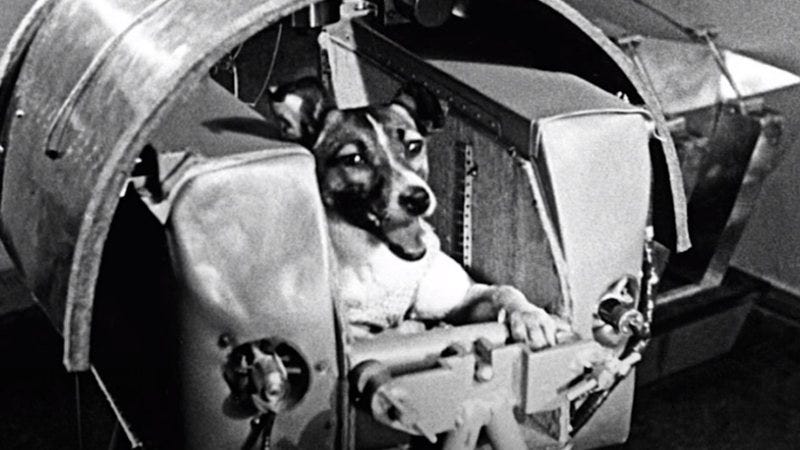
Everybody always talks about chimps in space, but a chimp was not the first living mammal to go into space. A dog was. Laika, a stray mongrel taken from the streets of Moscow, was launched into space on the Soviet spacecraft Sputnik 2 on November 3, 1957. Sadly, Laika died 5–7 hours into the flight due to overheating and stress.
Ever wondered why an astronaut is called an astronaut? It’s because an astronaut means a star sailor. Basically, astronaut is derived from the Greek words “astron”, which means “star”, and “nautes”, which means “sailor.” Astron was added to nautes and star sailors a.k.a. astronauts were born.
Gravity on the international space station is actually only 10–11% weaker than it is on Earth’s surface. Yep, there’s actually a strong gravitational pull on the ISS, which seems odd considering the astronauts' float, but they are not floating for the reason you think. Astronauts float freely due to the ISS’s continual state of free-fall — imagine a plane plummeting from the sky, how unless you are strapped in, you float while inside the plane. As the ISS moves ‘sideways’ and falls towards Earth, the horizon curves away beneath it at the same rate, keeping the ISS in orbit and simulating a feeling of weightlessness for anyone on board. So weightlessness on the ISS is an illusion created by a falling effect rather than a lack of gravity. Crazy, I know.
That’s all from me, thanks for reading! If you enjoyed this post, you may also enjoy the following:
Seven Fascinating Science Facts That Will Blow Your Mind
30 Hilarious Scientific Jokes That Will Test Your Intelligence to the Limits
27 Random But Fascinating Historical Facts That You Probably Didn’t Know
To learn more about me see this link, to support me click the link below:


