avatarAlvin T.

Free AI web copilot to create summaries, insights and extended knowledge, download it at here

5264

Abstract

/readmedium.com/do-you-want-to-master-the-japanese-language-in-just-two-months-fa881d9ac364">If Japanese is that difficult for English native speakers</a>, why should we expect it to be any different for Japanese people studying English?</p><div id="bde6" class="link-block"> <a href="https://readmedium.com/do-you-want-to-master-the-japanese-language-in-just-two-months-fa881d9ac364"> <div> <div> <h2>Do You Want to “Master the Japanese Language in Just Two Months?”</h2> <div><h3>I’m sorry, but it’s not even remotely possible — here’s why.</h3></div> <div><p>medium.com</p></div> </div> <div> <div style="background-image: url(https://miro.readmedium.com/v2/resize:fit:320/1*oMxZ8VnVqhK6nW7B6IBRWg.jpeg)"></div> </div> </div> </a> </div><h1 id="da99">The Japanese and English Languages are Worlds Apart</h1><p id="be30">A quick comparison of the two languages show the gulf between English and Japanese:</p><ul><li><b>Pronunciation (Phonology): </b>Modern Standard Japanese has relatively simple pronunciation<b> </b>with only 5 vowels and zero diphthongs. Conversely, English has at least <a href="https://www.dictionary.com/e/vowels/#:~:text=Every%20language%20has%20vowels%2C%20but,at%20least%2014%20vowel%20sounds.">14 vowels</a> and <a href="https://www.thoughtco.com/diphthong-phonetics-term-1690456">8–10 diphthongs, depending on who you ask</a>.</li><li><b>Pronunciation (Rhythm)</b>: Japanese is frequently called a <a href="https://www.ed.kagawa-u.ac.jp/~nagai/papers/kn5/kn5.htm">mora-timed language</a> where all sounds have equal timing (in theory). <a href="https://www.teachingenglish.org.uk/article/stress-timed">English is a stressed-time language</a> and certain sounds are stressed, and unstressed sounds are shortened to maintain a regular rhythm.¹</li><li><b>Vocabulary: </b>The Japanese and English languages do not share much vocabulary. <a href="https://web.mit.edu/jpnet/articles/JapaneseLanguage.html">Most Japanese vocabulary is either native to Japan (50%) or of Sino-origin(40%)</a>. The remaining are loanwords from other foreign languages.</li><li><b>Grammar (Word Order): </b>Japanese and English have different word orders (Japanese is subject-object-verb, and English is subject-verb-object); for the Japanese learner of English, it must be odd having to reverse the verbs and objects!</li><li><b>Rule Consistency: </b>The Japanese language has relatively few exceptions in terms of grammatical rules and pronunciation; what you see is usually what you get. Rules are usually very logical and consistent. <a href="https://en.wikipedia.org/wiki/History_of_English#:~:text=English%20is%20a%20West%20Germanic,southern%20Denmark%20and%20the%20Netherlands.&amp;text=The%20Anglian%20dialects%20had%20a%20greater%20influence%20on%20Middle%20English.">English, on the other hand, is full of exceptions due to its complicated histor</a>y. Many things in English simply don’t make sense. Why don’t “rough” and “through” and “cough” rhyme?</li></ul><p id="be81">Anecdotally, <a href="https://www.japantimes.co.jp/opinion/2017/10/29/commentary/japan-commentary/japanese-trouble-learning-english/#.XpZZ8RMzbdQ">according to an article in the Japan Times</a>, Japanese tutors at the English Tutor Network with TOEIC scores of 900 and above report spending <b>4000–5000 hours studying English </b>to achieve that level of proficiency. For a very hardworking Japanese person who decides to go to university, that works out to be slightly over 2000 hours:</p><ul><li>English class time up till high school: 790 hours</li><li>English homework and review time spent up till high school: 790hours</li><li>University entrance examination English preparation: 500 hours</li></ul><p id="23da"><b>Total: 2080 hours. </b>And this is assuming that this person put in a lot of effort to study outside of official class time. (Source: 「<a href="https://english-club.jp/blog/english-learning-time/">英語習得には最低3000時間!達成するための11のコツと学習習慣 」(english-club.jp)</a>, “<i>You need at least 3000 hours to be fluent in English!”</i></p><h1 id="9142">English — The Foreign Language No One Needs to Speak in Japan</h1><p id="a18c">The reality is most people do not need to use English in their daily lives in Japan. All day-to-day communication is done in Japanese, and whatever English is required is limited to business communication. And even then, this is usually when:</p><ul><li>communicating with non-Japanese expatriate bosses or foreign colleagues (usually in foreign companies) in Japan, or</li><li>dealing with foreign counterparts of Japanese companies based overseas.</li></ul><p id="5889">In the former, English working proficiency is required to communicate smoothly with foreign managers and other colleagues, as these people are usually not conversant in Japanese. Yet, this is a very specialized segment of the labor market. Usually, only a very small group of people working in the head office of the Japanese operation need to have interactions like these.</p><p id="eab1">For Japanese companies with sizeable foreign operations, international business operations are often handled

Options

by a separate international business division. All communications with foreign counterparts are often handled by this team. There is no real need for anyone else in the company to use English at work.</p><p id="51eb">Rakuten, the Japanese <a href="https://rakuten.today/tag/englishnization">internet company famous for its policy of “Englishnization” is probably an exception</a>, but even so, I wonder — to what extent is English really used within the company?</p><p id="d5e0">In these companies, for the Japanese expatriates that are sometimes posted to overseas operations, an army of local staff with Japanese ability often step in to support these expatriates. While this is not the case with all multinational Japanese companies, it has historically been the model that most Japanese companies adopted in their international expansion.</p><p id="5f20">In cases where language skill gaps still exist, Japanese translators and interpreters are employed to act as a go-between staff who do not have any common language.</p><p id="b73a"><b>In short, for most Japanese people, there is simply no need to speak and use English. </b>For most Japanese people, English is just a language that sounds cool — but ultimately — foreign.<b> </b>Since necessity is often the reason people develop a language skill, it stands to reason that most Japanese people don’t have the impetus to develop any working proficiency in the English language.</p><h1 id="18c8">Enough with the Problems, What About Practical Solutions?</h1><h2 id="4a56">If You Need to Work with Japanese Business Partners</h2><ul><li>Even if Japanese people cannot <i>speak</i> English particularly well, most Japanese people with university education<i> </i>can read and write it to a certain degree.</li><li>If you need to have a meeting with Japanese colleagues or partners, preparing a document and sending it beforehand will give your partners time to read and translate in advance.</li><li>Competent translators and interpreters are highly trained professionals well worth their weight in gold.</li><li>Accept that some misunderstandings will still occur due to cultural differences and not necessarily due to language incompetency. Japanese companies generally make decisions and function differently compared to companies in the Western world.</li></ul><h2 id="f986">If You Ever Visit Japan for Leisure (Once the Borders Reopen)</h2><ul><li>In major cities (Tokyo, Osaka), some people — especially the younger folks — will be able to speak some English. Speak slowly and use simple words! It might just work!</li><li>Hotels and major department stores should not have major problems with English, as long as you stick to the main chains.</li><li>Major tourist attractions and train stations usually have some kind of English signage (as well as Chinese and Korean in certain areas), so navigation is usually not a problem. Use Google Maps and Google Translate if you need to.</li><li>Hire a local tour guide, especially if you want to venture into areas less popular with tourists.</li><li>It might be useful to learn some basic phrases in Japanese related to traveling.</li></ul><h2 id="b57e">If You are Japanese, and Looking to Improve Your English</h2><ul><li>If you can read everything in this article — even if you need to use Google Translate to figure out some difficult words— congratulations to you, your English is better than you think!</li><li>Have more confidence! Start using English more in your daily life. Don’t be worried about making mistakes.</li><li>Find a<i> </i>language partner that you can consult if you need help. Social media has made it very easy to go online and start looking for connections to communicate in English.</li><li>You can also contact a professional language expert if you need help to improve your English language skills. Social media has lowered the barriers for such services and often, there are many freelancers online who will be able to help.</li></ul><p id="a9cc">This was written in response to <a href="undefined">Yuko Tamura</a>’s piece, “<a href="https://readmedium.com/the-3-reasons-japanese-will-never-master-english-7242ecc67e5f"><i>The 3 Reasons Japanese Will Never Master English</i></a><i>.</i></p><div id="45af" class="link-block"> <a href="https://readmedium.com/the-3-reasons-japanese-will-never-master-english-7242ecc67e5f"> <div> <div> <h2>The 3 Reasons Japanese Will Never Master English</h2> <div><h3>If you work with Japanese people, you should know this</h3></div> <div><p>medium.com</p></div> </div> <div> <div style="background-image: url(https://miro.readmedium.com/v2/resize:fit:320/1*[email protected])"></div> </div> </div> </a> </div><p id="0bb6"><i>The author writes mainly on Japan, modern work, society, and cryptocurrency. Discover his most-read stories <a href="https://readmedium.com/hi-im-alvin-b2e27849a944">here</a>.</i></p><p id="99ee"><i>If these topics interest you, consider <a href="https://medium.com/@alvintwrites/subscribe">subscribing to receive new stories from the author via e-mail</a>.</i></p></article></body>

Language and Japan

Why Japan Fails at English

And what you need to know if you work with Japanese companies, or plan to visit Japan.

Photo by Jezael Melgoza on Unsplash

That the Japanese are terrible at English is a widely heard stereotype that has a substantial basis in reality. One only needs to go onto YouTube to see English lessons in Japan satirized in comedic fashion.

Comedy aside, according to the 2021 results of the EF English Proficiency Index, Japan has one of the lowest levels of English competency globally. (Full report and methodology here.)
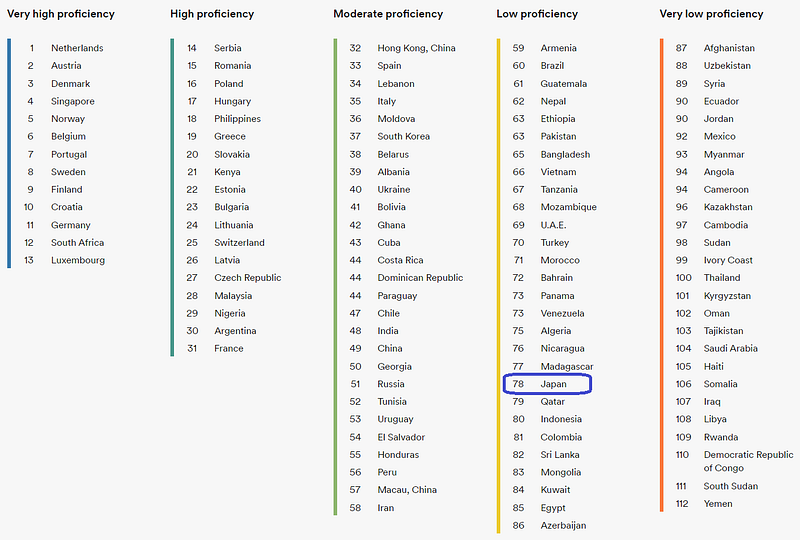
2021 English Proficiency Index, retrieved from EF EPI 2021 — EF English Proficiency Index, Japan is ranked 78 (circle by author).

Yuko Tamura laments that the English levels of most Japanese people are remarkably low because of three reasons: 1) teachers have poor English skills, 2) everything is dubbed, and 3) Japanese people are overly perfectionistic and are scared of making mistakes, which is a mentality that hampers language learning.

While all of these are certainly true, I want to discuss a few other critical reasons.

Maybe English is Just Hard to Learn

Maybe English is just too difficult to learn, as the English Proficiency Index seems to imply. We can categorize the countries that made the “very high proficiency” list into two main groups:

  • European countries — Netherlands, Austria, Denmark, Norway, Belgium, Portugal, Sweden, Finland, Croatia, Germany, Luxembourg
  • Post-colonial countries — Singapore and South Africa — these countries were both British colonies and English is institutionalized as an official language.

Based on the above, despite what English speakers would like to believe, global English proficiency should be considered an anomaly rather than the norm. The most fluent countries outside of the Anglophone world are either European or have inherited a British colonial legacy.

At the risk of oversimplification, many of the European languages represented on the “very high proficiency” list also have a lot in common with English. Most of these languages use the Latin alphabet, many of them share common vocabulary due to a common Latin heritage, and they have similar word orders. So, it is not surprising that many of these European languages are also considered quite easy for native English speakers to learn, according to the US Department of State Foreign Service Institute.
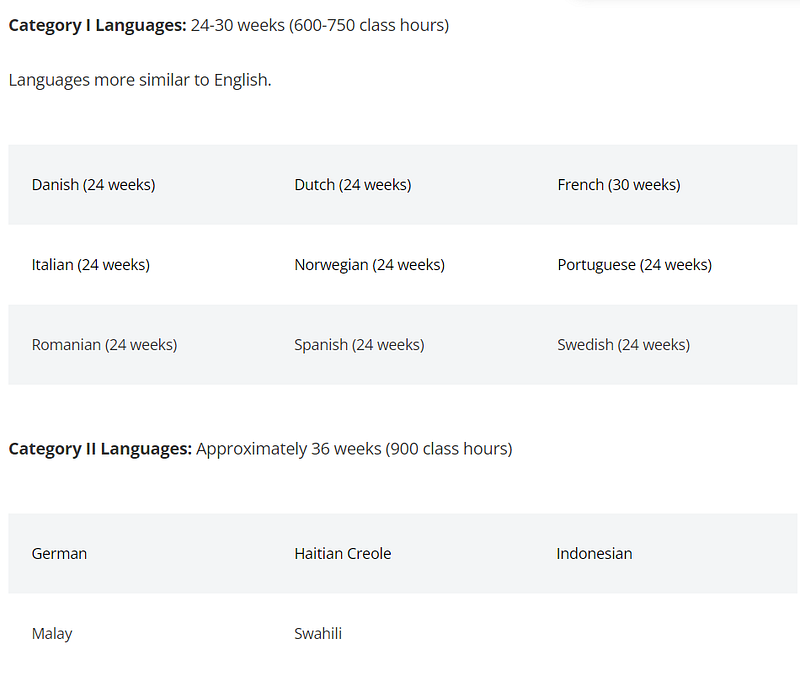
Screenshot from Foreign Language Training — United States Department of State, accessed on 7 Feb 2022.

Naturally, there are exceptions. Serbo-Croatian and Finnish are considered “hard languages” (not shown above) requiring 1100 hours to reach professional working proficiency because they are very different from English. Perhaps the Croatian and Finnish education systems are doing something right.

Yet, these languages are still not as different as Japanese when compared to English. Let us not forget that the US Department of State Foreign Service Institute also classifies the Japanese language as a “super-hard language” requiring 2200 hours of intensive study to achieve professional working proficiency (for native English speakers). If Japanese is that difficult for English native speakers, why should we expect it to be any different for Japanese people studying English?

The Japanese and English Languages are Worlds Apart

A quick comparison of the two languages show the gulf between English and Japanese:

  • Pronunciation (Phonology): Modern Standard Japanese has relatively simple pronunciation with only 5 vowels and zero diphthongs. Conversely, English has at least 14 vowels and 8–10 diphthongs, depending on who you ask.
  • Pronunciation (Rhythm): Japanese is frequently called a mora-timed language where all sounds have equal timing (in theory). English is a stressed-time language and certain sounds are stressed, and unstressed sounds are shortened to maintain a regular rhythm.¹
  • Vocabulary: The Japanese and English languages do not share much vocabulary. Most Japanese vocabulary is either native to Japan (50%) or of Sino-origin(40%). The remaining are loanwords from other foreign languages.
  • Grammar (Word Order): Japanese and English have different word orders (Japanese is subject-object-verb, and English is subject-verb-object); for the Japanese learner of English, it must be odd having to reverse the verbs and objects!
  • Rule Consistency: The Japanese language has relatively few exceptions in terms of grammatical rules and pronunciation; what you see is usually what you get. Rules are usually very logical and consistent. English, on the other hand, is full of exceptions due to its complicated history. Many things in English simply don’t make sense. Why don’t “rough” and “through” and “cough” rhyme?

Anecdotally, according to an article in the Japan Times, Japanese tutors at the English Tutor Network with TOEIC scores of 900 and above report spending 4000–5000 hours studying English to achieve that level of proficiency. For a very hardworking Japanese person who decides to go to university, that works out to be slightly over 2000 hours:

  • English class time up till high school: 790 hours
  • English homework and review time spent up till high school: 790hours
  • University entrance examination English preparation: 500 hours

Total: 2080 hours. And this is assuming that this person put in a lot of effort to study outside of official class time. (Source: 「英語習得には最低3000時間!達成するための11のコツと学習習慣 」(english-club.jp), “You need at least 3000 hours to be fluent in English!”

English — The Foreign Language No One Needs to Speak in Japan

The reality is most people do not need to use English in their daily lives in Japan. All day-to-day communication is done in Japanese, and whatever English is required is limited to business communication. And even then, this is usually when:

  • communicating with non-Japanese expatriate bosses or foreign colleagues (usually in foreign companies) in Japan, or
  • dealing with foreign counterparts of Japanese companies based overseas.

In the former, English working proficiency is required to communicate smoothly with foreign managers and other colleagues, as these people are usually not conversant in Japanese. Yet, this is a very specialized segment of the labor market. Usually, only a very small group of people working in the head office of the Japanese operation need to have interactions like these.

For Japanese companies with sizeable foreign operations, international business operations are often handled by a separate international business division. All communications with foreign counterparts are often handled by this team. There is no real need for anyone else in the company to use English at work.

Rakuten, the Japanese internet company famous for its policy of “Englishnization” is probably an exception, but even so, I wonder — to what extent is English really used within the company?

In these companies, for the Japanese expatriates that are sometimes posted to overseas operations, an army of local staff with Japanese ability often step in to support these expatriates. While this is not the case with all multinational Japanese companies, it has historically been the model that most Japanese companies adopted in their international expansion.

In cases where language skill gaps still exist, Japanese translators and interpreters are employed to act as a go-between staff who do not have any common language.

In short, for most Japanese people, there is simply no need to speak and use English. For most Japanese people, English is just a language that sounds cool — but ultimately — foreign. Since necessity is often the reason people develop a language skill, it stands to reason that most Japanese people don’t have the impetus to develop any working proficiency in the English language.

Enough with the Problems, What About Practical Solutions?

If You Need to Work with Japanese Business Partners

  • Even if Japanese people cannot speak English particularly well, most Japanese people with university education can read and write it to a certain degree.
  • If you need to have a meeting with Japanese colleagues or partners, preparing a document and sending it beforehand will give your partners time to read and translate in advance.
  • Competent translators and interpreters are highly trained professionals well worth their weight in gold.
  • Accept that some misunderstandings will still occur due to cultural differences and not necessarily due to language incompetency. Japanese companies generally make decisions and function differently compared to companies in the Western world.

If You Ever Visit Japan for Leisure (Once the Borders Reopen)

  • In major cities (Tokyo, Osaka), some people — especially the younger folks — will be able to speak some English. Speak slowly and use simple words! It might just work!
  • Hotels and major department stores should not have major problems with English, as long as you stick to the main chains.
  • Major tourist attractions and train stations usually have some kind of English signage (as well as Chinese and Korean in certain areas), so navigation is usually not a problem. Use Google Maps and Google Translate if you need to.
  • Hire a local tour guide, especially if you want to venture into areas less popular with tourists.
  • It might be useful to learn some basic phrases in Japanese related to traveling.

If You are Japanese, and Looking to Improve Your English

  • If you can read everything in this article — even if you need to use Google Translate to figure out some difficult words— congratulations to you, your English is better than you think!
  • Have more confidence! Start using English more in your daily life. Don’t be worried about making mistakes.
  • Find a language partner that you can consult if you need help. Social media has made it very easy to go online and start looking for connections to communicate in English.
  • You can also contact a professional language expert if you need help to improve your English language skills. Social media has lowered the barriers for such services and often, there are many freelancers online who will be able to help.

This was written in response to Yuko Tamura’s piece, “The 3 Reasons Japanese Will Never Master English.

The author writes mainly on Japan, modern work, society, and cryptocurrency. Discover his most-read stories here.

If these topics interest you, consider subscribing to receive new stories from the author via e-mail.

Japan
Business
English
Travel
Language
Recommended from ReadMedium