avatarDenise Shelton

Free AI web copilot to create summaries, insights and extended knowledge, download it at here

4084

Abstract

you may be surprised. Whether it’s the intervention of St. Anthony or just the focusing of your mind on the problem, it’s worked for me more times than I can count.</p><h1 id="a54e">3. St. Joseph — Patron saint of house sellers</h1><figure id="e110"><img src="https://cdn-images-1.readmedium.com/v2/resize:fit:800/1*9UWNN4zQ1ulB5F7SU-Btug.jpeg"><figcaption>“St. Joseph” by Guido Reni, c. 1641 (public domain)</figcaption></figure><p id="f868">Although <a href="https://en.wikipedia.org/wiki/Saint_Joseph">St. Joseph</a> has several specialties (carpenters and other workers, for instance), one of the most popular traditions associated with St. Joseph has to do with selling real estate.</p><p id="ce78">Some people (my friend Debbie among them) swear that burying a statue of St. Joseph in the yard of a house you’re trying to sell is the quickest way to find a buyer.</p><p id="78bd">The Catholic Church neither supports nor discourages the practice, although some people think it’s disrespectful.</p><p id="34cd">Some companies sell kits for this purpose. Here are the instructions from <a href="https://www.st-josephstatue.com/">one of them</a>.</p><blockquote id="271f"><p>• Bury the statue in the yard in the front of the house. Favorable spots are either close to the “For Sale” sign or close to the road.</p></blockquote><blockquote id="abdd"><p>• Bury the statue upsidedown, facing the house.</p></blockquote><blockquote id="8523"><p>• Pray to Saint Joseph when you are burying him and keep praying until the house is sold.</p></blockquote><blockquote id="268d"><p>• But<b> the most important part </b>is to have faith all the time, in yourself, in your Sale and in Saint Joseph.</p></blockquote><blockquote id="9349"><p>• After your house is sold, take him with you to your new home and put him in a place of honor.</p></blockquote><blockquote id="0dca"><p>• If you live in a condo, bury the statue of St Joseph in a pot.</p></blockquote><h1 id="cba0">4. St. Lawrence — Patron saint of cooks</h1><figure id="a932"><img src="https://cdn-images-1.readmedium.com/v2/resize:fit:800/1*NQZ0UmmbtuQgZTTgbUqX0A.jpeg"><figcaption>“The Martyrdom of St. Lawrence” by Titian, 1558 (public domain)</figcaption></figure><p id="b7cf">Are you trying to master the art of French cooking, and it just isn’t working out? Maybe a prayer to <a href="https://en.wikipedia.org/wiki/Saint_Lawrence">St. Lawrence</a> is in order.</p><p id="8bb0">St. Lawrence is one of the unfortunate souls whose patron saint status is attached to how he died. In his case, the prefect of Rome under the Emperor Valerian condemned Lawrence to death by roasting on a gridiron.</p><p id="486c">Legend has it that at one point during his torturous death, he quipped, “I’m well done on this side, turn me over.” His scrupulous attention to proper culinary technique even while he was the main course has earned St. Lawrence the title of Patron Saint of Cooks. (Barbecues may never seem the same.)</p><h1 id="b0b6">5. St. Apollonia — Patron saint of toothaches</h1><figure id="8f30"><img src="https://cdn-images-1.readmedium.com/v2/resize:fit:800/1*lXw0ORqEBn4i-MFsp9Kkcg.jpeg"><figcaption>“The Martyrdom of St. Apollonia” by Jacopo Zucchi, 16th century (public domain)</figcaption></figure><p id="6f9f"><a href="https://en.wikipedia.org/wiki/Saint_Apollonia">St. Appolonia</a> was a resident of Alexandria, Egypt, during a 2nd-century uprising against the Christians. She refused to renounce her faith and her surrender her virtue.</p><p id="cab4">If you thought St. Lawrence had it bad, brace yourself. St. Appolonia’s tormentors ripped all her teeth out. They then threatened to burn her to death if she didn’t renounce her faith. They were also planning to rape her. Before they could succeed, Appolonia lept into the flames and burned to death.</p><p id="e72d">For this reason, you can assume that when you ask for St. Appolonia’s help bearing the pain of that upcoming root canal, she can relate.</p><h1 id="3701">6. St. Sebastian — Patron saint of pandemics</h1><figure id="3898"><img src="https://cdn-images-1.r

Options

eadmedium.com/v2/resize:fit:800/1*cLcfIPITOEALDAqNocDxuA.jpeg"><figcaption><i>“Martyrdom of Saint Sebastian,”</i> by Il Sodoma, c. 1525 (public domain)</figcaption></figure><p id="13bc"><a href="https://en.wikipedia.org/wiki/Saint_Sebastian">St. Sebastian</a> was a Roman soldier who converted to Christianity during the reign of the Emperor <a href="https://en.wikipedia.org/wiki/Diocletian">Diocletian</a>. He actively encouraged many of his friends to convert as well.</p><p id="eecc">The Emperor was not happy about Sebastian’s missionary work and had him tied to a tree and shot full of arrows. Miraculously, Sebastian survived. After he recovered, he went back to Diocletian to rebuke him, at which point the Emperor had him clubbed to death.</p><p id="92e5">One of Sebastian’s converts was supposedly cured of the plague the moment he renounced the pagan gods and accepted Christ. During the Middle Ages, this story led to many people asking St. Sebastian for help during the numerous outbreaks of bubonic plague that swept Europe.</p><p id="1d91">The <a href="https://en.wikipedia.org/wiki/Chronicler">chronicler</a> <a href="https://en.wikipedia.org/wiki/Paul_the_Deacon">Paul the Deacon</a> claimed that the intercession of St. Sebastian in 680 freed Rome from a fatal epidemic. <a href="https://en.wikipedia.org/wiki/Golden_Legend">The Golden Legend</a>, a 13th-century text, tells of how the erection of an altar in honor of Sebastian banished a plague that afflicted the <a href="https://en.wikipedia.org/wiki/Lombards">Lombards</a> in the time of <a href="https://www.geni.com/people/Gumbert-Reigning-in-Exile-Hereditary-Prince-of-the-Lombard-s/6000000021096646159">King Gumbert</a>.</p><p id="7cdc">You might think, as some content creators have claimed, that St. Corona is the patron saint of pandemics, but you would be wrong. She was an early Christian martyr who was dispatched by tying her limbs to bent trees and then cutting them loose, thereby tearing her apart. For good measure, they also chopped off her head. She <i>is</i> the patron saint of something though: lumberjacks. (I’m serious.)</p><p id="79e5">©2020, Denise Shelton. All rights reserved.</p><div id="78d1" class="link-block"> <a href="https://readmedium.com/bad-girls-of-the-bible-the-good-books-most-notorious-women-567f6d5b9f86"> <div> <div> <h2>Bad Girls of the Bible: The Good Book’s Most Notorious Women</h2> <div><h3>And who is the Whore of Babylon anyway?</h3></div> <div><p>medium.com</p></div> </div> <div> <div style="background-image: url(https://miro.readmedium.com/v2/resize:fit:320/1*9hJw7mZkBwmmscE7N3zKQA.jpeg)"></div> </div> </div> </a> </div><div id="4ab3" class="link-block"> <a href="https://readmedium.com/the-7-most-successful-pirate-queens-of-all-time-be7925ca8ab1"> <div> <div> <h2>The 7 Most Successful Pirate Queens of All Time</h2> <div><h3>When they made booty calls, it wasn’t sex they were after</h3></div> <div><p>medium.com</p></div> </div> <div> <div style="background-image: url(https://miro.readmedium.com/v2/resize:fit:320/1*utsztIdftXoc4gflTDr3MA.jpeg)"></div> </div> </div> </a> </div><div id="1464" class="link-block"> <a href="https://readmedium.com/the-astonishing-truth-about-vomitoria-revealed-2d76627428c4"> <div> <div> <h2>The Astonishing Truth About Vomitoria Revealed</h2> <div><h3>The ancient Romans had them as do we</h3></div> <div><p>medium.com</p></div> </div> <div> <div style="background-image: url(https://miro.readmedium.com/v2/resize:fit:320/1*1uGsoIRQTOIz42O7rO78wQ.jpeg)"></div> </div> </div> </a> </div></article></body>

Culture

6 Weird Saints You Never Heard of and What They Can Do for you

From toothaches to pandemics, there’s a saint for everything
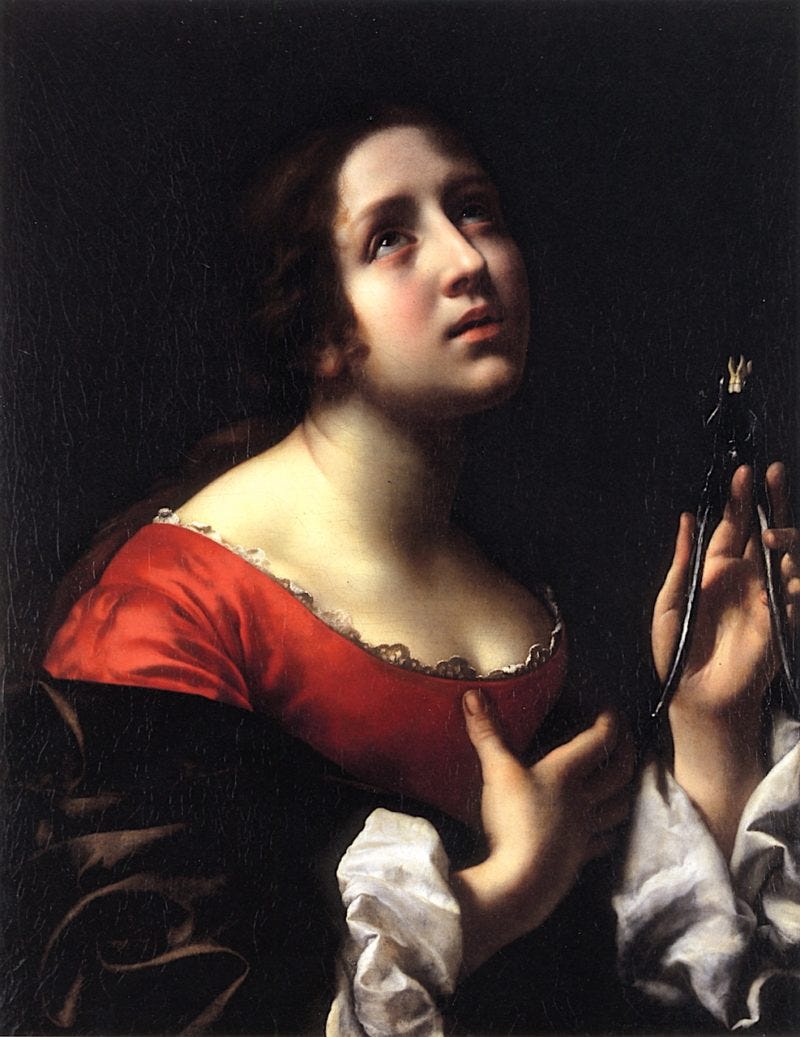
17th-century portrait of St. Apollonia holding a tooth in a pair of pincers by Carlo Dolci (public domain)

Patron saints are chosen as special protectors or guardians over areas of life. These areas can include occupations, illnesses, churches, countries, causes — anything that is important to us. The earliest records show that people and churches were named after apostles and martyrs as early as the fourth century. — Source: Catholic Online

If you have a Roman Catholic background, you know about patron saints. These are holy people the Church honors for their service to God and commitment to their faith. Even if you’re not Catholic, you’ve probably heard of the most popular ones:

Each patron saint has a feast day (March 17, in St. Patrick’s case), and each has one or more “specialties.” If you have a particular problem, the idea is to ask the patron saint who deals with that issue to put in a kind word for you with The Man Upstairs.

Here are six patron saints you probably didn’t know were taking requests. I can’t guarantee these saints will come through for you, but it certainly never hurts to ask.

1. St. Isidore of Seville — Patron saint of the Internet
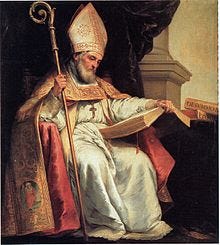
St. Isidore of Seville depicted by Bartolomé Esteban Murillo (public domain)

Having trouble with your Google search? Want to ensure your blog takes off like wildfire? St. Isidore is your man. He was a bishop whose claim to fame is that he was the first Christian writer to try to compile an encyclopedia of universal knowledge, which is pretty much what the Internet is today.

You can make up a prayer to St. Isidore if you like, but here’s one I found online that might help you with your internet porn addiction or troll tendencies:

Grant, we beseech Thee, that through the intercession of Saint Isidore, bishop and doctor, during our journeys through the internet we will direct our hands and eyes only to that which is pleasing to Thee, and treat with charity and patience all those souls whom we encounter. — Source: ElCidOnline.com

2. St. Anthony of Padua — Patron saint of lost things
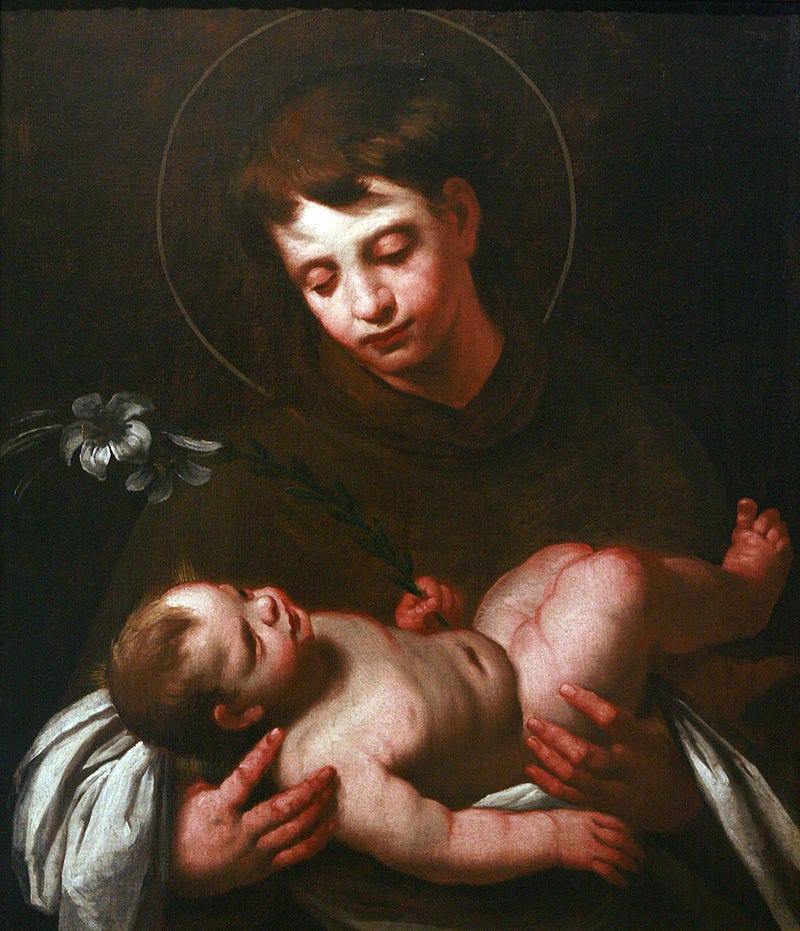
Painting of St. Anthony with the baby Jesus by Bernardo Strozzi, c. 1625 (public domain)

Have you lost your keys, one of your diamond earrings, or your passport? St. Anthony may be able to help you out. Unlike some patron saints, the prayers to whom are a bit boring, St. Anthony has a snappy little rhyme you can recite. There are various versions, but this is the one I have used with great success:

“Something’s lost that can’t be found, Please, St. Anthony, look around”

Try it, and you may be surprised. Whether it’s the intervention of St. Anthony or just the focusing of your mind on the problem, it’s worked for me more times than I can count.

3. St. Joseph — Patron saint of house sellers
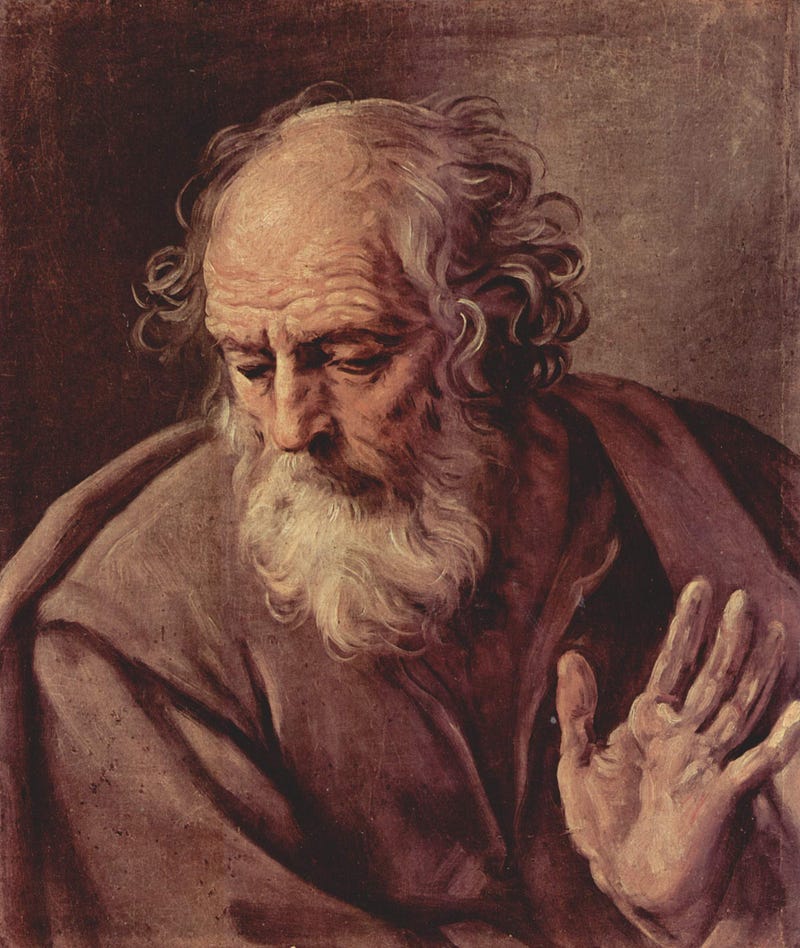
“St. Joseph” by Guido Reni, c. 1641 (public domain)

Although St. Joseph has several specialties (carpenters and other workers, for instance), one of the most popular traditions associated with St. Joseph has to do with selling real estate.

Some people (my friend Debbie among them) swear that burying a statue of St. Joseph in the yard of a house you’re trying to sell is the quickest way to find a buyer.

The Catholic Church neither supports nor discourages the practice, although some people think it’s disrespectful.

Some companies sell kits for this purpose. Here are the instructions from one of them.

• Bury the statue in the yard in the front of the house. Favorable spots are either close to the “For Sale” sign or close to the road.

• Bury the statue upsidedown, facing the house.

• Pray to Saint Joseph when you are burying him and keep praying until the house is sold.

• But the most important part is to have faith all the time, in yourself, in your Sale and in Saint Joseph.

• After your house is sold, take him with you to your new home and put him in a place of honor.

• If you live in a condo, bury the statue of St Joseph in a pot.

4. St. Lawrence — Patron saint of cooks
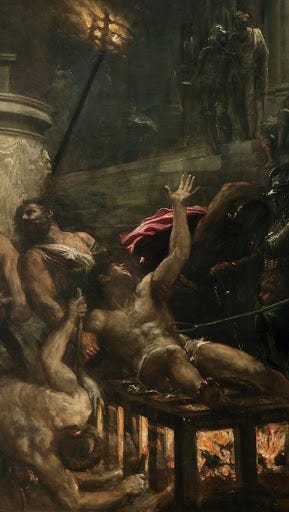
“The Martyrdom of St. Lawrence” by Titian, 1558 (public domain)

Are you trying to master the art of French cooking, and it just isn’t working out? Maybe a prayer to St. Lawrence is in order.

St. Lawrence is one of the unfortunate souls whose patron saint status is attached to how he died. In his case, the prefect of Rome under the Emperor Valerian condemned Lawrence to death by roasting on a gridiron.

Legend has it that at one point during his torturous death, he quipped, “I’m well done on this side, turn me over.” His scrupulous attention to proper culinary technique even while he was the main course has earned St. Lawrence the title of Patron Saint of Cooks. (Barbecues may never seem the same.)

5. St. Apollonia — Patron saint of toothaches
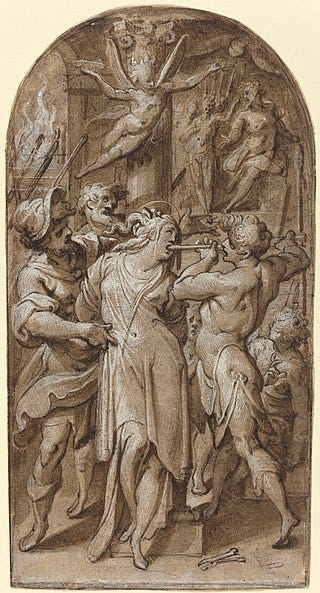
“The Martyrdom of St. Apollonia” by Jacopo Zucchi, 16th century (public domain)

St. Appolonia was a resident of Alexandria, Egypt, during a 2nd-century uprising against the Christians. She refused to renounce her faith and her surrender her virtue.

If you thought St. Lawrence had it bad, brace yourself. St. Appolonia’s tormentors ripped all her teeth out. They then threatened to burn her to death if she didn’t renounce her faith. They were also planning to rape her. Before they could succeed, Appolonia lept into the flames and burned to death.

For this reason, you can assume that when you ask for St. Appolonia’s help bearing the pain of that upcoming root canal, she can relate.

6. St. Sebastian — Patron saint of pandemics
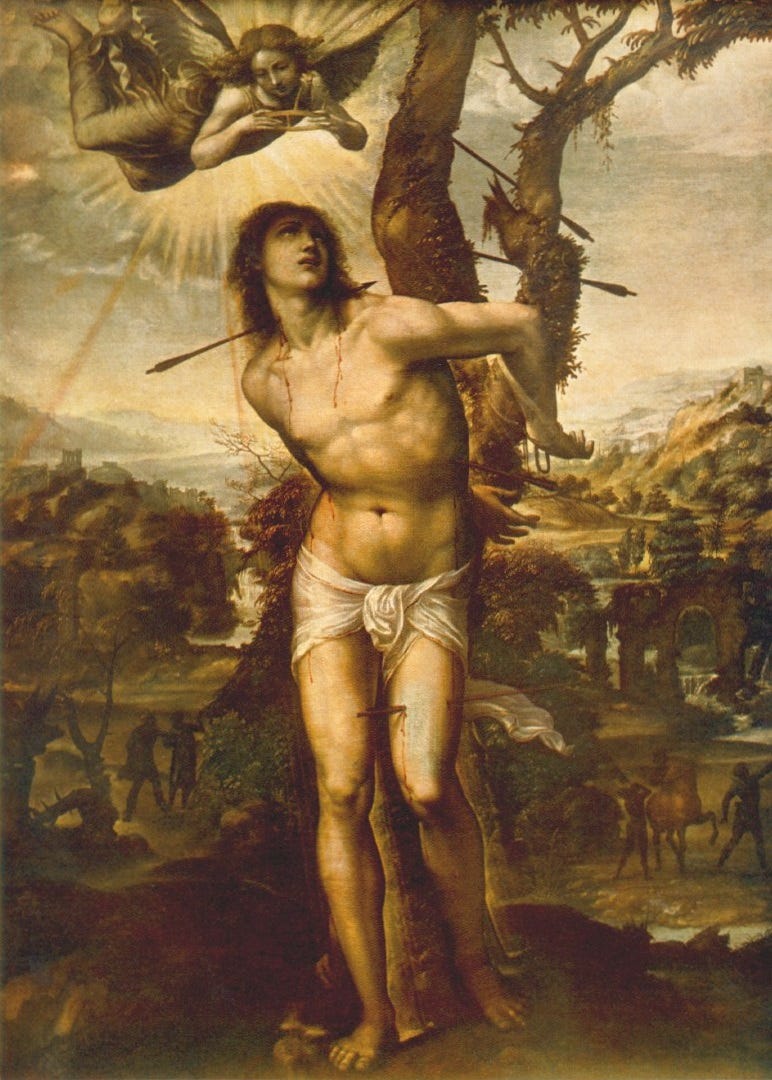
“Martyrdom of Saint Sebastian,” by Il Sodoma, c. 1525 (public domain)

St. Sebastian was a Roman soldier who converted to Christianity during the reign of the Emperor Diocletian. He actively encouraged many of his friends to convert as well.

The Emperor was not happy about Sebastian’s missionary work and had him tied to a tree and shot full of arrows. Miraculously, Sebastian survived. After he recovered, he went back to Diocletian to rebuke him, at which point the Emperor had him clubbed to death.

One of Sebastian’s converts was supposedly cured of the plague the moment he renounced the pagan gods and accepted Christ. During the Middle Ages, this story led to many people asking St. Sebastian for help during the numerous outbreaks of bubonic plague that swept Europe.

The chronicler Paul the Deacon claimed that the intercession of St. Sebastian in 680 freed Rome from a fatal epidemic. The Golden Legend, a 13th-century text, tells of how the erection of an altar in honor of Sebastian banished a plague that afflicted the Lombards in the time of King Gumbert.

You might think, as some content creators have claimed, that St. Corona is the patron saint of pandemics, but you would be wrong. She was an early Christian martyr who was dispatched by tying her limbs to bent trees and then cutting them loose, thereby tearing her apart. For good measure, they also chopped off her head. She is the patron saint of something though: lumberjacks. (I’m serious.)

©2020, Denise Shelton. All rights reserved.

Culture
Religion
Patron Saint
Prayer
Lifestyle
Recommended from ReadMedium