avatarDenise Shelton

Free AI web copilot to create summaries, insights and extended knowledge, download it at here

5706

Abstract

to hit on.</p><p id="c5bc">There’s a funny musical number in the Broadway musical<a href="https://en.wikipedia.org/wiki/Joseph_and_the_Amazing_Technicolor_Dreamcoat"> <i>Joseph and the Amazing Technicolor Dreamcoat</i></a><i> </i>about what happened to Joseph at the hands of Mrs. Potiphar<i>. </i>Check it out below.</p> <figure id="f9e9"> <div> <div> <img class="ratio" src="http://placehold.it/16x9"> <iframe class="" src="https://cdn.embedly.com/widgets/media.html?src=https%3A%2F%2Fwww.youtube.com%2Fembed%2FGLt6M4r7VLQ%3Ffeature%3Doembed&amp;display_name=YouTube&amp;url=https%3A%2F%2Fwww.youtube.com%2Fwatch%3Fv%3DGLt6M4r7VLQ&amp;image=https%3A%2F%2Fi.ytimg.com%2Fvi%2FGLt6M4r7VLQ%2Fhqdefault.jpg&amp;key=a19fcc184b9711e1b4764040d3dc5c07&amp;type=text%2Fhtml&amp;schema=youtube" allowfullscreen="" frameborder="0" height="480" width="640"> </div> </div> </figure></iframe></div></div></figure><h1 id="7242">Delilah</h1><blockquote id="9471"><p>So Delilah said to Samson, “Tell me where you get your great strength and how you may be bound so as to be made helpless.” — The Book of Judges 16:6</p></blockquote><figure id="0c40"><img src="https://cdn-images-1.readmedium.com/v2/resize:fit:800/1*KIaXOVpcUFEqBaFp4flxog.jpeg"><figcaption>“Samson and Delilah” by Max Liebermann, 1902 (public domain)</figcaption></figure><p id="6c6e"><a href="https://en.wikipedia.org/wiki/Samson">Samson</a> is an Israelite who uses his extraordinary strength against the <a href="https://en.wikipedia.org/wiki/Philistines">Philistines</a>. He falls in love with <a href="https://en.wikipedia.org/wiki/Delilah">Delilah</a>, a woman of <a href="https://en.wikipedia.org/wiki/Nahal_Sorek">Sorek</a>.</p><p id="69fc">The lords of the Philistines offer Delilah beaucoup bucks if she can discover the source of Samson’s great strength and disclose it to them.</p><p id="9b12">As you can see from the quote above, Delilah tips her hand so, naturally, Samson doesn’t trust her. He tells her some fairy tales about bowstrings and looms, but finally gives in and tells her that the source of his strength is his hair. Delilah cuts Samson’s hair off, turns him over to the Philistines, and goes on her merry way considerably richer.</p><h1 id="e1ee">Jezebel, Queen of Israel</h1><blockquote id="8298"><p>“And as if it had been a light thing for him to walk in the sins of Jeroboam son of Nebat, he took as his wife Jezebel daughter of King Ethbaal of the Sidonians, and went and served Baal, and worshiped him.” — 1 The Book of Kings 16:31</p></blockquote><figure id="66f4"><img src="https://cdn-images-1.readmedium.com/v2/resize:fit:800/1*JMt7Qh4GqRrJExGoC8KNfA.jpeg"><figcaption>“Jezebel” by John Liston Byam Shaw, 1896 (public domain)</figcaption></figure><p id="93b2">This time the chump is <a href="https://en.wikipedia.org/wiki/Ahab">Ahab</a>, King of Israel. After his marriage to <a href="https://en.wikipedia.org/wiki/Phoenicia#:~:text=Phoenicia%20(%2Ff%C9%99%CB%88n,eastern%20Mediterranean%2C%20specifically%20modern%20Lebanon.">Phoenician</a> Princess <a href="https://www.biography.com/religious-figure/jezebel#:~:text=of%20them%20flattering.-,Synopsis,worship%20the%20nature%20god%20Baal.&amp;text=Like%20Cleopatra%2C%20Jezebel's%20story%20is,the%20fall%20of%20a%20nation.">Jezebel</a>, she convinces him to turn his back on <a href="https://en.wikipedia.org/wiki/Yahweh">Yahweh</a> and worship the fertility god <a href="https://www.britannica.com/topic/Baal-ancient-deity">Baal</a>.</p><p id="3b66">Jezebel has most of the prophets of Yahweh put to death, but the prophet <a href="https://en.wikipedia.org/wiki/Elijah">Elijah</a> escapes after telling Ahab that there will be a drought until he changes his ways.</p><p id="bc94">After a couple of years of drought, Elijah comes back and proposes a contest to determine who is more powerful: Yahweh or Baal. Yahweh wins, and the drought is over. Then Elijah orders the execution of the prophets of Baal. Jezebel is not down with this idea, and Elijah flees once again into the wilderness.</p><p id="891d">Ahab has his eye on a vineyard that’s not for sale, so Jezebel successfully plots against the owner Naboth who is stoned to death on trumped-up charges. Ahab then takes possession of the vineyard. At this point, Elijah comes back and confronts Ahab about his crime. He tells Ahab that his entire kingdom will reject his authority and that dogs will eat Jezebel, so Ahab repents.</p><p id="0c06">What happens next is complicated. Suffice it to say that Ahab dies in battle, his line does not continue, and Jezebel’s eunuchs throw her out a window. At this point, she does indeed become dog food. Bummer.</p><p id="5204">FUN FACT: There is a term for killing someone by throwing them out of a window. It’s called “death by <a href="https://en.wikipedia.org/wiki/Defenestration#:~:text=Defenestration%20(from%20Old%20French%20fenestre,started%20the%20Thirty%20Years'%20War.">defenestration</a>.” You wouldn’t think a particular name for that would be needed, but there you have it.</p><h1 id="5c6d">Bathsheba</h1><blockquote id="29e3"><p>“One evening David got up from his bed and walked around on the roof of the palace. From the roof he saw a woman bathing. The woman was very beautiful, 3 and David sent someone to find out about her. The man said, “She is Bathsheba, the daughter of Eliam and the wife of Uriah the Hittite.” — 2 Book of Samuel 11:2–3</p></blockquote><figure id="ad63"><img src="https://cdn-images-1.readmedium.com/v2/resize:fit:800/1*o0WbtEoWTasL8M5V8tdgeQ.jpeg"><figcaption>“Bathsheba at Her Bath” by Rembrandt, 1654 (public domain)</figcapti

Options

on></figure><p id="f2ba"><a href="https://en.wikipedia.org/wiki/Bathsheba">Bathsheba </a>was the wife of <a href="https://en.wikipedia.org/wiki/Bathsheba">Uriah the Hittite</a>, a soldier in <a href="https://en.wikipedia.org/wiki/David">King David’s</a> army. While Uriah is busy fighting a war, David takes a walk on his roof, looks down, and sees the lovely Bathsheba taking a bath. David lusts after Bathsheba, and she betrays her husband and becomes pregnant by David.</p><p id="a19a">David makes sure that Uriah dies in battle before the fact that Bathsheba is pregnant by somebody else becomes an issue. David marries Bathsheba, but God is not happy with him. He sends the prophet <a href="https://en.wikipedia.org/wiki/Nathan_(prophet)">Nathan </a>to David to give him a bad time, and he repents.</p><p id="5ffb">Bathsheba gives birth to <a href="https://en.wikipedia.org/wiki/Solomon">Solomon</a>, who succeeds David and becomes a very wealthy and wise king. Tradition assigns more blame to Bathsheba than she deserves. It’s David who screws up. God punishes him by taking his favorite son <a href="https://en.wikipedia.org/wiki/Absalom">Absalom</a> from him and not allowing him to build a temple for the <a href="https://en.wikipedia.org/wiki/Ark_of_the_Covenant">Ark of the Covenant</a>.</p><h1 id="0e69">Herodias and Salome</h1><p id="39f7"><b><i>“Prompted by her mother, she said, “Give me the head of John the Baptist here on a platter.” — The Book of Matthew</i></b></p><figure id="4928"><img src="https://cdn-images-1.readmedium.com/v2/resize:fit:800/1*9hJw7mZkBwmmscE7N3zKQA.jpeg"><figcaption>“The Feast of Herod” by Peter Paul Rubens, c. 1637 (public domain)</figcaption></figure><p id="ec39"><a href="https://en.wikipedia.org/wiki/Herodias">Herodias</a> was the wife of <a href="https://en.wikipedia.org/wiki/John_the_Baptist">Herod Antipas</a>, and <a href="https://en.wikipedia.org/wiki/Salome">Salome</a> was her daughter by a previous marriage to none other than Herod Antipas’ brother <a href="https://en.wikipedia.org/wiki/Herod_II">Herod II</a>.</p><p id="9153"><a href="https://en.wikipedia.org/wiki/John_the_Baptist">John the Baptist</a> preaches against Herod marrying his very much alive brother’s wife, and Herodias has her husband throw him in prison.</p><p id="e29b">Salome dances for her uncle/stepfather at a banquet in honor of his birthday. Antipas is so pleased with her performance that he offers to give her whatever her little heart desires. Salome consults her mother. Herodias, who is holding a grudge against John the Baptist for publically denouncing her marriage, tells Salome to ask for his head on a platter, so she does. Antipas isn’t happy about it, but a promise is a promise. I can’t imagine the dinner guests were too pleased about it either.</p><h1 id="aabb">The Whore of Babylon</h1><blockquote id="56bb"><p>“And there came one of the seven angels which had the seven vials, and talked with me, saying unto me, Come hither; I will shew unto thee the judgment of the great whore that sitteth upon many waters; With whom the kings of the earth have committed fornication, and the inhabitants of the earth have been made drunk with the wine of her fornication.” — The Book of Revelation 17:1–2</p></blockquote><figure id="1828"><img src="https://cdn-images-1.readmedium.com/v2/resize:fit:800/1*Rx-KwhvUkdCney1kSjecsQ.jpeg"><figcaption>“The Whore of Babylon” woodcut by Albrecht Dürer, 1498 (public domain)</figcaption></figure><p id="25a0">You may have heard someone slut-shame a woman by calling her “<a href="https://en.wikipedia.org/wiki/Whore_of_Babylon">the Whore of Babylon</a>,” and wondered, “Who is the Whore of Babylon anyway?” Well, that’s a good question and one on which there’s a fair bit of disagreement among biblical scholars.</p><p id="7e29">The Whore of Babylon appears in <a href="https://en.wikipedia.org/wiki/Book_of_Revelation">the Book of Revelation</a>, which is the only a<a href="https://en.wikipedia.org/wiki/Apocalyptic_literature">pocalyptic document</a> in the New Testament. It tells of the end of the world and the <a href="https://en.wikipedia.org/wiki/Second_Coming">Second Coming</a> of Christ in grandiose and obscure terms, and it is open to numerous interpretations.</p><p id="e744">All agree, however, that the Whore of Babylon isn’t an actual person but the personification of something else like the <a href="https://en.wikipedia.org/wiki/Roman_Empire">Roman Empire</a> or <a href="https://en.wikipedia.org/wiki/Jerusalem">Jerusalem</a>. One interpretation suggests that the whore isn’t an earthly city at all but a spiritual state, while another maintains she is supposed to be the <a href="https://en.wikipedia.org/wiki/Catholic_Church">Roman Catholic Church</a>.</p><p id="709e">Whatever she represents, she wins the prize for the wickedest woman in the Bible. Check out this description and see if you don’t agree:</p><blockquote id="b80e"><p>“I saw a woman sit upon a scarlet colored beast, full of names of blasphemy, having seven heads and ten horns. And the woman was arrayed in purple and scarlet color, and decked with gold and precious stones and pearls, having a golden cup in her hand full of abominations and filthiness of her fornication. And upon her forehead was a name written, MYSTERY, BABYLON THE GREAT, THE MOTHER OF HARLOTS AND ABOMINATIONS OF THE EARTH. And I saw the woman drunken with the blood of the saints, and with the blood of the martyrs of Jesus.” — the Book of Revelation 17:3–6</p></blockquote><p id="927e">It’s hard to top that. There are also inspiring Bible stories about virtuous women, but I would argue that you might find them a little less exciting.</p></article></body>

Bad Girls of the Bible: The Good Book’s Most Notorious Women

And who is the Whore of Babylon anyway?
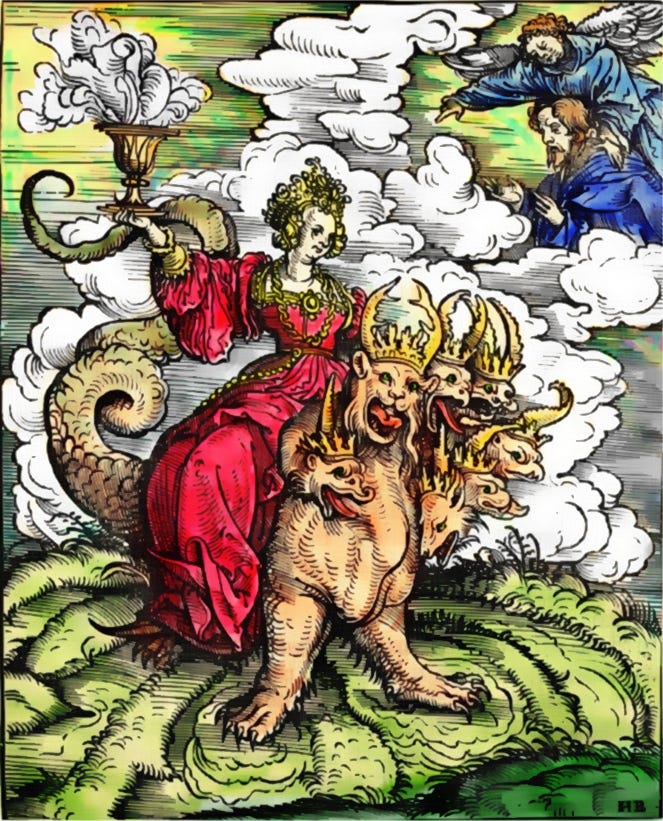
Woodcut of “The Whore of Babylon” by Hans Burgkmair the Elder, 1523 (public domain)

The Bible has its good guys and its bad guys, but it’s the wicked women who consistently attract top billing. Here is a list of some of the most notorious ones.

NOTE: Since inserting words like “supposedly” and “myth” may upset some people, for purposes of this story, I’m going to treat this information as the “gospel truth.” Believe whatever you like. Did these gals get a bad rap? Maybe, but that’s a discussion for another day.

Eve

“The woman said to the serpent, “We may eat fruit from the trees in the garden, but God did say, ‘You must not eat fruit from the tree that is in the middle of the garden, and you must not touch it, or you will die.’” — The Book of Genesis 3:3–4
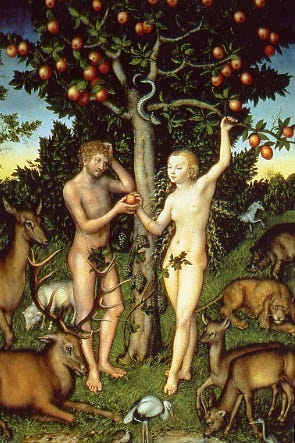
“Adam and Eve” by Lucas Cranach the Elder, 1526 (public domain)

Everybody knows Eve, the first woman who God fashions from the rib of the first man, Adam. Adam and Eve have a sweet deal in the Garden of Eden, but Eve blows it. According to the Good Book, we have her to thank for the world’s woes, including pain during childbirth. Thanks a lot, Eve!

She gives in to temptation by the serpent and eats the fruit from the Tree of the Knowledge of Good and Evil (not an apple, by the way). What’s worse, she gets poor dopey Adam to do it, too. The result is that God expels them from the Garden and makes them live in the real world where things are pretty bad in comparison. Harsh.

Lot’s Wife and Daughters

“And it came to pass, when they had brought them forth abroad, that he said, Escape for thy life; look not behind thee, neither stay thou in all the plain; escape to the mountain, lest thou be consumed.” — The Book of Genesis 19:17
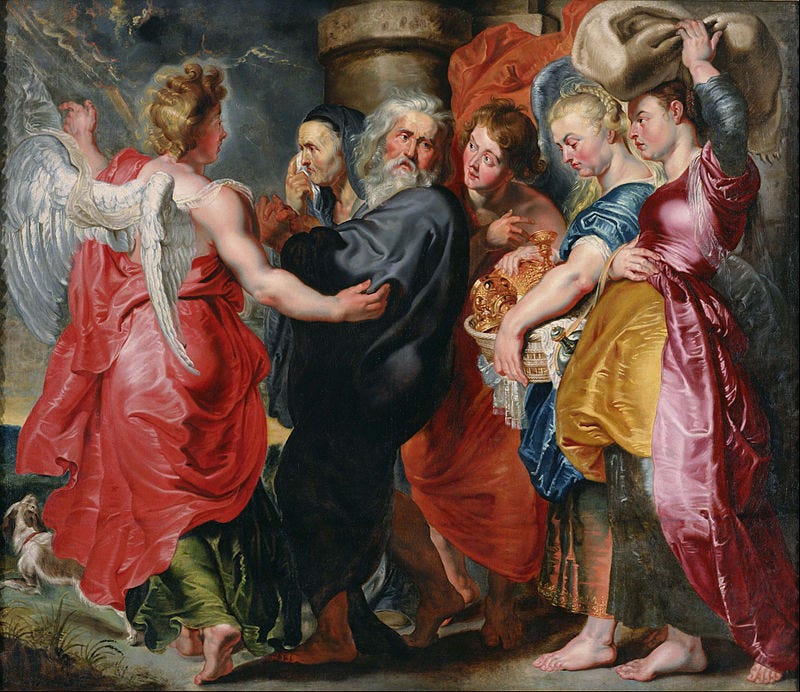
“The Flight of Lot and His Family from Sodom” by Jacob Jordaens, c. 1620 (public domain)

Once again, a virtuous man is stuck with a sinful woman. In this case, three of them. The Bible doesn’t tell us Lot’s wife and daughters’ names, so we know who the relevant person in this story is supposed to be.

God-fearing resident of Sodom Lot gets the heads up from an angel that God is going to destroy the evil-doer infested cities of Sodom and Gomorrah using extreme prejudice. So he and his family high-tail it out of there in the nick of time.

The angel also tells them that they must not turn around and look back at the city once they leave, but Lot’s wife just can’t help herself. For this lapse in judgment, God turns her into a pillar of salt. So Lot and his daughters escape to a cave in the mountains without her. The situation is pretty lonely for all concerned since they are stuck in the cave indefinitely.

One of Lot’s daughters decides to get her father drunk and have sex with him. She then convinces her sister to do the same thing. The rationalization for this is to ensure that their father’s “seed” survives.

The Bible doesn’t mention any punishment for this unique solution to the problem of getting a date for Saturday night. The daughters become pregnant, bear their half-siblings, and everyone lives happily ever after.

Potiphar’s Wife

“…after a while his master’s wife took notice of Joseph and said, “Come to bed with me!” — The Book of Genesis 39:7
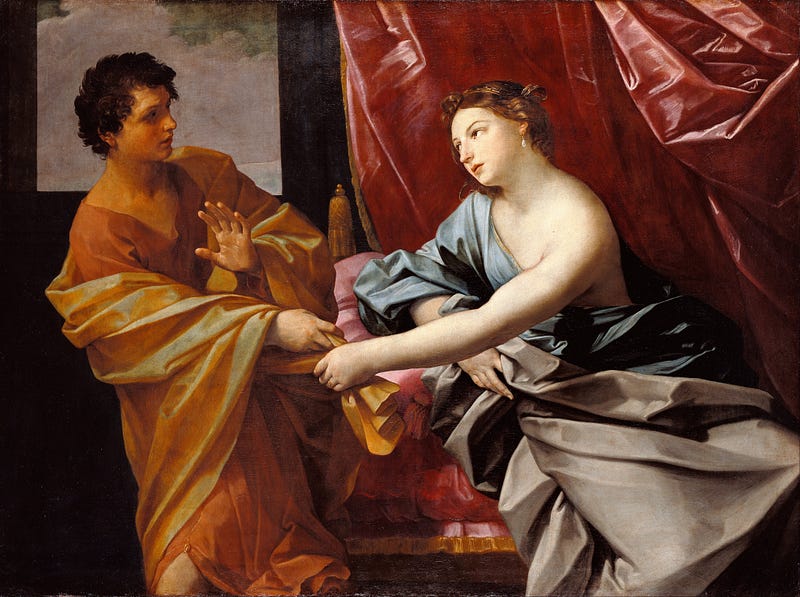
“Joseph and Potiphar’s Wife” by Guido Reni, 1630 (public domain)

Joseph’s brothers are jealous of him because their dad likes him best, so they sell him into slavery. He becomes the property of a wealthy man named Potiphar.

Joseph works his way up to an essential position in the household. Things are going pretty well until Potiphar’s wife takes a shine to young Joseph and tries to seduce him. When Joseph refuses her advances, she tells her husband that Joseph tried to rape her. Potiphar has him arrested and thrown in prison. Mrs. P. presumably has to find another boy toy to hit on.

There’s a funny musical number in the Broadway musical Joseph and the Amazing Technicolor Dreamcoat about what happened to Joseph at the hands of Mrs. Potiphar. Check it out below.

Delilah

So Delilah said to Samson, “Tell me where you get your great strength and how you may be bound so as to be made helpless.” — The Book of Judges 16:6
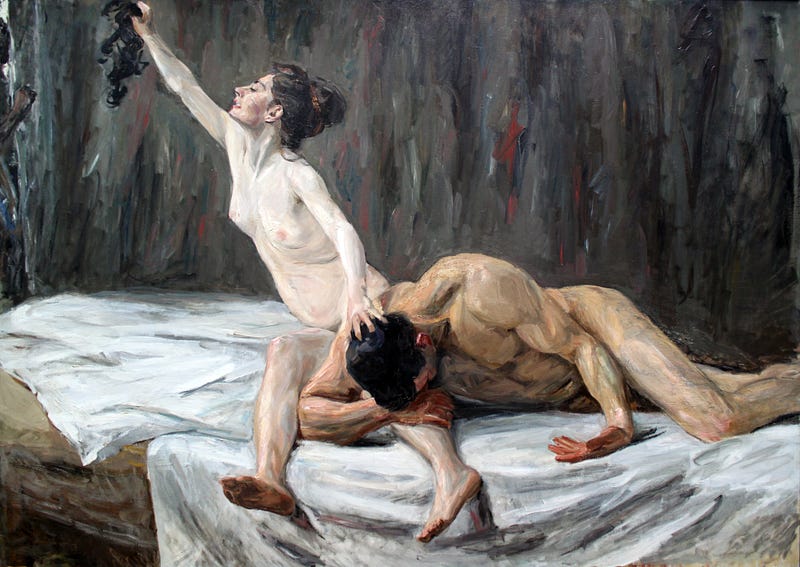
“Samson and Delilah” by Max Liebermann, 1902 (public domain)

Samson is an Israelite who uses his extraordinary strength against the Philistines. He falls in love with Delilah, a woman of Sorek.

The lords of the Philistines offer Delilah beaucoup bucks if she can discover the source of Samson’s great strength and disclose it to them.

As you can see from the quote above, Delilah tips her hand so, naturally, Samson doesn’t trust her. He tells her some fairy tales about bowstrings and looms, but finally gives in and tells her that the source of his strength is his hair. Delilah cuts Samson’s hair off, turns him over to the Philistines, and goes on her merry way considerably richer.

Jezebel, Queen of Israel

“And as if it had been a light thing for him to walk in the sins of Jeroboam son of Nebat, he took as his wife Jezebel daughter of King Ethbaal of the Sidonians, and went and served Baal, and worshiped him.” — 1 The Book of Kings 16:31
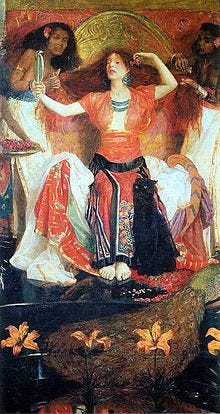
“Jezebel” by John Liston Byam Shaw, 1896 (public domain)

This time the chump is Ahab, King of Israel. After his marriage to Phoenician Princess Jezebel, she convinces him to turn his back on Yahweh and worship the fertility god Baal.

Jezebel has most of the prophets of Yahweh put to death, but the prophet Elijah escapes after telling Ahab that there will be a drought until he changes his ways.

After a couple of years of drought, Elijah comes back and proposes a contest to determine who is more powerful: Yahweh or Baal. Yahweh wins, and the drought is over. Then Elijah orders the execution of the prophets of Baal. Jezebel is not down with this idea, and Elijah flees once again into the wilderness.

Ahab has his eye on a vineyard that’s not for sale, so Jezebel successfully plots against the owner Naboth who is stoned to death on trumped-up charges. Ahab then takes possession of the vineyard. At this point, Elijah comes back and confronts Ahab about his crime. He tells Ahab that his entire kingdom will reject his authority and that dogs will eat Jezebel, so Ahab repents.

What happens next is complicated. Suffice it to say that Ahab dies in battle, his line does not continue, and Jezebel’s eunuchs throw her out a window. At this point, she does indeed become dog food. Bummer.

FUN FACT: There is a term for killing someone by throwing them out of a window. It’s called “death by defenestration.” You wouldn’t think a particular name for that would be needed, but there you have it.

Bathsheba

“One evening David got up from his bed and walked around on the roof of the palace. From the roof he saw a woman bathing. The woman was very beautiful, 3 and David sent someone to find out about her. The man said, “She is Bathsheba, the daughter of Eliam and the wife of Uriah the Hittite.” — 2 Book of Samuel 11:2–3
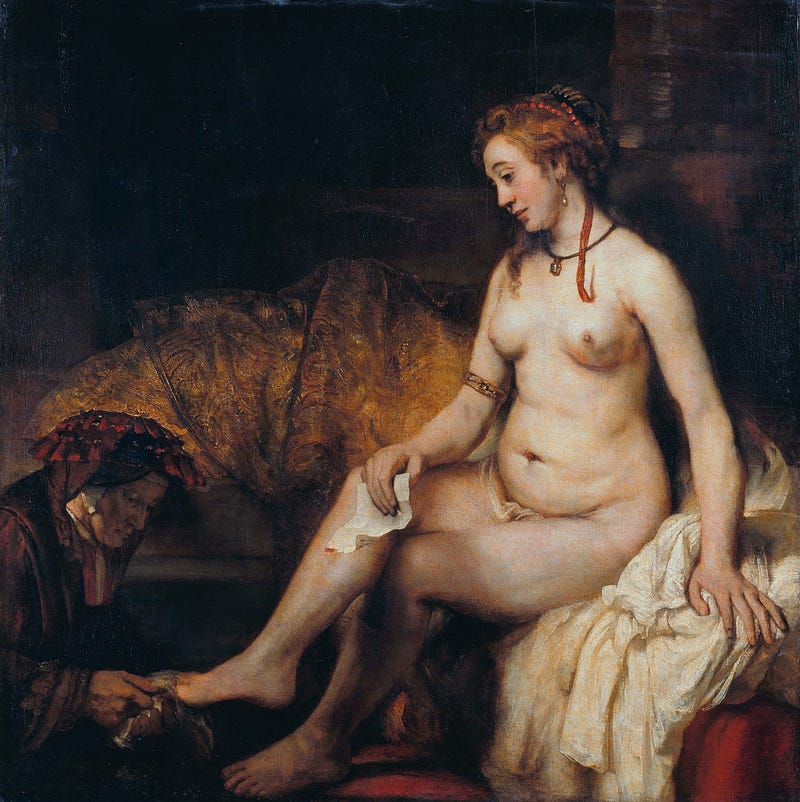
“Bathsheba at Her Bath” by Rembrandt, 1654 (public domain)

Bathsheba was the wife of Uriah the Hittite, a soldier in King David’s army. While Uriah is busy fighting a war, David takes a walk on his roof, looks down, and sees the lovely Bathsheba taking a bath. David lusts after Bathsheba, and she betrays her husband and becomes pregnant by David.

David makes sure that Uriah dies in battle before the fact that Bathsheba is pregnant by somebody else becomes an issue. David marries Bathsheba, but God is not happy with him. He sends the prophet Nathan to David to give him a bad time, and he repents.

Bathsheba gives birth to Solomon, who succeeds David and becomes a very wealthy and wise king. Tradition assigns more blame to Bathsheba than she deserves. It’s David who screws up. God punishes him by taking his favorite son Absalom from him and not allowing him to build a temple for the Ark of the Covenant.

Herodias and Salome

“Prompted by her mother, she said, “Give me the head of John the Baptist here on a platter.” — The Book of Matthew
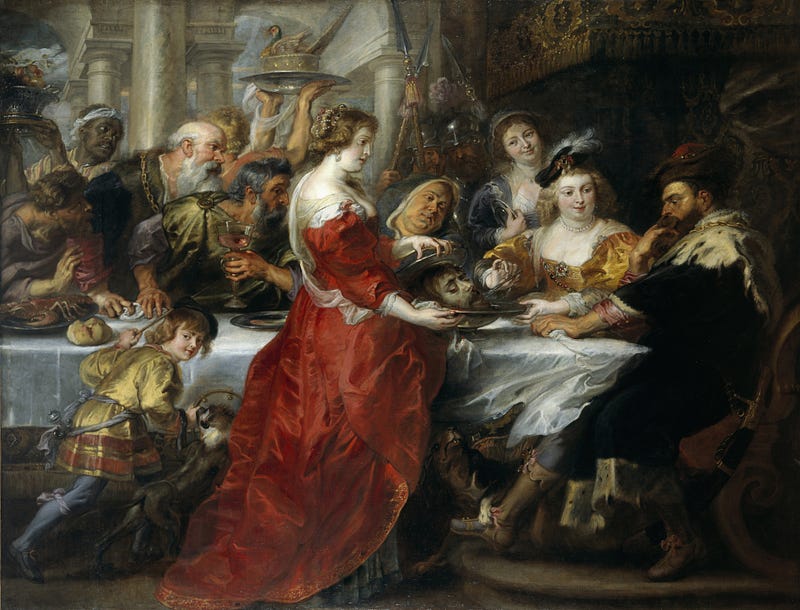
“The Feast of Herod” by Peter Paul Rubens, c. 1637 (public domain)

Herodias was the wife of Herod Antipas, and Salome was her daughter by a previous marriage to none other than Herod Antipas’ brother Herod II.

John the Baptist preaches against Herod marrying his very much alive brother’s wife, and Herodias has her husband throw him in prison.

Salome dances for her uncle/stepfather at a banquet in honor of his birthday. Antipas is so pleased with her performance that he offers to give her whatever her little heart desires. Salome consults her mother. Herodias, who is holding a grudge against John the Baptist for publically denouncing her marriage, tells Salome to ask for his head on a platter, so she does. Antipas isn’t happy about it, but a promise is a promise. I can’t imagine the dinner guests were too pleased about it either.

The Whore of Babylon

“And there came one of the seven angels which had the seven vials, and talked with me, saying unto me, Come hither; I will shew unto thee the judgment of the great whore that sitteth upon many waters; With whom the kings of the earth have committed fornication, and the inhabitants of the earth have been made drunk with the wine of her fornication.” — The Book of Revelation 17:1–2
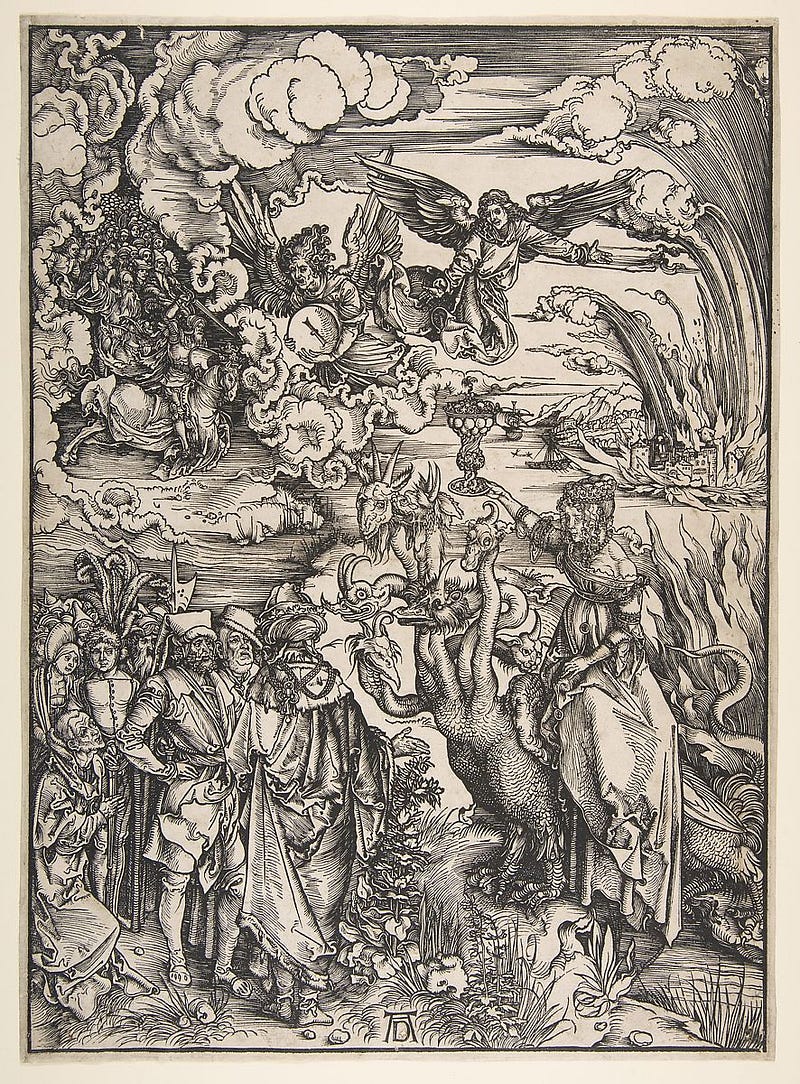
“The Whore of Babylon” woodcut by Albrecht Dürer, 1498 (public domain)

You may have heard someone slut-shame a woman by calling her “the Whore of Babylon,” and wondered, “Who is the Whore of Babylon anyway?” Well, that’s a good question and one on which there’s a fair bit of disagreement among biblical scholars.

The Whore of Babylon appears in the Book of Revelation, which is the only apocalyptic document in the New Testament. It tells of the end of the world and the Second Coming of Christ in grandiose and obscure terms, and it is open to numerous interpretations.

All agree, however, that the Whore of Babylon isn’t an actual person but the personification of something else like the Roman Empire or Jerusalem. One interpretation suggests that the whore isn’t an earthly city at all but a spiritual state, while another maintains she is supposed to be the Roman Catholic Church.

Whatever she represents, she wins the prize for the wickedest woman in the Bible. Check out this description and see if you don’t agree:

“I saw a woman sit upon a scarlet colored beast, full of names of blasphemy, having seven heads and ten horns. And the woman was arrayed in purple and scarlet color, and decked with gold and precious stones and pearls, having a golden cup in her hand full of abominations and filthiness of her fornication. And upon her forehead was a name written, MYSTERY, BABYLON THE GREAT, THE MOTHER OF HARLOTS AND ABOMINATIONS OF THE EARTH. And I saw the woman drunken with the blood of the saints, and with the blood of the martyrs of Jesus.” — the Book of Revelation 17:3–6

It’s hard to top that. There are also inspiring Bible stories about virtuous women, but I would argue that you might find them a little less exciting.

History
Bible
Feminism
Women
Morality
Recommended from ReadMedium