
6 Ways to Generate Ideas
What I teach my students about brainstorming
You have good ideas. What you need is a way to recognize those ideas and use them, to turn them into articles, stories and poems.
I’ll tell you what I tell my students in college English: pay attention to what you’re thinking, and mold those thoughts into great ideas on paper.
Step 1: Meditate
Some people respond well to meditation, and if you’re one of them, or even if you haven’t tried meditation before, you might find ideas in quiet thought.
Close your eyes and be still, in a comfortable sitting position. Focus on your breathing. Your mind will wander; it’s natural, and part of the process.
When you notice your mind wandering, gently say to yourself, “Look, a thought about ___!” and then go back to your breath. Do this for as long as you feel comfortable.
Step 2: Brainstorm
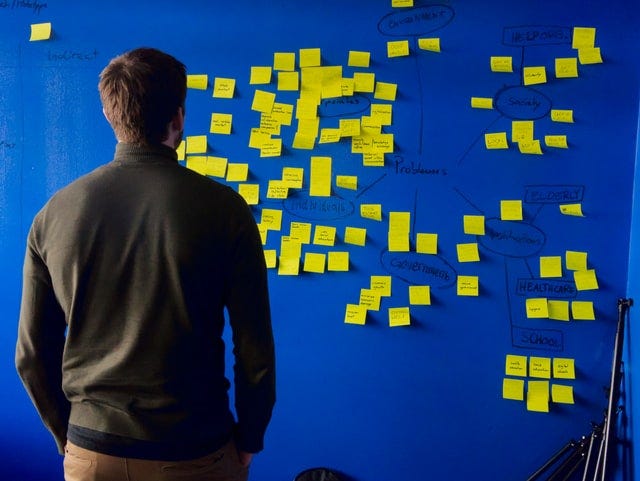
Next step is to do some thinking with paper in front of you. That might be a computer screen or a physical notebook. Find some time when you can really devote yourself to quiet thought.
Then examine what’s happening in your life, possibly using what you learned during meditation. At this stage, I told my students to think about the book they were writing a paper on, and to imagine it as a whole. Then they should put down their general impressions of it without judgement of those impressions.
In this case, if you are generating ideas for articles, fiction, or poetry, look to what you have been thinking about. Examine your own thoughts and put them on paper, without judgement.
Simply notice them and put them down. Try to fill a page with random thoughts, large and small.
Maybe your observation is that you have no thoughts. What an amazing concept! You have no thoughts! How is that possible, and is this enlightenment? Is this what nothingness looks like?
You are thinking of what you need to do today, or how to cook later, or the fact that you need to use the bathroom.
How do you feel about those thoughts? Can you write about how you feel? Is there anything controversial about those feelings? What history, personal or societal, can you point to?
In other words, write it all down, and sort through it later. Remember, no judgement. NO JUDGEMENT.
Step 3: Take a break
Walk away from your list and do something else. Make yourself some coffee. Read a book. Look out the window or take a walk.
Pet the cat. Think about why you don’t have a cat and question those choices. Possibly you have a dog who would eat the cat. Hmm.
The main job you have in this phase is to relax. Let it go, whatever it is. Don’t push. Just be.
Notice your anxiety and greet it: “Hello anxiety, old friend. Looks like we’re together again.” Or not! Do what you want! Just relax. RELAX.
Step 4: Buckle down
Now’s the time. Pounce. Look at your list with a critical, judgmental eye. Are there any ideas that might be fruitful? Can you make any associations with anything on the list?
Ask yourself what the list says about you. Could that be something other people might feel as well? Is it useful? Maybe you want to write about something and not publish it.
What? Write and not publish? What for!
Maybe there are some thoughts you put down that could be researched into shape. Maybe you have some ideas on the list that could lead to a character you want to write about, or something you want to shape a poem around.
Do you like the sound of the language you used? Can you picture anything, or hear anything, or smell something?
Step 5: Pick something a develop it
I hope at this point you have an idea, or lots of ideas. Think about form. How best can you express the idea(s) you have? Maybe your idea could be best expressed as a painting, a poem, or an article.
If your idea is for your workplace, you might not want to consider interpretive dance, though that’s always a possibility and one that might shock your co-workers into the moment.
Isn’t living in the moment the point of all this? This thing called life? You’re an ARTIST, after all.
Step 6: Do it all over again
Repeat the process. Realize once again that you want to do this, that you indeed MUST do this, because you are alive, and you are participating in your life.
If that is not the point, write about what is the point, and publish that. I am eager to read it.

Follow The Orange Journal so you don’t miss a post. Do you love to write about self-improvement and personal development? Learn how to be added as a writer here. 🍊