
6 Steps to Crank Up Creativity
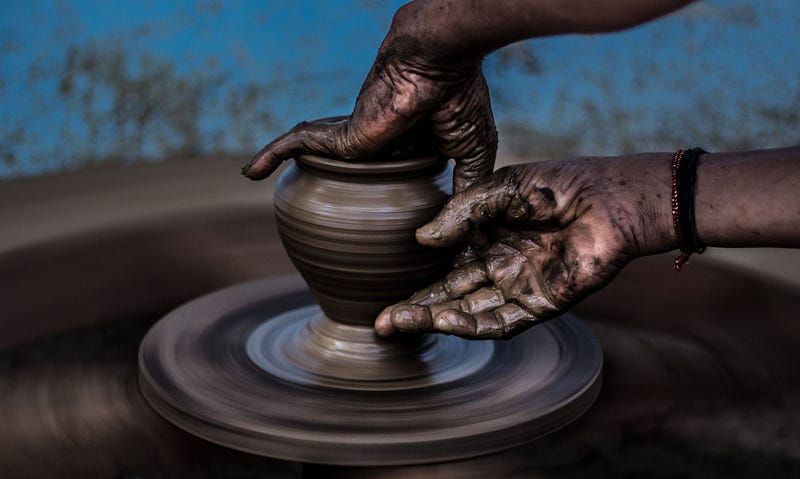
Do you feel you are swimming in mud instead of shaping it? How to pump up that creative muscle.
Write that novel. Sing that song. Develop that comedy act. Find a new career. There is that Something that has been niggling at you for some time. How do you make it happen?
I have used this process for writing a thesis, finding a new career, even creating better relationships. Whatever you want to create can be done. There are only six steps and everyone is capable.
The six steps are:
- Dream
- Dare
- Discover
- Do
- Detach
- Do it again
Each step requires time and energy. Allow yourself that as you work through the process. Know in advance creating is changing, and that is a challenge, but one worthy of your life.
There is no growth without change and you are worthy. There is a reason you have had this desire in the back of your head, popping up like a wily weasel. Don’t ignore it. Grab it by the neck. There is no better time than the present to address it. Take a breath and jump in.
1. Dream
The first step should not be dismissed.
You may be tempted to say to yourself, Oh yeah, I know what I want to do, and jump to step two.
Don’t.
Pause and really consider — have you always wanted to cruise around the Pacific in a sailboat? develop a new career in a totally different field? compose music? What is your dream?
Claim it and name it.
Then spend time envisioning it. What would that look like?
Intentionally imagine every aspect of that dream.
Imagination is required and time to flesh out that vision to almost concrete status. What does it look like? What does it feel like? To own that boat or write that book?
Daydreaming helps you to meet goals and expand your creativity. Like anything, it requires time. You are creating those goals as you dream about it. Give yourself permission and the time to actively think.
This is not something that is encouraged by our go-go society, yet it is imperative for a healthy and full life.
I find being in Nature fosters my dreaming. Where can you sit and think in quiet? Find that place and flesh out that dream.
It is your reason for living.
The alternative is best voiced by poet, Langston Hughes:
Hold fast to dreams For if dreams die Life is a broken-winged bird That cannot fly.
Hold fast to dreams For when dreams go Life is a barren field Frozen with snow.
Once you have that dream firmly fixed, give yourself permission to move to the next step.
2. Dare
For many people, making a vision board aids in this process. Putting that dream down on paper where it can be seen is powerful, but cannot be done until you first discover by dreaming what you want to create.
It takes a measure of courage to say, “This is it.”
A vision board will give you a reminder every time you glance at it, but it also broadcasts something to people who see it. (It is your choice whether or not you keep it private, but posting it where you can see it is important.)
Your dream is a change in the positive direction of your life. Other people may be challenged by it.
You most certainly will be.
There really is no alternative when you consider Langston Hughes’ words. If something has been poking your subconscious, it is overdue for being addressed.
You are stuck until you move forward.
Change requires courage, and for most a stagnant life is an option.
Not for those who choose to follow their dreams.
You are not that person if you are reading this. You are choosing to get un-stuck, move forward, embrace the life that calls to you. There is something in you prompting you forward.
Dare to chase it.
Realize there are risks. Accept those risks.
In order to lessen the risk, take the third step.
3. Discover and Develop
This is the stage of research which will help you to decrease the risks involved with your change.
Are you hoping to improve your relationships? If you have defined that through dreaming and daring to hope, start reading and researching how to do that.
Are you wanting to compose music? Are there lessons online? Is there a local teacher? What if you simply want to play an instrument?
Everything can be googled. Everything.
Do not stop with google. Good research involves interviews. Talk to those who have experience. Experience is invaluable. What have they tried that was successful? or not? Save yourself from repeating their failures by learning from them.
Ask for help.
When I needed to re-do my house with very little money, I hung out at Home Depot and followed people around based on their appearance. When I needed to paint, I followed a man with splotches on his clothes and asked, “I bet you’ve painted before, but I have not and would really love your advice.”
This drew a laugh and good advice.
Find your HomeDepot and be open to learning. Most people love giving advice, especially about a subject they know.
Be open to the process.
Do you want to move into a different career field? Can you speak to someone in that field? How did they get there? What do they recommend?
Do not forget the library and reference librarians. They know more about searches than most and are available to help, even online.
Develop questions and keep a curious mind. What do I need to move forward? Who should I talk to next?
Pretend to be a reporter and constantly ask: who, what, where, why and how?
Consider each search another layer of onion, you are working to peel away. Consider all learning a beautiful thing.
It is.
Develop a plan for your growth towards your dream. This may involve saving money, or scheduling time.
Once again put it on paper. A visual representation serves to remind you.
In this step, you are also developing support. Many of those you interview may ask to keep in touch. If not, do not be shy about asking to add them to your network. This is invaluable.
Build support as you develop your plan.
In this process, each step forward involves all the preceding steps. As you discover, keep dreaming. It will provide motivation.
As you work on discovery, incorporate daring. Dare to approach people you admire and want to learn from. Dare to ask, “Who do you know that I could speak to about this?”
Discovery is not independent of daring. Daring is not removed from dreaming. They are all inter-related to moving a dream from vision to reality.
Persist in dreaming, daring and discovering.
They will propel you forward.
You may never feel completely ready to take the fourth step, but at some point you will need to:
4. Do
Take the first step towards your goal.
Buy that instrument. Tell your partner you want change. Inspect boats for your trip. Put pen to paper. Commit to a teacher or class. Spend some money on this dream.
This may feel scary. It is. It involves a belief in you and movement in a positive direction. You have the data (from the discovery stage) and the mental drive (from dreaming) to support what may feel shaky.
As you re-visit the dreaming stage, listen closely.
What is your mind saying? Positive or negative statements will pop up. “What were you thinking? You can’t do this!”
or “You’ve got this! Just persevere.”
Be open to criticism, but mindful of your own. Those negative thoughts are keeping you in a place of discontent. Choose to dream and replace them.
Instead of saying, “I can’t do this!” replace it with “I can’t do this yet, but I will.”
Fumble through your first attempt and check it off as a learning experience, whatever it is — your first attempt to get published, your first song on a musical instrument, your first time sailing a boat.
No one is a master on their first attempt. No one.
That is why a sixth step is required.
5. Detach
Your spouse laughed at your attempt to be more loving. Your submission was rejected. You crashed that boat into the dock. No one responded to the humorous post on Twitter. You put on weight while dieting.
Should you run back to your comfort zone, tail tucked between your legs?
No.
Should you detach with love? Absolutely.
Take it for what it was — a great first attempt, a bold and daring step into a great adventure called your life.
Do not diminish it. Be open to learn in what feels like a failure. This is key to progress.
Embrace it.
Failure is the key to success
I started learning tennis and connected my racquet to the ball easily at first, but then noticed I began missing more.
My coach said, “Keep your eye on the ball,” something I had been doing at first, but later got distracted watching his movement, the net, etc.
It seems like simple advice, but it was absolutely correct.
Stay open to correction. Is there someone willing to read your writing and give you feedback? Is there a counselor to help in your relationship? What does the sailing coach recommend?
Whatever your dream, find a way to step forward.
This process is repetitive.
Return to research.
Ask for advice.
What if your first attempt is wildly successful? Do you still detach?
First, celebrate.
Then, detach.
Commit to the process of creativity and get back into the cycle. Your life is not over yet.
6. Do it again
That’s right. Failure feels awful. It is scary to try.
Each time will feel better. As you practice the cycle of creation, you are creating a new you.
A wiser, better version.
Giving up is not an option. You have stepped outside of your comfort zone and you are just beginning to learn your capabilities.
If you ever tried a new exercise, you know new muscles will be sore the following day. You also learn that the soreness diminishes as you stretch and use those same muscles.
The sooner you repeat, the sooner the soreness dissipates.
The same is true for creating — get back to it. Incorporate feedback from mentors/teachers/coaches.
Stay open to learning.
I got my current position after applying 7 times and interviewing with at least 3 people. Each person I interviewed with, gave me tips for the next encounter. Each time I learned.
I did not give up. Don’t you.
Go back and dream about a better future. Dare to risk what it takes to get there. Discover the steps you must take, developing support and a plan as you go. Jump and actually do that which you dreamt about, but be willing to detach and learn, learn, learn.
Then, do it all again.
Embrace this cycle to create that which prompts your dreams — a new business, a new hobby, a better you.
Let me know how it goes.
Cat practices cold submersion and works in Non-Destructive Testing. You can read more on her blog:
Or how she incorporated change into a cycle of creativity for a new life: