
3 Ways You Won’t Persuade a Trump Voter (And 3 Ways You Might)
The science behind why your attempts at persuasion fail — and what to do instead.

To change hearts and minds, stop making these common mistakes and start doing what works.
All over America, Democrats are working hard to elect Biden and an important part of that effort is persuading people that voting for Trump is a mistake.
While persuasion is a critical component of any winning strategy, our methods often make things worse, putting us on a war-like footing with the Trump supporters in our lives. We are so terrified about where the nation is headed that our first instincts are to close up, push back, and strike out at our friends, family, and neighbors rather than reach forward and pull them closer in a way that can actually change hearts and minds.
In the heat of the moment, Biden supporters tend to wield Three Big Weapons to persuade people who disagree with us:
1. Debate — hit ’em with arguments and facts
2. Shame — if that doesn’t work, try call outs, bad names, and colorful, descriptive epithets
3. Ostracism — if they still don’t get it, bring on the banning and shunning
The trouble with these aggressive responses, however, is they don’t work. More often, instead of getting through to people, we unintentionally:
- Undermine our credibility
- Step on our message
- Reinforce opposition
- Discourage future political discussion
To really change public opinion and build support for Biden and the progressive movement as a whole, we need to draw folks in rather than drive them away. That means putting down those three destructive weapons and picking up tools capable of turning adversaries into allies.
Here’s a quick primer on why our current approaches fail and what to do instead.
PUT DOWN: Debate
Our first impulse when talking with Trump voters is to try to persuade them with arguments and evidence. However, science shows this debate-style approach doesn’t work for three primary reasons.
1. Reactance
When we debate, we actively try to shape what others think, believe, and do through the use of facts and reason. For Trump supporters, though, it can feel like we are trying to impose our will on theirs. When that happens, they experience a psychological phenomenon known as reactance: “an acute negative response to the perception of being controlled” that generates an urge to resist, no matter how reasonable or well-supported our arguments.
2. Defensiveness
Debates often get heated even when we don’t want them to. A major reason that happens is because people tend to experience attacks on their political beliefs as attacks on them personally. When we tell a Trump voter, “your idea is bad,” they’re likely to hear, “you are bad” even if that’s not what we mean. As a result, they’ll feel they have to rebut our arguments in order to prove they are a good person.
3. Motivated cognition
The human mind is biased toward our existing worldview. From an evolutionary standpoint, this makes sense. If our current belief system has kept us alive up to this point, better to cling to those beliefs a bit longer than necessary than go through the energy-intensive and risky process of revising our opinions. The down side of this stability, though, is that people are far less likely to perceive, seek out, listen to, and incorporate facts and arguments that challenge their existing beliefs. As a result, when we present Trump voters with information contrary to their opinions, they are naturally inclined to discount our evidence and generate new rationalizations for why they are right.
PICK UP: Motivational interviewing
If providing reasons to vote against Trump won’t change voters’ minds, what should we do instead? Simple. Encourage them to generate those reasons themselves.
As the French polymath Blaise Pascal once said, “People are generally better persuaded by the reasons which they have themselves discovered than by those which have come into the mind of others.” An argument that’s not persuasive coming from us can be very persuasive when it’s coming from Trump supporters themselves.
This approach takes advantage of the inconsistency and ambivalence of voters’ political attitudes and beliefs. Most Trump supporters, for example, aren’t particularly happy with his tweeting, treatment of women, or the way he’s handled the pandemic even though they plan to vote for him. To shift their evaluations of the president, we need to highlight these contradictions and encourage them to get in touch with their more negative thoughts and feelings by asking questions.
One good approach is to ask the following:
How would you describe the ideal president?
How close do you think President Trump comes to that ideal?
In what ways does he fall short of your ideal president?
This approach, called motivational interviewing (MI) was originally developed as a psychotherapy technique to help people overcome addiction, but is increasingly recognized as a tool to avoid counterproductive reactance and defensiveness in any situation where people are contemplating change.
PUT DOWN: Shame
By the time we realize the Trump voter we’re talking with is impervious to our arguments and evidence, we’re usually frustrated and weary. It’s at this point that otherwise respectful conversation degenerates into heated argument as we slip from criticizing a voter’s ideas to criticizing them as people.
Sometimes this shift is blatant: We start calling people out, calling them names, and calling in the troops while lobbing a few choice profanities along the way.
More often though, we’re subtler in our attacks, impugning others’ motives while making sweeping generalizations about their character. Disagreeing about economic policy becomes, “You’re selfish.” Disagreeing about affirmative action becomes, “You’re racist.” And voting for Trump becomes, “disgusting.”
But science shows us this kind of shaming is an ineffective method for changing minds for three big reasons.
1. Fight-or-flight
No matter how much the name calling and finger-wagging may feel (and be) justified, it’s bound to trigger people. The normal response to being called out and shamed is fear and an impulse to fight back to or flee. If the Trump voter opts to fight, the end result is retrenchment and hostility, not opinion change. If they opt to flee, the opportunity to share an alternative perspective is lost. Either way, progress is thwarted.
2. Cognitive shutdown
An added disadvantage of triggering someone’s fight-or-flight response is the effect it has on the reasoning and information-processing parts of the brain. When people are in a state of fear, the most primitive parts of the brain take over. The cerebral cortex largely shuts down, making it very hard to think clearly or process new information. As a result, when triggered, Trump voters are unable to learn or do the intellectual work opinion change requires.
3. Empathy failure
An important part of political persuasion is encouraging people to engage in perspective taking: the process of imagining the world through the eyes of others different from themselves. Unfortunately, when Trump voters are feeling attacked and shamed, they are likely to momentarily lose their capacity for empathy and compassion. This is because when people are shamed they‘re so consumed with alleviating their own suffering that they’re unable to see things from the perspective of others.
PICK UP: Comfort
If shaming people triggers a fight-or-flight response that undermines their capacity for change, what should we do instead? The answer is do the opposite: make them feel safe-enough to think clearly and compassionately.
The ideal political conversation helps people enter and stay in the “Growth Zone”: a place where they feel neither perfectly safe nor so overwhelmed they become frightened and defensive. When people aren’t challenged, they have no motivation to learn. When they are too threatened, they can’t learn. But when you position a conversation between those two poles, you create a space where learning is both desirable and possible.
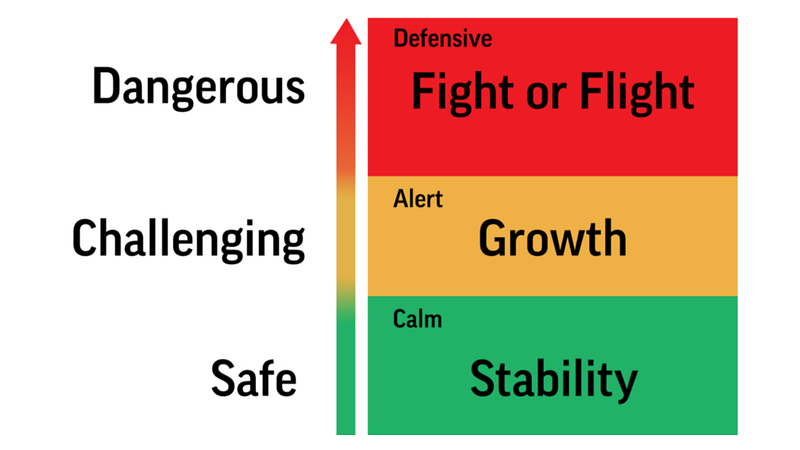
Keeping someone in the Growth Zone can be a tricky balance requiring a delicate touch (and trial-and-error practice). To positively enlighten, encourage learning by sparking natural curiosity and providing emotional support. Help folks move out an entrenched worldview without pushing or shaming them so much that they get angry and fight back or defensively shut down and back away.
PUT DOWN: Ostracism
Once it’s clear shaming won’t change a Trump voter’s mind, Democrats often resort to ostracizing them. We’ve all heard the advice to cut toxic people from our lives, and there’s no doubt that’s sometimes necessary in the interest of our own self-care. But much of the time when we sever ties with Trump voters it’s not because they’re treating us badly so much as because we’ve given up on making a difference. This type of ostracism is counterproductive for three reasons.
1. Exposure
People’s political beliefs are not innate and unchanging, but heavily influenced by environmental factors. Biden supporters tend to live in areas with a lot of other Democrats while Trump voters tend to live in areas with a lot of other Republicans. Likewise, media exposure is highly polarized, with most Democrats and independents using and trusting a wide variety of news sources while Republicans overwhelmingly trust Fox News (65%) more than any other source. As a result, when we cut off right-leaning voters, we reduce their exposure to progressive ideas, making it more likely they will continue to support Trump or, worse, support him more.
2. Social identity
Contrary to conventional wisdom, voters’ political choices are mostly driven by group identity not a coherent ideology. Trump voters largely support Trump because they are Republicans and he is the Republican nominee, not because they are particularly drawn to his ideas or even like him as a person. Since group identity is so important in shaping beliefs and political allegiances, our best hope for recruiting Trump voters to our cause is to encourage them to feel like “one of us” rather than enemies or outsiders.
3. Extremism
The final reason to abandon ostracism as a strategy is that it inflicts emotional damage that can drive Trump voters toward greater extremism. Love and belonging are fundamental human needs. When people are rejected from one group, they “go shopping” for new ones, making them ripe for recruitment by any community that makes them feel wanted and valued. In search of the emotional security of belonging, voters may end up aligning their beliefs with whatever group takes them in. Recent research, for example, has shown that ostracized individuals are more open to joining gangs and terrorist organizations target isolated and ostracized individuals for recruitment. Likewise, many former white nationalists report that the desire to belong was the primary reason they embraced an ideology of hate.
PICK UP: Connection
So if ostracism isn’t an effective way to persuade, what should we do instead? The answer is to do the opposite: Rather than end our relationships with Trump voters, strengthen them.
While it may be hard to imagine getting closer to the Trump supporters in our lives, chances are we all have more in common than we think. Begin by focusing on areas where it’s easy to find common ground (Music! Sports! Recipes! Hobbies! Cute kittens and puppies!) and then gradually introduce politics. As relationships get stronger, they will increasingly be able to bear the stress of weightier topics and the trust, affection, and respect we earn in unrelated areas will make others take our political views more seriously.
If debate, shame, and ostracism are so bad, why do we use them?
Brains are tricky things and our intuitions about what’s going on in the minds of Trump voters can easily lead us astray. Often, we reach for these weapons because we truly believe they will work: If we can just get them to understand the facts, they’ll see the light!
But let’s be honest. More often than not, we reach for these bludgeons because using them feels good. Whether we’re Shining the Torch of Truth in a dinner-table face-off, piling on a Twitter shame-fest, or hitting the “unfriend” button on Facebook, we get a dopamine-rush of self-righteous satisfaction that’s as pleasurable and addictive as any street drug.
The first step in making the transition from weapons of war to tools of persuasion, then, is to ask ourselves what matters most: Feeling good or making a difference?
If you really care about electing Biden and ensuring that Trump doesn’t spend another four years in office, your choice is clear.
About the Author
Dr. Karin Tamerius is the founder of Smart Politics, a former psychiatrist, and an expert in political psychology who specializes in teaching progressives how to communicate more productively and persuasively with people across the political spectrum. She’s best known for writing the Angry Uncle Bot in the New York Times. Email her at: [email protected].
Many thanks to Locke Peterseim for assistance writing and editing this piece.


