
Is Google BigLake Superior of all Data Warehouse and Lake Solution?
How Google attacks other Providers like Amazon, Microsoft and Co.

With BigLake, Google has released a new service that lets you build Data Lakehouses and Data Mesh Architectures with relative ease. Learn more here.
Strengths of other Solutions
Each Data Warehouse solution has its own strengths and weaknesses. Amazon, for example, has the most customers in the cloud. This means that many customers already have databases and systems running in the AWS cloud and may choose Redshift due to simple and existing interfaces.
The same applies to Microsoft customers, where Microsoft’s many years of market dominance mean that there is a lot of software and programming available, e.g. in the area of VBA and .NET, so that Azure is more likely to be chosen here. Snowflake has its strengths in that it runs on all major platforms and is therefore more independent.
Google’s Strength in the Data Science Market
However, I see Google’s strengths in the fact that, for me personally, Google is one of the leaders in the market when it comes to Data Science. They offer countless tools and services in the areas of artificial intelligence, business intelligence, etc. Google has a variety of different instruments such Data Studio and Google Analytics are good tools for analysis in the marketing and web area, whereas unique tools like BigQuery ML which users can run with SQL Machine Learning. With the integration of Google Sheets and other BI tools, they also compete with Microsoft in the area of self-service BI.
Google BigLake as a Bridge
As already mentioned, Google definitely has its strength in the Field of Data Science but might have to catch up with the bigger cloud providers of Amazon and Microsoft. Therefore, Google launches BigLake. It is designed to allow companies to unify their Data Warehouses and Data Lakes without having to worry about the underlying storage format or system. You can easily access Google internal storage as well as cross-platform data such as Microsoft Azure or AWS within BigQuery using SQL, without having to cache it. It’s a big benefit that you don’t have to duplicate your data in two different environments and create data silos. You can also support your data governance because with BigLake you can also assign rights to the data.
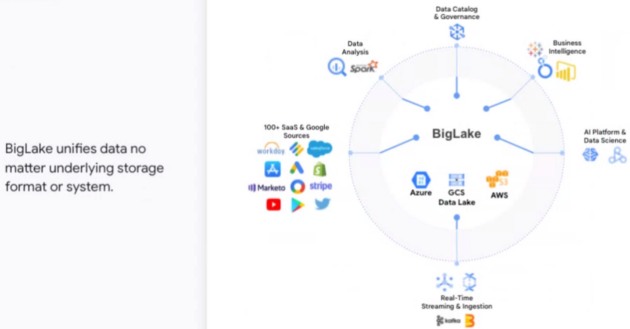
With the new capabilities you and your organization will gain more power and benefits in your daily data integration and analytics processes — like better security and governance controls, performance and scalability and easy data control [1].
Summary
Each Data Warehouse solution has its strengths. Above all, Microsoft and Amazon can score points with many customers on their cloud. In my opinion, Google has advantages in the area of data analytics. With Google BigLake, companies now have the opportunity to connect their systems to Google’s powerful data tools, regardless of the cloud. A smart move by Google to reduce the dominance of Microsoft and Amazon in the cloud area, while making their own solutions more palatable.
Sources and further Readings
[1] Google, BigLake (2022)