/ipfs.io/ipfs/QmUMPt9mBbJ4CQS36GNRrcmTYDnjtdXtsN8QWMBYKM3QNF">unencrypted high frequency</a> (HF) radio for long-range communications and mobile phones to communicate.</p>
<figure id="29af">
<div>
<div>
<img class="ratio" src="http://placehold.it/16x9">
<iframe class="" src="https://cdn.embedly.com/widgets/media.html?type=text%2Fhtml&key=a19fcc184b9711e1b4764040d3dc5c07&schema=twitter&url=https%3A//twitter.com/radio_research/status/1499128714554052610&image=https%3A//i.embed.ly/1/image%3Furl%3Dhttps%253A%252F%252Fabs.twimg.com%252Ferrors%252Flogo46x38.png%26key%3Da19fcc184b9711e1b4764040d3dc5c07" allowfullscreen="" frameborder="0" height="281" width="500">
</div>
</div>
</figure></iframe></div></div></figure><p id="ae37">These reports are backed up by open-source intelligence.</p><h2 id="4638">Software-defined radio</h2><p id="ffd9">There is some indication that Russian troops have used more sophisticated software-defined radios (SDR), such as the R-187P1 Azart and R-168–5UN-2 tactical radios, which were worn by a Russian airborne soldier captured near Kyiv.</p><p id="cce7">The briefings provided by the Russian Ministry of Defence (MoD) over recent years has been that this equipment was widespread and that the majority of the Russian Armed Forces (RuAF) were utilizing digital radios and systems intended to help with planning and decision-making.</p><p id="d14a"><b>R-187P1 Azart</b></p><p id="61fe">The R-187P1 Azart is a sixth-generation digital tactical encrypted and jam-proof SDR. It operates in the very high frequency (VHF)/ultra high frequency (UHF) bands, has a range of 18 km in ground communications.</p><p id="50c6"><b>R-168 Akveduk</b></p><p id="10d0">This fifth-generation family of tactical digital radios, is designed to provide uninterrupted communications in an electromagnetically active environment. Variants includes HF and VHF systems designed to <a href="http://nevskii-bastion.ru/r-145bma/">provide communications</a> up to 350 km and 20 km respectively while mounted in a command vehicle and is deployed in tandem with the R-187P1.</p><h2 id="7987">Supply chain problems</h2><p id="55d9">However it seems that the use of these systems is very limited. Intelligence suggests that these systems contain a high percentage of China-sourced components. There is speculation that deliveries to front-line units have been hampered by equipment shortages due, in no small part, to <a href="https://www.kommersant.ru/doc/4712794">corruption in the manufacturing supply chain</a>.</p><div id="9849" class="link-block">
<a href="https://www.kommersant.ru/doc/4712794">
<div>
<div>
<h2>К военным поставкам подходят с гражданским азартом</h2>
<div><h3>Как стало известно "Ъ", в уголовном деле о предполагаемых махинациях на 6,7 млрд руб. при поставках в вооруженные силы…</h3></div>
<div><p>www.kommersant.ru</p></div>
</div>
<div>
<div style="background-image: url(https://miro.readmedium.com/v2/resize:fit:320/0*trbum6_kYiSdBT_2)"></div>
</div>
</div>
</a>
</div><p id="cca7">I used to speak a little Russian, but I turned to Google Translate for that:</p><blockquote id="21d8"><p>Twenty investigators of the ICR GSU have been instructed to deal with the alleged machinations with radios. As it became known to “Kommersant”, in the criminal case on alleged fraud for 6.7 billion rubles. when supplying the armed forces of Russia with radio stations R-187-P1 “Azart”, not only the investigative body changed, but also the direction of the investigation. If until now the main defendant was the former deputy chief of the General Staff- the head of the Main Communications Directorate of the Armed Forces (GUS Armed Forces) of Russia Khalil Arslanov, now the investigation is interested in the manufacturer of “Azart”. This happened after witnesses testified about a possible conspiracy between the military and merchants.</p></blockquote><p id="f899">Why am I not surprised?</p><h1 id="782a">Back to cellphones</h1><p id="e977">Use of cellphones isn’t uncommon in today’s warfare; stories of Ukrainian soldiers doing the same abound. However, <a href="https://www.instagram.com/p/CaffyMjpO3G/?utm_source=ig_web_copy_link">Nicholas Lai
Options
dlaw writes</a> about a captured Russian soldier who stated that he used his phone to communicate.</p><blockquote id="67fb"><p>‘The officers began to station themselves further and further away from the battle… They’re out of radio range at this point, and no one can reach them.”</p></blockquote><p id="9f68">The soldier goes on to explain that, because of a lack of long-range communication equipment, no one could contact the Central Command of the deployed forces and obtain orders for tactical re-deployment in response to changing threats.</p><h2 id="90d5">And that headline picture of the 128 sim-card array?</h2><p id="0325">In a series of Twitter messages, Cathal Mc Daid, CTO at Adaptive Mobile Security, described the devices employed and their significance. According to Mc Daid, the system was made up of a SIM box server that could switch among 128 distinct SIM cards, GSM gateways for connecting voice calls and SMS messages to a local mobile network.</p>
<figure id="cff7">
<div>
<div>
<img class="ratio" src="http://placehold.it/16x9">
<iframe class="" src="https://cdn.embedly.com/widgets/media.html?type=text%2Fhtml&key=a19fcc184b9711e1b4764040d3dc5c07&schema=twitter&url=https%3A//twitter.com/mcdaidc/status/1503697414301044739&image=https%3A//i.embed.ly/1/image%3Furl%3Dhttps%253A%252F%252Fabs.twimg.com%252Ferrors%252Flogo46x38.png%26key%3Da19fcc184b9711e1b4764040d3dc5c07" allowfullscreen="" frameborder="0" height="281" width="500">
</div>
</div>
</figure></iframe></div></div></figure><p id="35a2">Of course, that all relies on a cellphone tower network.</p><p id="921a">Or does it?</p><p id="8987">That Leer 3 we saw earlier in a Telegram clip is not just for jamming, it would seem.</p><p id="7dde">The system can “read” GSM networks (cellular network in the GSM 900 and GSM 1800 frequency bands) and pinpoint mobile phone users, <b>substitute itself to the network and send messages to mobile phone users in its zone of operation </b>or simply jam and neutralise the network. It has a 6km radius of effectiveness from its Orlan-10 drones.</p><p id="3ca3">There may yet be a future for cellphones on the battlefield.</p><p id="2788">As of writing, Ukraine claims to have destroyed 35 Russian UAVs since the present conflict started in February 2022.</p><p id="9ff1">I wonder, how many were being used for Russian cellphones?</p><p id="cfda">Sources: TheVerge.com, Rusi.org, armyrecognition.com, nevskii-bastion.ru, komersant.ru, twitter.com</p><p id="26b4"><b><i>About me:</i></b><i> If you follow me I guarantee variety in your inbox! I write on a wide range of topics including humor, tech and travel, together with daily news events and the minutiae of my daily life living on a boat. I also write techno-thrillers…and about…</i></p><p id="7501"><b>…technology matters of global consequence</b></p><p id="5cae"><i>If you enjoy reading stories like these and want to support other writers and me, consider signing up to become a Medium member. It’s $5 a month, giving you unlimited access to incredible stories on Medium. If you sign up using my link below, I’ll earn a small commission at no extra cost to you.</i></p><div id="86ee" class="link-block">
<a href="https://james-marinero.medium.com/membership">
<div>
<div>
<h2>Join Medium with my referral link - James Marinero</h2>
<div><h3>As a Medium member, a portion of your membership fee goes to writers you read, and you get full access to every story…</h3></div>
<div><p>james-marinero.medium.com</p></div>
</div>
<div>
<div style="background-image: url(https://miro.readmedium.com/v2/resize:fit:320/0*GlWrKzRKj-dfMYmI)"></div>
</div>
</div>
</a>
</div><p id="65e4"><i>You can follow me on <a href="https://www.facebook.com/james.marinero/">Facebook</a> <a href="https://twitter.com/jamesmarinero">Twitter @jamesmarinero</a> . On <a href="https://www.pinterest.com/jamesmarinero">Pinterest</a> you will find many of my research photos from around the world. Check out my <a href="https://www.jamesmarinero.com/">website</a> where I occasionally have a free book on offer.</i></p><p id="31b8"><a href="https://ko-fi.com/jamesmarinero"><i>Buy me a coffee?</i></a></p></article></body>
Ukraine War
Russian Battlefield Comms Problems
There appear to have been some own goals for the Russian Armed Forces in the Ukraine. So, what do they actually have available?
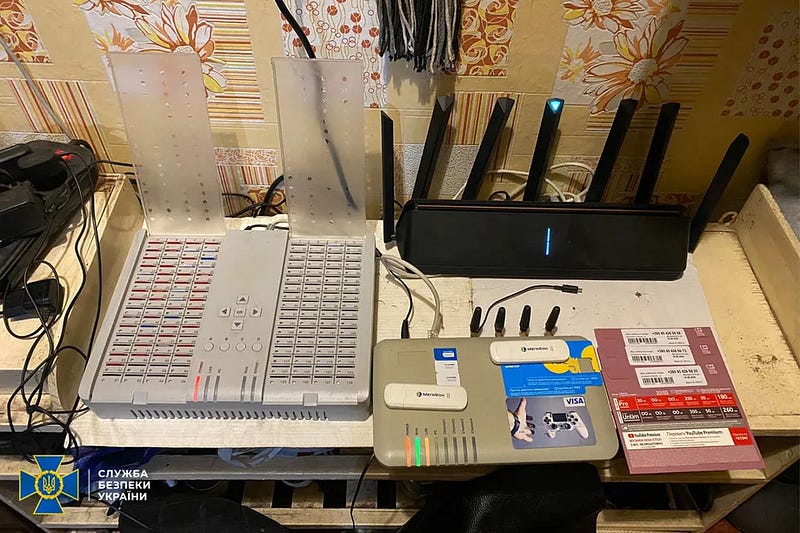
128 sim card setup allegedly used by a hacker supporting Russian forces in the Ukraine. Photo credit: Ukrainian Security Services via Twitter
Russian troops who are now operating in Ukraine have been observed utilizing insecure, consumer-grade communications technologies. Because these communication channels lack encryption, Ukrainian security personnel have been able to intercept messages sent between Russian military units since the invasion began, as I wrote about recently.
Ukrainian reports suggest that radio comms across the Russian forces are poor, leading to makeshift solutions including the use of unencrypted high frequency (HF) radio for long-range communications and mobile phones to communicate.
These reports are backed up by open-source intelligence.
Electronic warfare capability
Russia has tremendous capability in the electronic warfare arena (there’s a good analysis at Defensionem) and they are able to jam almost any system devised by man, even the radio proximity fuses of incoming artillery rounds. The problem is that some of the systems they use are liable to jam their own communications systems as well, so they are used with caution. But they are definitely in use in the Ukraine. This clip is unverified but appears to show a RB-341V ‘Leer-3', used to jam GSM (cellular) signals with the support of Orlan-10 unmanned aerial vehicles (UAVs).
But, jamming apart, what are Russian forces using in the Ukraine to talk to each other on the battlefield? It’s one thing to have a system capable of managing fast moving echelons of tanks on the plains of North Germany, but it seems that it’s a different problem to managing a 40 km column of armour on stop on a highway and getting Javelined and rocketed to hell.
The recent frontline deaths of five Russian generals appears to indicate that the command and control system (ACCS) is dysfunctional. A breakdown in effective communications may well be a large factor in that low efficiency.
Ukrainian reports suggest that radio comms across the Russian forces are poor, leading to makeshift solutions including the use of unencrypted high frequency (HF) radio for long-range communications and mobile phones to communicate.
These reports are backed up by open-source intelligence.
Software-defined radio
There is some indication that Russian troops have used more sophisticated software-defined radios (SDR), such as the R-187P1 Azart and R-168–5UN-2 tactical radios, which were worn by a Russian airborne soldier captured near Kyiv.
The briefings provided by the Russian Ministry of Defence (MoD) over recent years has been that this equipment was widespread and that the majority of the Russian Armed Forces (RuAF) were utilizing digital radios and systems intended to help with planning and decision-making.
R-187P1 Azart
The R-187P1 Azart is a sixth-generation digital tactical encrypted and jam-proof SDR. It operates in the very high frequency (VHF)/ultra high frequency (UHF) bands, has a range of 18 km in ground communications.
R-168 Akveduk
This fifth-generation family of tactical digital radios, is designed to provide uninterrupted communications in an electromagnetically active environment. Variants includes HF and VHF systems designed to provide communications up to 350 km and 20 km respectively while mounted in a command vehicle and is deployed in tandem with the R-187P1.
Supply chain problems
However it seems that the use of these systems is very limited. Intelligence suggests that these systems contain a high percentage of China-sourced components. There is speculation that deliveries to front-line units have been hampered by equipment shortages due, in no small part, to corruption in the manufacturing supply chain.
I used to speak a little Russian, but I turned to Google Translate for that:
Twenty investigators of the ICR GSU have been instructed to deal with the alleged machinations with radios. As it became known to “Kommersant”, in the criminal case on alleged fraud for 6.7 billion rubles. when supplying the armed forces of Russia with radio stations R-187-P1 “Azart”, not only the investigative body changed, but also the direction of the investigation. If until now the main defendant was the former deputy chief of the General Staff- the head of the Main Communications Directorate of the Armed Forces (GUS Armed Forces) of Russia Khalil Arslanov, now the investigation is interested in the manufacturer of “Azart”. This happened after witnesses testified about a possible conspiracy between the military and merchants.
Why am I not surprised?
Back to cellphones
Use of cellphones isn’t uncommon in today’s warfare; stories of Ukrainian soldiers doing the same abound. However, Nicholas Laidlaw writes about a captured Russian soldier who stated that he used his phone to communicate.
‘The officers began to station themselves further and further away from the battle… They’re out of radio range at this point, and no one can reach them.”
The soldier goes on to explain that, because of a lack of long-range communication equipment, no one could contact the Central Command of the deployed forces and obtain orders for tactical re-deployment in response to changing threats.
And that headline picture of the 128 sim-card array?
In a series of Twitter messages, Cathal Mc Daid, CTO at Adaptive Mobile Security, described the devices employed and their significance. According to Mc Daid, the system was made up of a SIM box server that could switch among 128 distinct SIM cards, GSM gateways for connecting voice calls and SMS messages to a local mobile network.
Of course, that all relies on a cellphone tower network.
Or does it?
That Leer 3 we saw earlier in a Telegram clip is not just for jamming, it would seem.
The system can “read” GSM networks (cellular network in the GSM 900 and GSM 1800 frequency bands) and pinpoint mobile phone users, substitute itself to the network and send messages to mobile phone users in its zone of operation or simply jam and neutralise the network. It has a 6km radius of effectiveness from its Orlan-10 drones.
There may yet be a future for cellphones on the battlefield.
As of writing, Ukraine claims to have destroyed 35 Russian UAVs since the present conflict started in February 2022.
I wonder, how many were being used for Russian cellphones?
About me: If you follow me I guarantee variety in your inbox! I write on a wide range of topics including humor, tech and travel, together with daily news events and the minutiae of my daily life living on a boat. I also write techno-thrillers…and about…
…technology matters of global consequence
If you enjoy reading stories like these and want to support other writers and me, consider signing up to become a Medium member. It’s $5 a month, giving you unlimited access to incredible stories on Medium. If you sign up using my link below, I’ll earn a small commission at no extra cost to you.
You can follow me on FacebookTwitter @jamesmarinero . On Pinterest you will find many of my research photos from around the world. Check out my website where I occasionally have a free book on offer.