
50 Things I’m Less Sure of Than Ever on my 50th Birthday
Age teaches you that things are rarely as clear-cut as they seem.

Today I turn 50. If I’d been writing this article 25 years ago it would have been one of those “25 Lessons I’ve learned at 25” articles. But that’s the thing about age. The more time you spend on the planet, the more you realise that nothing is as clear-cut as it seems. I’ve had to unlearn a lot of the lessons I’d learned by 25, and relearn, and unlearn, and relearn again. And guess what? I’m still not sure. About all kinds of things. Here are 50 of them.
We should all respect other cultures and religions
We should, but not when religious or cultural beliefs are used as a front for human rights violations. I’ve just finished reading Headscarves and Hymens: Why the Middle East Needs a Sexual Revolution. It’s an in-depth look, from the perspective of a British Muslim woman, at the extremely complicated issues at stake for women in Islamic societies. We have to find a balance between respecting other cultures and protecting the vulnerable. And unsurprisingly, I’m not sure how we do that.
Democracy is a great system
It’s better than the alternatives, but it’s inherently flawed. When the majority decide, they don’t decide in favour of the marginalised and the vulnerable. And, of course, under current electoral systems, often the majority don’t decide at all. First-past-the-post voting systems mean that more than half the people can vote against someone and still end up with him (or her) as their leader.
We have gender equality in the Western world
I used to believe, as a young, well-educated woman in a Western society, that gender equality was a done deal. Now I’m not so sure. There are a hundred ways women are treated differently from men, whether we’re in court trying to get justice for an assault, or at work, trying to get a promotion. When we become mothers, inequalities seem to kick in at a very intense level. Bosses and hirers may see men and women as equally able to do a certain job. But they don’t seem to see mothers and fathers as being equally committed to their work.
We need gender equality in the Western world
What we really need is equity. Because equality doesn’t always work. We have equal pay legislation in most Western countries, yet women still earn less than men overall. This is because of a complex set of factors that mostly revolve around the mother/father divide, rather than the man/woman divide. Equal pay legislation isn’t effective in bringing about an equitable situation.
I’m not sure (again) what the solution is, but I find it fascinating to look at what Sweden (a country with one of the smallest gender pay gaps in the world) is doing. It’s known for its incredibly progressive parental leave policies, which not only encourage mothers and fathers to take an equal amount of parental leave, but actually insist that parental leave must be at least partially shared between both parents. It apparently has a surprising knock-on effect when it comes to gender equality in the workplace.
Love is enough
Love is actually incredibly hard work. If you love each other and at least one of you doesn’t bust their ass making the relationship work, it won’t.
Love should be unconditional
Some love (the love a parent has for their child) probably should be unconditional. Most isn’t, and neither should it be. If your partner abuses you, mistreats you or leaves you, it’s OK to stop loving him or her. Putting conditions on love is a healthy choice.
I am a good mother
I’ve been both sure of this and unsure of this, over the years. Parenthood is far too complicated for any of us to be certain we’re doing the right thing, 100% of the time.
I need to keep everybody happy
I’ve always been a people pleaser. I still am, but it’s getting extremely tiring. I may have to give up this belief due to sheer exhaustion.
There’s a right way and a wrong way
People live their lives their own way. In many, many situations, there is no right way and no wrong way. Unless you’re loading a dishwasher. Then there’s definitely a wrong way.
If you haven’t got anything nice to say, you should shut up
Sometimes not nice things need saying, privately and publicly.
I am not judgemental
I still maintain that I’m less judgemental than most, but I have my biases. We all do.
Hard work leads to success
On this I’m very unsure. Some of the hardest working people I know are not successful. Some of the most successful people I know simply had a huge head start.
Money doesn’t make you happy
I used to be so sure of this. But I can’t ignore the evidence. When I have money, I’m happier. So are most people. This is all about financial security, rather than money for the sake of money, but still. Interestingly, the correlation between lack of money and misery seems to be much stronger than the correlation between abundance of money and happiness. Samuel Johnson was right when he said:
“Poverty is a great enemy to human happiness; it certainly destroys liberty, and it makes some virtues impracticable and others extremely difficult.”
Which is why I’m less sure than I used to be about the next one.
We are all responsible for our own actions
The way we act stems from the way we think and the things we believe, and that stems from how we’re brought up and the experiences we’ve had. I used to be able to look at other people and think “I would never act like that”. But the older I get the less sure I am of that simple fact. I can no longer be sure that, if I’d led the exact same life as they have, I wouldn’t act the exact same way.
Money doesn’t matter
Circling back to money, I used to think that having money (or not having it) simply dictated what we have, not who we are. I’m not so sure about this anymore. Money defines us. In some interesting ways.
If you don’t believe me, take a look at Dollar Street. It’s an online database that shows how people on a certain income live, in many countries around the world, and it’s fascinating. Long story short, we tend to have much more in common with people in different countries on a similar income level, than we do with people in our own country, on a vastly different income level. If you’re ready to give this the depth of consideration it deserves, it might seriously affect the way you think about ‘us’ and ‘them’.
People are inherently good
I still want to believe this, but evidence to the contrary has been mounting up in my life for five decades now. People are a product of their environment, and the scary thing is that whether that makes them ‘good’ or ‘bad’, they will always believe they’re right.
Everything happens for a reason
I used to believe this, and I have some anecdotal evidence that it’s true, but also a lot that it isn’t. Sometimes there is no reason. And sometimes there’s a really stupid reason.
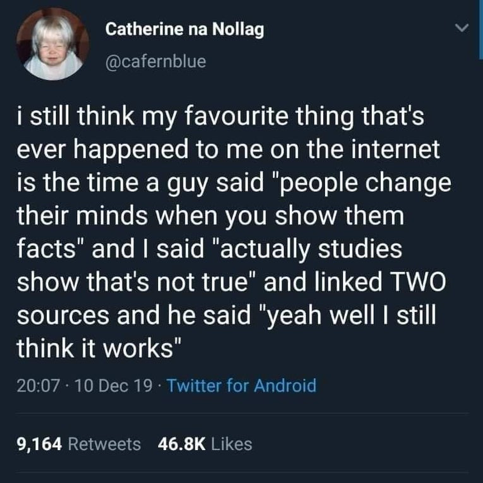
You can change people’s minds with logic
People are ridiculously committed to (a) what they want to believe, and (b) what they have always previously believed. Even if it defies all logic.
Our governments will look after us
They will look after themselves. UK Prime Minister Boris Johnson once belonged to the Bullingdon club, a society full of ridiculously rich university students who, as part of their initiation ceremony, had to burn money in front of homeless people. And the US (at the time of writing) has Trump. I am not sure (to say the least) that either of these people care about looking after the ordinary citizens in the countries they govern.
‘We’ are the good guys
Everyone is a hero in their own story. History books are written by the winners. Propaganda is rife. ‘We’ are not the good guys. Not from other people’s perspectives, anyway.
We are our choices
I can’t believe I’m questioning this one. I’ve always been so sure of it. It’s one of my favourite snippets of four-word advice. But no matter how hard I strive to make the right choices, life still seems to give me a fair amount of crap to deal with. Often, we have to live with choices other people made, that impact us on a daily basis. Which I guess links to the next point.
I’m in control
I’m really not. There is so much that is utterly, completely, frustratingly out of my control. I have to work out what my (tiny) circle of influence is and just focus on that.
Age is just a number
How many years you’ve been on this planet affects everything, for good and for bad. Today I am 50 years old. And 50 years wise. I have 50 years of experience, and achievement, and damage, and humility, and general wear and tear. I’m not the same person I was at 20. And that’s how it should be.
I’m making a difference
I’m trying so hard, but the actions available to me just seem so very, very small. Over 70% of the pollution on earth comes from just 100 companies, and I’m trying to wash out a peanut butter jar so it can be recycled. I’ll drop three tins of soup in the collection box for the local food bank, when I know it would take around $30 billion to end world hunger.
The world makes sense
Speaking of how much we’d need to end world hunger, I appreciate that $30 billion sounds like a lot. But according to The Boston Medical Center, it’s about $3 billion LESS than consumers in the US spend on weight loss products each year. Let that sink in.
Women are X and men are Y
We are what we are. I don’t think any more that our gender defines us, but I think expectations of our gender definitely do.
I was lucky to be a stay-at-home mom
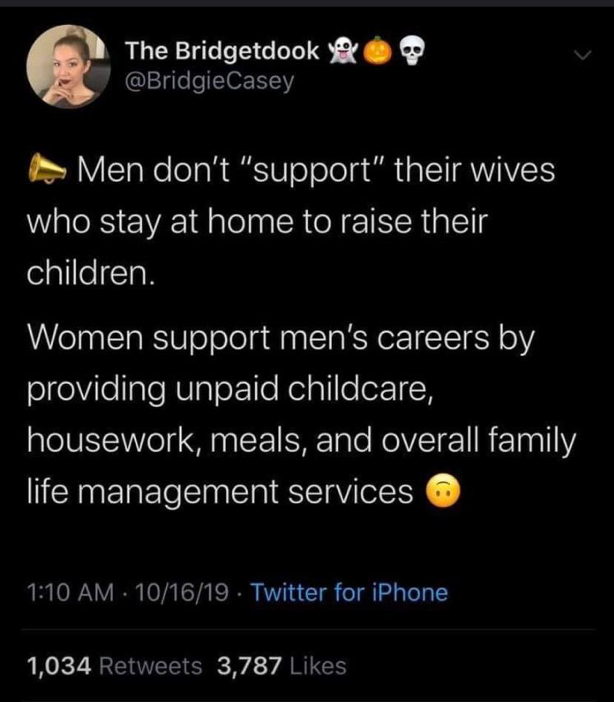
I still appreciate the time I spent with my kids, but I’ve changed the way I look at stay at home motherhood. There is a huge opportunity cost when a well-educated woman gives up a career to care for kids full-time. I used to believe that moms who got to stay home because their husbands supported them financially were lucky. I don’t believe that anymore. I’m more aligned with the opinion expressed by this Twitter user, and backed up by research on this issue.
Do or do not. There is no try.
I grew up on Star Wars and still have respect for master Yoda, but I’m just gonna say it. Sometimes a try is as good as it gets. Between the not doing and the doing, sometimes there’s a lot of trying, and failing.
Divorce is bad for kids
I was lucky. I grew up in a two-parent family and had a happy childhood. So I believed the hype about how ‘broken homes’ were bad for kids. I’m no longer sure about this. Partly because I’ve dug deeper into the stats.
Evidence tends to point to better outcomes for kids in two parent families, but after studying for two university degrees (one in Child & Family Studies) I’ve learned that correlation doesn’t equal cause. Worse outcomes for kids from single parent homes are potentially far more closely linked to income than simply only having one parent. And lower incomes in single parent homes are linked to gender inequality, government policy, and absent parents not properly supporting their kids.
We can’t eradicate poverty
I’ve just read a very interesting book called Utopia For Realists. It’s one of the books that actually made me feel less anxious and depressed about the world. But it also made me frustrated, because it addressed how close the US came to instigating a universal basic income (under Nixon, of all people) and how, if he’d have gone through with it, it would have gone a long way to winning the ‘War on Poverty’. I’m not saying I’m sure we could eradicate poverty. Just that I’m no longer sure that we can’t.
Progress only goes in one direction
This is a logical belief, but it’s not true. Sometimes progress is reversed. It happened in The Dark Ages. This was the period of time after the fall of the Roman Empire, when much knowledge was effectively ‘lost’, literacy rates plummeted, and many social structures broke down, including those that supported art, philosophy and science.
I see progress going backwards now too. More restrictive abortion laws, Make Women Great Again conferences, a president who gets elected after admitting on video to sexual assault. (Warning — that’s the link to the actual tape. May trigger sexual assault victims, or anyone who believes that the correct consequence for sexual assailants is something other than promotion to the most powerful position on the planet.) Progress can stall and reverse. It goes in both directions.
People in abusive relationships should leave
I’m not saying that they should stay. But I’ve come to realise that abuse is complicated, and every time someone leaves an abusive relationship the pieces of the puzzle just move around. The abuse doesn’t stop, it just gets transferred to the next person. We need to find ways to stop the cycle of abuse.
There are simple solutions
In case you’re wondering, I don’t know how to stop the cycle of abuse. I don’t know how to end inequality, I don’t know what to do about institutionalised racism, and I don’t know how to transfer the whole planet to sustainable energy. I used to think there were simple solutions to at least some of life’s problems. The longer I live, the more complex almost everything seems.
There’s a perfect place to live
I’ve lived, worked and studied in seven different countries, across three different continents, and travelled to many more. There are pros and cons to all of them.
There’s a perfect way to live
Married, single, kids, no kids, college or not, career or job. Everyone needs to figure out which choices and lifestyle work for them. And most of the time it doesn’t hurt to just let people be.
There’s a perfect way to parent
There are good ways and bad ways to be a parent, but I’m not sure there’s a perfect way.
Perfect relationships exist
I was probably never 100% sure of this, but I grew up with the fairy tales and the happy-ever-after myths like everyone else. I was truly shocked to find out how hard it is to maintain a marriage over a couple of decades. I used to be surprised by how high the divorce rate was. Now I sometimes wonder how any couple stays together through everything that life throws at us.
Self-belief leads to results
A lack of self-belief can be paralysing, for sure, and stop you taking action. But honestly, some of the people who believe they’re really something special, are the most ineffectual people I know.
I know how to eat
I’m interested in nutrition, but I’ve become overwhelmed with the amount of conflicting information there is about how, when and what we should eat. I’m no longer sure of anything but the basics. I’m just trying to stick to Michael Pollan’s advice at this point.
“Eat food. Not too much. Mostly plants.”
I want to write a novel
I’ve wanted to since I was a child. So why have I instead written all these articles, essays, blog posts, non-fiction books, and even sales copy? No novel yet. Maybe I don’t want it as much as I thought.
Everything matters
As I’ve addressed previously, most things don’t matter. Or as Arthur Balfour put it:
“Nothing matters very much, and most things don’t matter at all.”
When things go wrong, you just have to work harder
Sometimes hard work can fix broken things. Sometimes you just have to let them be broken.
Watching TV is a waste of time
I’ve always preferred a book, and beaten myself up over too much time spent in front of the TV, but I love stories, and stories told in the form of films and TV shows are just as valid as those told in ink. I’m no longer a snob about this.
Doing nothing is a waste of time
I really committed to this belief, and consequently it feels like I’ve been crazy busy for about 20 years. But I’m no longer sure that doing nothing is a waste of time. I feel like nothing is a thing we desperately need to do, at least occasionally.
I should mind my own business
A long time ago I offered help to a very stressed looking young mom who I didn’t know. She told me to mind my own business. So I did, for years. I thought it wasn’t worth offering help to strangers, but maybe it is. Not everyone will reject it. Occasionally poking your nose in is just what someone needs.
We’re all doomed
I’ve been involved in environmental issues forever. So it’s easy to get pessimistic about the future, but another one of the books that made me less depressed is The Optimistic Environmentalist. It’s worth a read if you’re not sure if we’re doomed or not.
Treat others as you’d like to be treated
This is sound generic advice, but doesn’t always work when it comes to specifics. I’ve spent too much time trying to help others fix their problems working from my own mindset, experiences and perspective. Sometimes it’s important to ask people what they need, rather than giving them what you’d need in similar circumstances.
I know what I’m doing in life
I really don’t. I think I do. But life keeps surprising me. Sometimes I feel like I’m playing emotional whack-a-mole. As soon as I deal with one issue, another one pops up. Life is always in flux, and sometimes there’s a odd kind of relief in admitting you absolutely, genuinely, don’t know what to do next.
I know what I want out of life
What we want out of life can change over time, or even in a heartbeat. It’s good to have an idea of what you want, but I’m less sure than ever that it’s set in stone. I’m finally learning to go with the flow. I kinda know what I want. But I’m also open to suggestions.
Want to hear more about stuff I’m not sure about? Follow me.


