
Culture
5 Weird Wingmen of Santa from Around the World
You know Dasher and Dancer and Prancer and Vixen. Now meet some other intriguing holiday helpers.
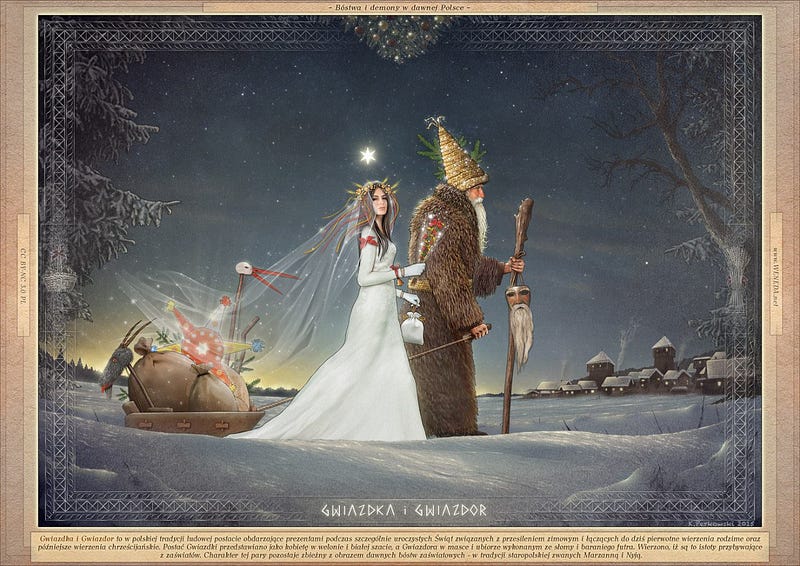
The Christmas season is the traditional gift-giving time for the world’s Christians, but not everyone does this on Christmas Day, nor is Santa Claus the universal source of holiday largesse. St. Nicholas Day, St. Lucia Day, and Three Kings Day are other holidays where children can expect visits from magical gift-givers.
One similarity across traditions is that of “Santa’s Helpers.” In the United States, toymaking elves and flying reindeer lend Santa a hand. In other parts of the world, St. Nicholas or his equivalent get help from different quarters, some of them quite disturbing to modern American sensibilities.
Knecht Ruprecht: Foundling, servant, and liturgical quizmaster
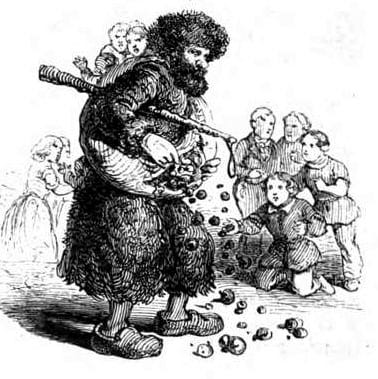
German-speaking countries have a rich tradition of Santa’s helpers whose names vary with the geographical region. Collectively they are known as the Companions of St. Nicholas. Among them are characters with colorful names like Belsnickle and Schmutzli.
One of the saint’s most widely known helpers is Knecht Ruprecht or Ruprecht the Farmhand. The story goes that he was a foundling St. Nicholas took under his wing. Knecht Ruprecht wears a brown hooded robe, carries a big stick and a bag of ashes. He walks with a limp due to a childhood injury.
When St. Nicholas and his helper arrive at a house on St. Nicholas Eve, Knecht Ruprecht quizzes the children to make sure they know their prayers. If they do, he distributes apples, nuts, and gingerbread. If they don’t, he hands out coal, beats them with the stick, and hits them with the bag of ashes (presumably to mark them as evildoers).
Gwiazdka: Mysterious star lady
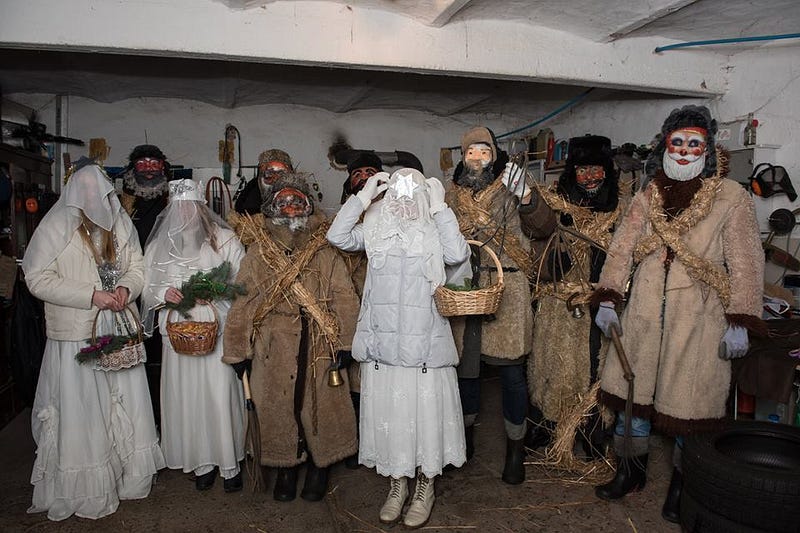
In some parts of Poland, the Santa Claus figure has its roots in pre-Christian culture. Gwizador or Star Man is an all-knowing older man from another world dressed in sheepskin who rewards good deeds with gifts. He appears around the Winter Solstice time accompanied by a mysterious veiled woman called Gwiazdka or Star Woman. Gwiazdka sometimes appears as a bride with a crown of bright ribbons and flowers or an angel. She wears a long white dress and carries or wears a star. Gwiazdka never speaks but assists Gwizador in the distribution of gifts. She is unique in that she is female. In nearly all other traditions, the gift-givers helpers are men or boys.
Père Fouettard: Butcher with a whip
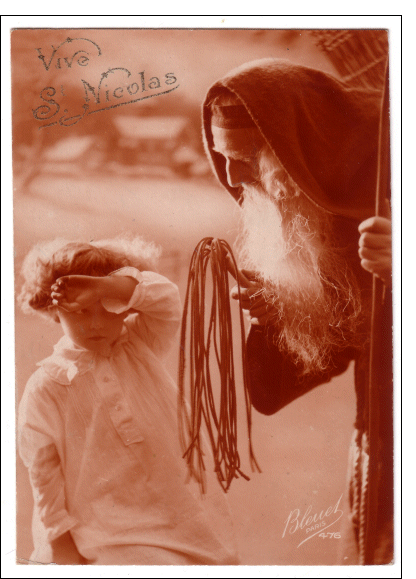
In some parts of France and Belgium, St. Nicholas has another abusive side-kick to deal with pint-sized juvenile delinquents. While St. Nicholas fills the shoes of saintly, obedient children with sweets, Père Fouettard or “Father Whipper” gets medieval on the tushes of kids who have failed to measure up to their parents’ expectations.
Legend has it that Père Fouettard was a butcher who murdered three boys and offered their meat to St. Nicholas as a delicacy. The discriminating saint refused this peculiar hospitality display, brought the boys back to life, and sent them home to their parents. Instead of turning the evil butcher over to the authorities, St. Nicholas offered him the good behavior enforcer job as a means of redemption.
The threat of an old guy with a whip is one way to ensure the kiddies do their homework. I wouldn’t be surprised if they also clean their rooms, plates, the gutters and wash and wax the car.
Zwarte Piet: A Dutch dilemma
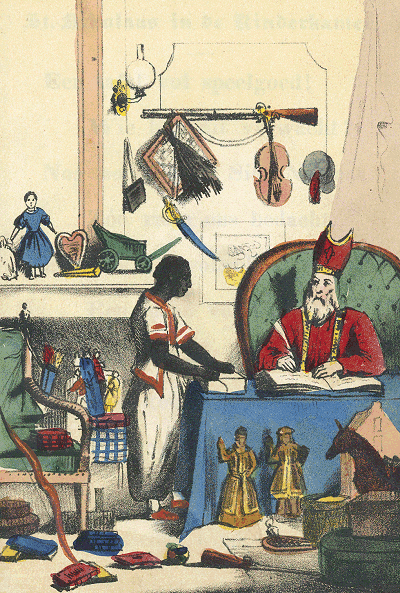
The traditional wingman to the Dutch Santa Sinterklass is a character called Zwarte Piet or Black Pete. Zwarte Piet is represented as a black Moor with frizzy hair and exaggerated red lips, wearing gold earrings and an elaborate Renaissance costume. He helps Sinterklass distribute gifts to good little girls and boys. Much like Santa’s naughty and nice list, Zwarte Piet has a book where he keeps track of good and bad behavior. He bundles naughty children in a sack and takes them to Spain for a year to punish them. (Having been to Spain myself, I don’t think that’s much of a punishment.)
When the character of Zwarte Piet emerged in Dutch culture, there were few if any black people available to play the part. A white person in blackface usually assumes the role, which is now offensive to large segments of society. They deem Zwarte Piet a racist stereotype and want him banned. Others treasure their nostalgic associations with the tradition. Not surprisingly, according to a National Geographic article, neo-Nazis and white supremacists are among the pro-Piet camp.
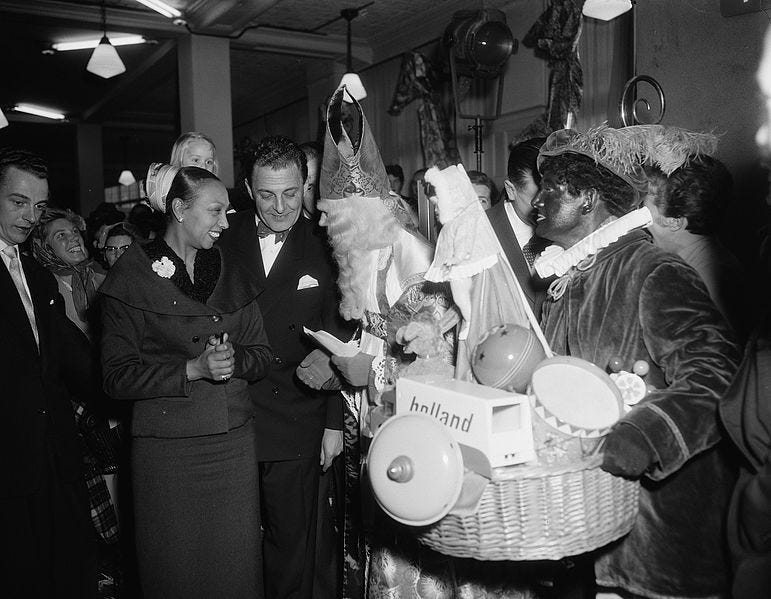
As a compromise, some communities have morphed Black Pete into a chimney sweep character called Sooty Pete, who, instead of donning blackface, smears his face with streaks of ashes. Not everyone feels the change goes far enough, however. This year, the Guardian reported that many Dutch libraries are removing children’s books depicting Zwarte Piet from their shelves. Schools and businesses are also dropping the character from their celebrations. It’s natural for traditions to change as attitudes and awareness evolve. Dutch children are bound to adapt. Whether their parents will or not is still under discussion.
Krampus: Demon with an attitude
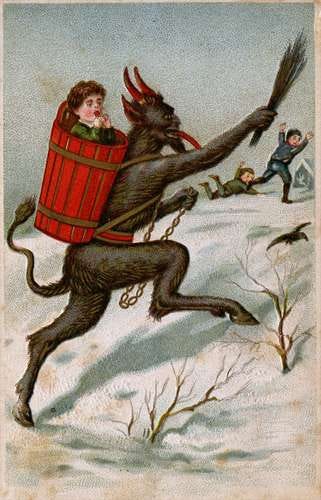
On St. Nicholas eve (also known as Krampusnacht or “Krampus Night”), the gift-giver and the spawn of Satan show up to administer justice in Deutschland. Instead of doling out coal to those on the naughty list himself, jolly old St. Nick delegates his dirty work to Krampus.
The son of Hel, the Norse god of the underworld, Krampus is a half-demon, half-goat monster who treats naughty girls and boys with extreme prejudice. He beats them with sticks and then devours them or carries them off to Hell as the mood strikes him. Krampus is a far cry from Rudolf, but hey, old country traditions are hardcore. No candy-assed, tattletale elves on the shelves for them! Not such a bad idea if you’re looking for a genuinely effective way to coerce good behavior from tiny tots.
©2020, Denise Shelton. All rights reserved.
If you liked this, please visit my website. I write on Substack, too. Thanks for reading!