
5 Ways To Stay Warm And Cut Costs In Your Rented European Home This Winter
As two travelers (myself and my partner) on incredibly tight budgets, we’re always on the lookout for ways to cut our costs. Buying our clothes used, investing in a sewing machine to make, alter, or hem clothes that we already own, eating in, buying in bulk (if we’re fortunate enough to have a place to store everything), traveling via bus, house sitting, we’ve done it all.
In the past few years, we’ve found ourselves in Italy, a country that has quickly become our second home.
Since we’ve “moved” here, we quickly noticed how expensive winters were. Any apartment we had that used gas whether it be for heating, oven, stovetop, or water heater would always leave us with a gas bill in the hundreds for the month. For two people on a budget, this wasn’t what we call “sustainable.”
Talk about not knowing when we were living in the good ol’ days.
Today, if you’re living in Europe, you might have noticed that your gas (and electric) bill has gone stratospheric. In my neighborhood, in a small town in southern Italy, bills have gone from 200–300 euros a month to 900–1200 a month. In a town where people are on incredibly fixed incomes, this spells financial disaster.
This isn’t just during the winter. During this year, there has been a variety of demonstrations such as Neapolitans burning their energy bills, restaurants shutting down and posting their multi-thousand euro energy bills in the window, or, as one restaurant did, started charging their patrons for gas and electricity. In fact, some French cities began fining businesses for keeping their doors open with the air conditioning on. Which is just insane to me. As someone from the southern United States, everyone closes their doors when the A/C is on. Hearing someone yell, “Shut the door, the air is on!” is the indigenous bird call of Georgia.
This is all to say: Europe has been preparing for a cold and financially-crippling winter.
And, just to make it about my partner and me, this means we don’t use the gas. Ever. Unfortunately, because Italy makes most of its electricity through the combustion of natural gas, we’re still affected by the price of natural gas. Even regions of Italy that use solar/wind power are still experiencing double or triple the normal electricity rates due to demand. Everyone but residents of Basilicata.
Instead of moving our residency to Basilicata, we’ve set about trying to figure out ways to winterize the home and cut energy use before this unseasonably warm weather (thanks, Climate Change!) leaves us.
Here are some of the ways we’ve figured out how to save money on electric and gas costs this winter.
Before we get started, I will go ahead and assume you’ve done the tips that everyone recommends to save money. This might include: changing to LED bulbs, turning off the lights when you leave the room (yes, this is still people’s top tip. Which one of you is leaving the lights on in a room you’re not using?), taking shorter and colder showers, keeping the thermostat lower and putting on more sweaters, and every other tip that clickbait websites offer.
Here are some other tips that have helped us.
Sealing the cracks
Seeing as many homes in Europe are either stone, concrete, or brick, they’re already fairly well insulated. My partner and I went apartment-hunting in Perugia this past winter and one of our main questions was, “How cold does this apartment get in the winter without heat?” Interestingly, most of the students didn’t really understand what we were asking, but one older gentleman had clearly been waiting for someone to ask that very question and immediately jumped at the opportunity to tell us that the apartment never dropped below 16 degrees (60F) in the winter without any heating. Although we ended up not renting there, that was on the top of our list.
So, if you have a similar apartment or house, you’re already in good hands.
But I’ve found that thick stone walls aren’t always enough to stay insulated. Wind whips into the house from under the doors to the balcony and the storage box for the tapparella, or rolling shutter.
Around the box for the rolling shutter, we applied some weather-resistant caulk. Another option is to open up the box that stores the rolling shutter and stuff it with insulation, or even a sheet of foam insulation, to prevent wind from entering (or leaving) the box.
Around the doors and windows, we applied a strip of weather stripping (it looks like this) to prevent wind from leaking through the cracks or warped window frames. Of course, without double-paned windows this isn’t 100% effective, but it does cut down on the draft.
Curtains are your friend
Your fire is set, the pellet stove is humming in the background, and a swift wind is chilling your feet. But didn’t you just put in weather stripping?
Coming from the southern United States, curtains are for the sun and nosy neighbors. Ideally, they aren’t that heavy. After all, you still want to be able to peek through them at your neighbors.
So I was unsure of the efficacy of these lovely pieces of fabric until I was in the aforementioned situation.
I had already used weather stripping to seal the edges of the doors and windows, so where was the wind coming from?
I still don’t know.
But I do know that hanging up a heavy curtain, more of a drape, really, made the wind disappear. And, seeing as I am the proud renter of single-paned windows, the sense of radiating cold from the window panes diminished somewhat when I hung the curtains.
Pellet Stove: To use or not to use?
If you’re like me, then you were unaware that pellet stoves existed before arriving in Europe. I’ve heard that some grills in America have started using them, but I haven’t seen pellet stoves outside of Europe.
The concept is very simple. You put wooden pellets (which look a lot like rabbit food) into the hopper on top of the stove. The stove has a metal coil that heats up and burns the pellets. This, in turn, heats a metal plate at the top of the stove, and a fan blows across the plate, pushing the heat outward. The nicer ones have a port in the back that allows the owner to hook the pellet stove up to a series of vents in the house to provide heating in every room.
In theory, these are great. It uses wooden pellets which are made from the by-product of the logging industry, branches that can’t be used for construction, misshapen trees, and that type of thing. Except, that isn’t necessarily the case. Europe imports a portion of their pellets from America, and when there isn’t any “waste,” just cut down some trees. Who will notice?
In addition, a large push is being made to remove subsidies for burning forest biomass. Between the push and the rise in demand for wooden pellets, we’ve seen the cost per bag go from 3.50–4.50 euros a bag to 11–13 euros a bag in the last few months.
This, coupled with the fact that pellet stoves need to be plugged in to work, means they are no longer a cheap and effective way to heat a space.
Instead, we have started to use firewood. Shocking, I know.
But when the price of pellets went up, we thought the price of firewood had risen as well. To our great fortune and excitement, it hadn’t.
A canna of wood (4 meter cubed) was till about 300 euros. For us, this will easily last two months, usually even three.
If you have a functional fireplace and you aren’t using it, call around and get wood prices from people who will deliver it. In our experience, it even comes with a bundle of kindling. No more weekly trips into the forest for kindling!
Cook longer, slower meals
Either way, you’re going to have to eat, right? And either way, you’re paying for that electricity or gas, right?
At least, this is how we reason it to ourselves.
So we started using the oven every day. Breads, cookies, roasted veggies, every meal will have at least one baked item in it in the winter.
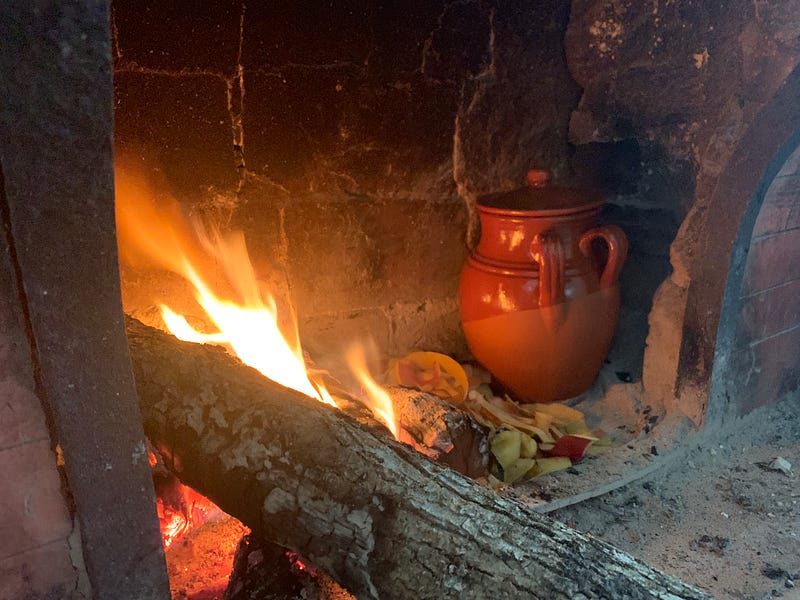
What we never considered (again, being from the southern United States. I feel I must use this as an excuse often) is cooking in the fireplace. So, we invested 15 euros in a fireplace grill and 7 euros in a pignata, a narrow-mouth terracotta jar that goes near the embers and cooks what’s inside.
When I say the pignata has been game-changing, I mean it’s a whole ‘nother sport. Apples? Toss ’em in the pot with some spices, butter, and wine. Dried beans? Into the pot with a little celery and laurel, then toss it with pasta. Boom. Pasta fagioli.
Of course, my fireside adventures don’t end there.
Picking up a carbon steel pan from IKEA, I found that it’s perfectly safe in a fireplace. And since our fire is already merrily burning away in the morning, it’s become a perfect way to make pancakes.
The idea is: the longer the meal is to cook, the warmer the house will become as you cook, and the warmer you will be standing near the fire.
Do as the southern Italians do?
As I mentioned in a previous article, southern Italians (and I imagine people all over the world) will gather in one room during the winter. When my partner and I started to rent our current apartment, we noticed that the kitchen was the only room with insulation around the doors, and an aftermarket double-paned window in the balcony doors.
They spent all winter in the kitchen. After all, it’s where the fireplace is.
But I can’t do that. I get antsy.
However, I can stay in two rooms.
In the summer, I like to spread out. I want to be outside, inside, in every room, anywhere it’s cool. And I have so much energy, I need to expend just a little of it or I will never sleep.
In the winter, I want to move as little as possible, and I will sleep for twelve hours easily. But that isn’t healthy, so I need a way to stay warm when I’m awake. And I’ve found that combining all of these tools has helped keep the living room and kitchen warm. Not so warm I don’t need a sweater. But warm enough that I don’t need gloves like last winter.
Nathaniel Mellor is a published short story writer living in southern Italy. He writes about traveling over on Only A Bag. And if you want to see him review gear, he has a YouTube channel.