
Self-improvement | Philosophy
5 Unlikely Quotes I’ve Been Secretly Obsessing Over for the Past Year
You’ll wish you’d known them sooner

People love to circle-jerk over certain quotes.
And it’s easy to see why. Some quotes can be super powerful, encapsulating an entire philosophy in just a few sentences.
Although they can seem clichè (I swear if I see one more ‘Live Laugh Love’ sign), there are many that can have a serious impact.
Here are my favourite ones over the past year that I wish I stumbled across sooner.
First quote
Take your thoughts, write them, read them aloud, talk to yourself and others about them.
~ Epictetus
A lot of people say we’re in an information era.
I disagree
I think we’re in an over-information era. With 1000s of videos, books, articles and pieces of content released every second, it has become impossible to keep up.
When so much is begging and tugging for your attention, the most important skill is staying still while this happens.
Being able to search for a new piece of information will never change.
Remembering and making sense of it will.
It’s easy to inflate your ego by reading five books in one week and telling the world how much of a better person you are.
It’s not easy to remember, recall and understand what you’ve learned, and then put it to good use.
That’s what will make you stand out.
Information will always be abundant. There will always be another book to read and place under the pedestal you stand on. Every sunrise will bring a new social media feed craving your eyes and ears.
We must spend more time solidifying what we already know is important instead of letting ourselves forget about it.
The only thing more important than information is remembering and knowing what to do with it.
This is why we should take our thoughts and “write them, read them aloud, [and] talk to others about them”.
Tell everyone what you’re currently trying to remember and understand. Seek opinions and conversation about it at every instance. Write them out and connect them to existing ideas.
Stop getting an erection with each new book you read (and a week later forget).
As Einstein once said: “Any fool can know. The point is to understand.”
Comprendé?
Second quote
I am not what happened to me, I am what I choose to become.
~ Carl Jung
The first step towards improving at anything is becoming aware of what is possible and what is holding you back.
The two most important truths to become aware of are:
- Choosing to be defined by your past (victim mentality) relinquishes any form of self-control, giving other people power over your future.
- Self-efficacy — the ability to believe in yourself — is a skill that can be developed. You can choose who you want to be; you have full power over yourself.
Victim culture is bred on cynicism and ignorance. Once you realise what is possible the only person left to blame is yourself.
And what is possible happens to be limitless (but importantly of your own making).
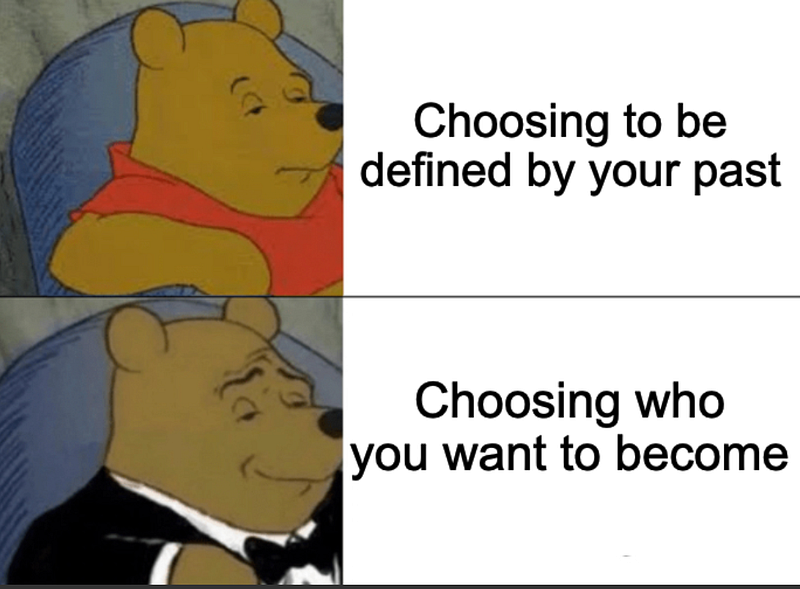
We are highly malleable creatures — not self-determined — capable of producing nearly any outcome we want.
Given we put in enough effort.
And while genetics undeniably play a large role in our lives, they don’t decide whether or not we’re f*cked; they can predispose you to areas of opportunity, but they don’t predetermine.
The only true determined constraints are the ones you self-impose.
The beauty of the quote “I am not what happened to me, I am what I choose to become”, is that it perfectly summarises Jung’s psychology and philosophy.
Since Jung’s work is worth obsessing over, so is a quote that summarises it so well.
He vehemently believed in personal growth. By refusing to be defined by past problems, you claim power over your own life. You alone control the identity you embody.
Here’s a piece I wrote that might help you change your identity:
Jung believed heavily in “making the unconscious conscious”, which is to become aware of what is holding you back. Otherwise, these problems will ruin your life. And “you will call it fate”.
Either define who you want to be or the world will define it for you.
Quote three
The best is the enemy of the good.
~ Voltaire
Perfectionism is romanticised by many people as if it’s some quirky personality trait.
Funny what narcissism makes people believe.
Really, perfectionism is a disease that affects your ability to produce content and get yourself out there.
I once spent an entire week creating a daily routine, making it perfect and fully optimised. It was blocked out perfectly into 30-minute segments to make me as productive as possible.
There was one problem: I never followed it.
After all those hours spent trying to perfectly plan my time, it ended up being a massive waste.
I was too scared of not sticking to the plan (failing) and became overwhelmed by it. I chose to not start at all — that way I couldn’t fail.
Perfectionism — most of the time — is a cool way of saying procrastination.
So long as you try to produce the perfect outcome every time, you’ll never get any outcome at all.
That’s why the “best is the enemy of the good”. You have to be willing to look like an idiot to eventually look like a master. Perfectionism is what prevents people from ever looking like idiots.
Most of the time it’s not slipping up that will cause you to give up, but trying to be impossibly perfect.
Expecting the best every time will prevent anything from being done. That makes it impossible to do anything good.
This quote is a subtle reminder to lower your ego and be unapologetically bad.
Only then can you be good.
Quote four
How would the version of you tomorrow want the version of you today to act?
Instant gratification is like thinking about getting with the girl in the red dress.
You get all dreamy, imagining what it would be like and how amazing life would be. You start thinking about date nights, holidays at the beach, what music you’d dance to…
Then you get brought back to reality — one that now feels worse.
Delayed gratification is about doing the activities that give you a chance at getting with the girl in the red dress.
It’s about consistently training hard in the gym, being persistent with your business to make a stable living, going out of your comfort zone, talking to new people, travelling to new places, learning new things…
The tasks are difficult, but the outcome is a more desirable reality.
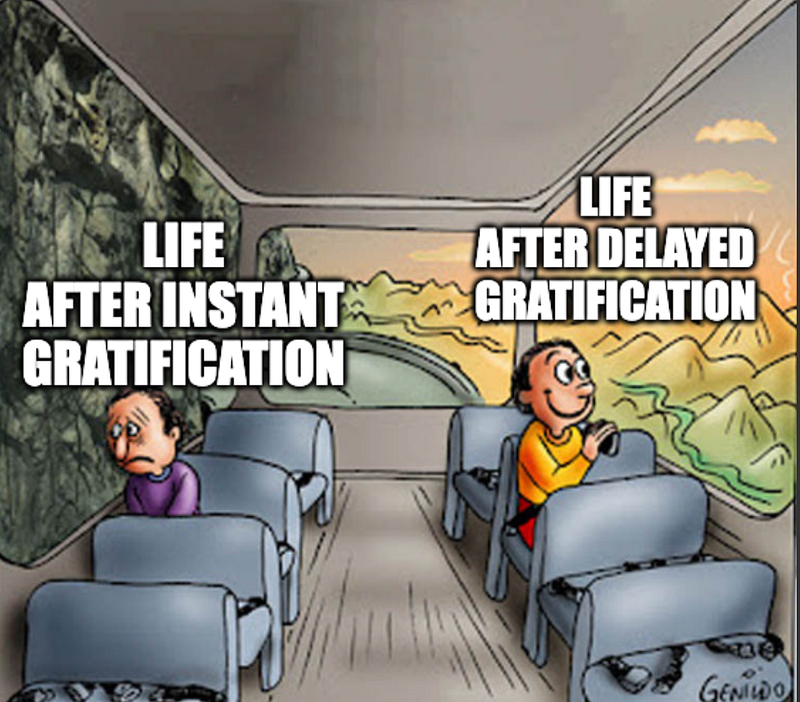
Good things in life take a while to build — the progress compounds over time. But the rewards lag behind.
By imagining how the version of yourself tomorrow would want you to act today, you can keep yourself accountable for the more difficult activities.
That’s why this quote is so powerful. It captures the idea of acting in accordance with your future self — the version of you that gets the girl in the red dress (or whatever your goal is in this metaphor).
So think about how future-you would want current-you to act.
Then do it. You can thank yourself later.
Quote five
I’m not in this world to live up to your expectations and you’re not in this world to live up to mine.
~ Bruce Lee
A lot of people make the mistake of believing that they’re more important than they really are.
They expect people to be constantly thinking about and judging them, tracking their every move like some omniscient being waiting for them to slip up.
This is nothing more than the spotlight effect — thinking that everyone notices you and that you’re the centre of the world (surprise, you’re not).
Firstly — and truthfully — very few people care about you.
So when you go out and try to make something of yourself, realise that barely anyone neither cares nor notices.
How liberating!
Secondly, if people do care: so what? You will both soon leave this Earth, and those most critical of you will likely never attend your funeral.
So why would you care about their opinion? Do you want to die regretting being a shell of who you could’ve been because ZombieSlayer69 made an online comment calling you cringe?
You do not need to live up to anybody's expectations (most of which are fictitious anyway).
That’s why I love this quote by Bruce Lee (who was much more than just a martial artist, by the way).
It reminds me that I should set my expectations high and tell everyone else with their opinions to kindly f*ck off — their expectations don’t matter.
Living true to yourself is focusing on your own outcomes and desires in life.
Not anyone else’s.
It also extends to not forcing your expectations onto other people. Treat others how you’d want to be treated and all that.
Conclusion
Remember the first quote?
That’s right — don’t just mindlessly move on from this article. Put these new ideas into practice.
Talk to yourself and others about them, recall what you learn often and create a bias towards solidifying information instead of learning more things to forget.
But don’t worry. There is no need to live up to that expectation — that would make me far too hypocritical.
I hope you enjoyed.
Somehow there is another article just as awesome as this one, look: