
5 Tips From Aristotle To Live Your Un-Lived Life (and Make Peace With It)
The one who falls and gets up is stronger than the one who never fell.
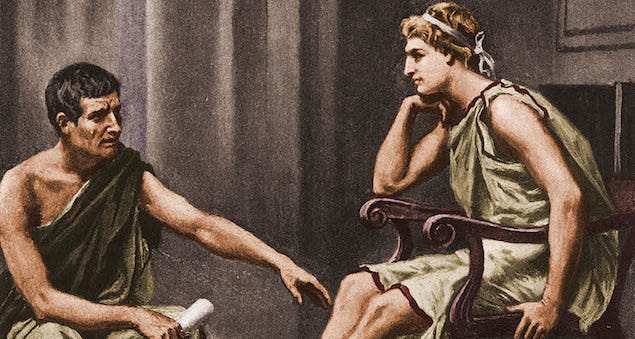
Aristotle had multiple nicknames. Some were:
- The man who knew everything
- The philosopher, named by Thomas Aquinas
- The master
Orphaned at a young age, Aristotle’s guardian, Proxenus of Atarneus, sent him to Plato’s academy.
Platonic academy in ancient Greece was managed by Plato and worked on the principles of observation, logic, and knowledge sharing. But when Aristotle was 37, Plato died too.
This brought immense shock to Aristotle. The orphan soon realized that life had much to offer, despite his orphanage and teacher’s death. On one account, Aristotle said:
“Some men are born natural slaves.”
Are you a natural slave or a warrior like Aristotle?
Either way — we are slaves of negative thinking, bad habits, and unhealthy relationships.
Aristotle was able to defeat his negative whims. Maybe because it was 384 BC back then, and it’s 2022 (now).
Untruthful comparison. But yeah, this is the truth.
Aristotle guides us through his 5 quotes to live your un-lived life and escape mental slavery.
Let’s get started.
1. Secret code for youngsters
Most of Aristotle’s life spend under the teachings of Plato.
Plato idolized arrogant Socrates (his teacher), but he never misbehaved with Aristotle.
Plato remained calm with Aristotle.
Sooner, Plato and Aristotle became the best bond. Just like Rumi and Shams. Reviving this, Aristotle said:
“Good habits formed at youth make all the difference.”
Many of us didn’t know the right habits when we were young. But who says you’re old now?
We celebrate our birthdays on the occasion of missing one year of life from our timeline. So how does learning makes you old?
Aristotle guides us to invest in some good habits such as:
- Learning
- Hard work
- Staying calm
- Doing work for the community
2. Mental re-shaping
It always occurs to me:
- The one who is a good writer must have been a reader.
- The one who is a good listener must have gone unheard.
- The one who is a good navy must have been a hurt civilian.
It all makes sense when Aristotle says:
“He who is to be a good ruler must have first been ruled.”
Successful people today weren’t as successful back then. Learning teaches us right and wrong.
It’s a part of life.
To jump from a reader to a writer, an unheard person to a listener, a hurt civilian to a navy, we must find the true spark side of us.
- Most of us are not born with the *gift*.
- So most of us find what’s bothering us and make it our gift.
Half of my family is in the Naval.
And let me tell you, even though they can’t, the urge to correct everything drives them to ship between the oceans, with two continents alongside just for peace.
3. Embrace the positive talk
Have you ever heard someone labeling you as:
- Mad
- Or perhaps, fool, disdain, maniac.
For some people, “mad” is a humiliation. For people like me, especially writers, mad is an honor.
I mean, what even is the best word to make a writer happy? Say no more. It’s the word “Mad.”
This reminds me of Aristotle:
“There is no great genius without some touch of madness.”
Genius is a metaphor for madness.
We all have skeletons in our closets. Some people are outwardly fools and maniacs than other people.
So, don’t worry. (That is easy to say…)
If you cannot help yourself and be worried, follow his simple practice I follow every day:
- Laugh at yourself before someone else gets to.
- Say: “Aha, that’s what I call myself when I try to talk to you.”
Funny, isn’t it?
4. Find the right moment or behold…!
If maybe our ancestors went out of control, there would be a different world. Perhaps,
- Christopher Columbus would end up caged when he mistook the country for India
- Socrates would be alive
- Julius Caesar, instead of burning, inaugurated the Alexandria library
- Antarctica had ongoing tourism, and we could all dance and hop with penguins.
(Heyy, reality check. Back to life.)
Aristotle once said:
“Anybody can become angry — that is easy, but to be angry with the right person and to the right degree and at the right time and for the right purpose, and in the right way — that is not within everybody’s power and is not easy.”
Our timings can’t align. If the timing were that perfect, I’d still be sitting in Arabia, sipping my Turkish tea and walking in a robe to the nearest hammam when I get melancholy.
- Timing has its way of messing with people.
In that order, Aristotle and Uncle Dale Carnegie advise staying quiet and not fighting.
If only fighting and arguing could do better things, we wouldn’t be here, messed up. Stay quiet, and don’t waste your energy. Or, if you want, manage the timing first.
5. Clay slices or seven
When I was little (I still am), I asked my mom: What are humans made up of?
The correct answer is presented to you by Aristotle:
“All human actions have one or more of these seven causes: chance, nature, compulsions, habit, reason, passion, and desire.”
Humans are made up of seven causes. Clay is an external slice of our body.
These seven causes are like Chakras and help you stay true to your purpose every time.
Here is what it looks like in general:
Find a reason, drive passion, find desire, follow nature, make a habit, manage compulsions and give yourself a chance until you succeed.
Believe in yourself like Plato and Aristotle. And maybe you will one day recall that all the sacrifices you made for yourself didn’t go awry.
Final thoughts:
Aristotle tutored “Alexander the Great” (warrior & king). So you see, it’s all connected.
From arrogant Socrates → thinker Plato → calm Aristotle → warrior Alexander, it’s a cycle.
The longer it goes, the latter benefits the most.
So what is in your cycle that makes you stand out? Tell me in the comments below.
Join 1,100+ writers and get your next writing inspiration right now.
Or, join Medium with my referral link.


