
5 Timeless Chess Principles You Can Apply as a Strategic Leader
Chess is well-known as the game of strategy.
I have always enjoyed learning the principles and strategies of the game that can help me become a better player.
And they have taught me so much more than just the game of chess.
They have taught me how to become a better leader, and in particular, a strategic leader.
In this article, I will discuss 5 timeless chess principles that you can apply as a strategic leader.
Principle #1. Think Ahead
Ever wondered what chess players do most of the time?
They think.
And they don’t just think. They think ahead, well into the future of the game.
Skillful players plan multiple moves ahead and have a long-term vision of the game. Their ultimate goal is to win the game.
For example, a player may choose to sacrifice a pawn in the current move to create a strong position or launch an attack several moves later. Maybe the pawn’s end brings a new angle, a new perspective to the game. Maybe it opens up the field for the rook, or the bishop. Or it just distracts the opponent.
Either way, chess masters keep their eyes on the final outcome the entire time, while skillfully inching move-by-move closer to it. They see small intentional losses as milestones that lead them to their goal, instead of getting emotionally attached to them.
“Leadership is the capacity to translate vision into reality.” — Warren G. Bennis
Similar to chess players, effective strategic leaders develop a vision for the future, and set long-term goals and objectives for their organization.
As I discussed in my article about the importance of keeping an eye on your ultimate goal, as a leader you need to make sure you are always, and I say always, driving towards the vision and mission.
You should be willing to make decisions today that are going to reap benefits in the future.
As an example, a tech company may choose to invest in research and development for a new product idea that may take years to develop, but has the potential to revolutionize the industry. This is similar to the mind shift I discussed in my article about the Value Triangle, and how you should be turning constraints into opportunities to general value.
As a strategic leader, you keep your eyes on the mission and vision.
Principle #2. Anticipate Your Opponent’s Move
Have you noticed how chess players seem to be lost in thought, almost frozen in their position?
Well, they’re not exactly frozen. They are observing.
They observe the opponent’s moves so far in the game, and their expressions, and pick up other visual and non-visual cues to stay one step ahead of their opponent.
Is he nervous, confident, lost? Is he planning an attack? Am I missing a smart move?
A chess master takes all these hints and cues, and anticipates and builds a mental map of what the opponent’s game plan might be. And they feed that into their own counter-strategy and use that to launch a counter-attack later.
“Remember this: Anticipation is the ultimate power. Losers react, leaders anticipate.” — Tony Robbins
Similar to a chess player, as a strategic leader you must keep your eyes and ears open at all times.
You should keep abreast with the latest developments in your industry, anticipate market trends, customer behaviors, competitor strategies, and any other external factors that may affect your organization and your mission.
You should be intimately familiar with your organization’s strengths and weaknesses, and be aware of external opportunities and threats that might come knocking on your doors.
The last thing you want to do is to sit tight and ignore what is happening around you.
You need to strategize where your organization is headed, what forces are working in favor and against it, and what moves you need to take as a leader to guide it in the right direction.
As a strategic leader, you are aware of external opportunities and threats that impact you and your teams.
Principle #3. Decide Your Next Move

Every move in chess, however innocent it might seem to the observers, involves decision-making.
Skillful chess players review scores of factors before making the decision: the current state of the board, the available resources, the opponent’s potential moves, the risks involved, etc. They run mental calculations, and analyze the permutations and combinations of their moves, before arriving at the final decision.
And they do this on every single move.
For example, a player may choose to change his opening strategy based on the opponent’s playing style. And continue to calibrate every single move based on the previous move.
“Leadership is making the wise decision even when it’s hard.” — Todd Stocker
Just like a chess player makes decisions on every move, as a leader you make decisions daily.
As I discussed in the article How Decision-Making is Like Driving a Vehicle, the nature and complexity of the decisions vary — from the choice of room we want to reserve for your next meeting, to who we want to promote on our team, or who should be let go.
As a strategic leader, you need to make decisions by analyzing the current situation, and the risks involved, and understanding the implications in your organization.
As an example, to decide who on your team should be promoted, you need to review multiple factors beyond just their performance in the recent quarter/year: Is this person ready to take on the senior role? Do we have the budget and need for this position? Is this the right move for the organization as a whole?
As a strategic leader, you make thoughtful decisions every day.
Principle #4. Adapt Your Strategy
Chess players are masters at adaptation.
They adapt their strategies based on their opponent’s moves, and the evolving dynamics of the game.
They continue to evolve their strategy and their approach with every move.
For example, if the opponent throws a curve ball by unexpectedly sacrificing their rook, it is worth thinking and adjusting the game plan. Was that a stupid move? Is the opponent playing a mental game? Am I missing something obvious?
A player who starts defensively may become a super-aggressive player later in the game as the game evolves, and vice versa.
That is the beauty, and power, of adaptation.
“Adaptability is about the powerful difference between adapting to cope and adapting to win.” — Max McKeown
Similar to a chess player, as a leader, you need to be able to adapt your strategies and plans based on changes around you.
During the recent COVID-19 pandemic, there was a massive movement of customers to online platforms. This prompted leaders to evolve and adapt their business strategies so they could tap into and align with this new reality. Now, with the evolution of Artificial Intelligence, leaders are thinking about how they can leverage the power of AI to simplify workflows, and improve their team’s productivity.
In my article about the 6 Skills You Need To Become a Strategic Leader, I discussed how a strategy is not guaranteed to succeed.
As a strategic leader, you evolve your strategy continuously.
Principle #5. Manage Your Resources
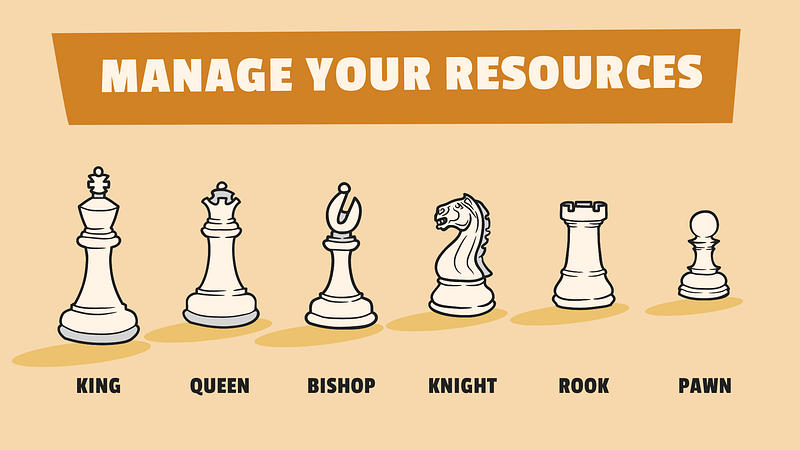
Each chess player starts with 16 pieces.
Each of those pieces has a specific value, a specific trait, and the player must manage these resources efficiently to gain an advantage.
A pawn is different from a bishop. A bishop is different from a knight. A knight is different from a queen. And so on.
Each of these pieces has its unique strengths and weaknesses. A skillful chess player knows how to use the pieces so they can work together as a team.
A grandmaster can win a game with 1/3 of the pieces, because he knows how to effectively use those pieces. He can coordinate the movement of the pieces around the board, and implement his strategy effectively.
“The strength of the team is each individual member. The strength of each member is the team.” — Phil Jackson
Just like chess players have limited resources, as a leader you too have limited resources available at your disposal — whether it is human capital, financial resources, or other assets.
You need to allocate the budget and people to different projects or initiatives to maximize the value generated.
As a strategic leader, you know the individuals in your team, and their strengths and weaknesses, and allocate assignments and roles to them to maximize the chances of success.
You create an environment and culture of trust and belonging, so your team members are motivated and energized to bring their best to the team.
As a strategic leader, you manage your resources efficiently and effectively.
Bringing it Together: 5 Timeless Chess Principles You Can Apply as a Strategic Leader
Chess and strategic leadership have a lot in common.
Success in each of those requires a combination of foresight, adaptability, effective decision-making, and the ability to manage resources and risks.
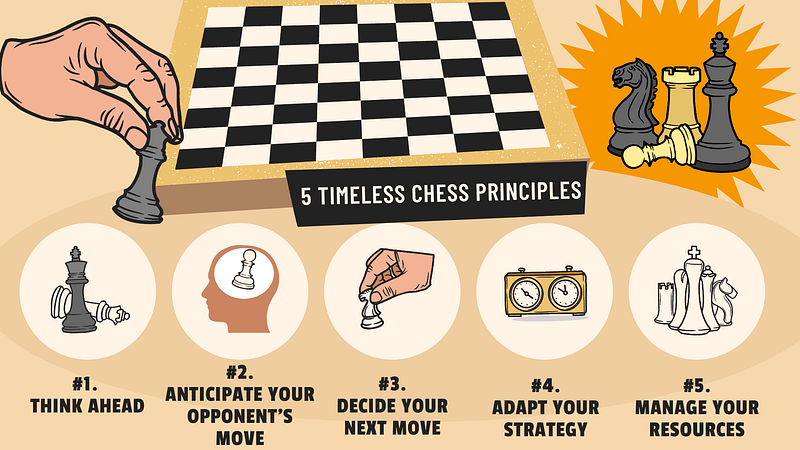
In this article, we discussed the 5 timeless chess principles that leaders can apply to level up their strategic leadership skills:
- Think Ahead. Chess players think and plan several moves ahead to stay on top of their game. Similarly, strategic leaders should be thinking and driving their organization toward the long-term vision and goals.
- Anticipate the Opponent’s Move. Skillful chess players can anticipate what their opponent is thinking by reading cues and making inferences from the gameplay. Similarly, strategic leaders should be abreast of the competitive environment, and anticipate the opportunities and threats that may come their way.
- Decide Your Next Move. Every chess move is a decision that needs to consider scores of factors. Similarly, leaders should weigh factors and risks when they make decisions to move their organization forward.
- Adapt Your Strategy. Chess players adapt their strategy as the game progresses. Similarly, leaders should be always ready to adapt and evolve their strategy to stay competitive.
- Manage Your Resources. Every chess player starts with exactly 16 pieces, and must skillfully manage those resources through the entire game. Similarly, leaders should be strategic and thoughtful about how they want to use their resources to maximize the returns.
Like my writing?
If you liked this post, I would appreciate some claps👏 as a form of encouragement. Thank you!
To read similar content you can follow me (Gaurav Jain) and subscribe to get these posts delivered directly to your Inbox. Check out my profile for other ways to connect with me.
Feedback is a gift! I would love to hear your thoughts and suggestions in the comments below 🙏
You may want to check out these related articles:
- You Hit the Bull’s Eye. Was It the Right Bull? (Start With Why)
- The 6 Skills You Need to Become a Strategic Leader
- Making the Hours Count: The Misconception Behind Smart Work
- How Decision-Making is Like Driving a Vehicle
- Mind-Shifting: How Leaders Can Turn These 3 Constraints into Opportunities (the Value Triangle)


