

Making the Hours Count: The Misconception Behind Smart Work
You may have heard this advice, whether from a boss in a performance discussion, or a motivational speaker. And as a leader, you may have given this advice to your own teams at work:
“You got to work smart, not hard.”
Yes, indeed. That’s great advice, and it’s usually well-intended.
However, this advice is widely misunderstood or misinterpreted, and in this article, I want to unpack it and tackle the misconceptions behind it.
Working Smart vs Working Hard
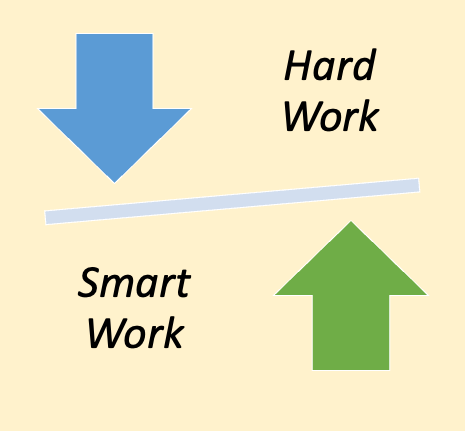
I’m a big believer in working smart. No question about it.
However, I do have a problem with the not-hard part of that advice. I think that is what creates the misunderstanding behind this well-intended advice.
Smart work is about efficiency and productivity. It is about doing more with less.
Smart work is not about doing less or finding shortcuts or band-aid solutions to achieve a goal.
I would argue that smart work cannot be achieved without due effort, creativity, and out-of-the-box thinking.
When you work smart, you channel your efforts towards more productive outcomes. You think more strategically, creatively, and objectively. You focus on the outcome and commit yourself to achieving them most efficiently.
Thus, smart work and hard work are on the same side, and complement each other. They’re not fighting each other.
The following quote sums it up nicely:
“Don’t count the hours, make the hours count.”
The 3 Ingredients of Smart Work
My previous argument begs the question: How do you work smart?
If I were to pick the top ingredients of Smart Work, I would pick these three: Efficiency, Creativity, and Dedication.
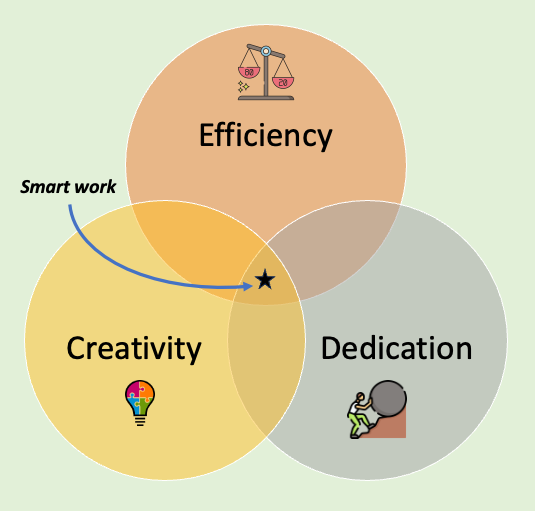
#1. Efficiency
At the core of working smart is striving for efficiency. Efficiency is all about making your hours count.
We’ve all heard of the 80/20 (Pareto) principle. You need to identify the most impactful tasks that will help you achieve your goals, and focus all your energy towards them.
You should adopt a frugal mindset, and allocate your time and resources to what matters the most. This will help you to make progress faster and with less resources.
#2. Creativity
Smart work taps on your creative juices, and forces you to think outside the box to come up with innovative or smart approaches to achieving your goals.
Delegation is an approach where you leverage the strengths of those around you, whether your team at work, or your family and friends. The beauty of effective delegation is that it gives an opportunity to someone more qualified or passionate to get the job done, while simultaneously freeing up your precious time to focus on higher-value tasks.
Tasks that are mundane, repetitive, or time-consuming can be delegated to computers (aka Automation). You should be constantly looking for opportunities to automate workflows or tasks. With artificial intelligence-based tools becoming much more accessible and practical today than they were earlier, you should also be looking to leverage the power of AI wherever it makes sense.
#3. Dedication
Last but not least, smart work requires tremendous discipline and hard work. With the proliferation of information and social media, you can easily get distracted and pulled into a rabbit hole if you are not careful and intentional.
If you are looking to make a real impact, you need to put in focused effort towards your top goals. You need to avoid taking shortcuts, and instead focus on the quality and experience of the output you are producing.
Thus, hard work is an integral ingredient of Smart Work.
Conclusion
Many people hold a misconception about the idea of ‘working smart’ that it implies that they should work less, and that couldn’t be further from the truth.
Working smart is about optimizing the way we work, not avoiding hard work. In fact, working smart requires focus, intentionality, and dedication, and being smart about how you spend your time.
In my experience, there are three key ingredients of smart work:
- Efficiency — focus on doing more with less
- Creativity — thinking out of the box
- Dedication — putting in focused effort
By understanding and embracing these elements, you can become more productive and achieve more with less.
Like my writing?
If you liked this post, I would appreciate some claps👏 as a form of encouragement. Thank you!
To read similar content you can follow me (Gaurav Jain) and subscribe to get these posts delivered directly to your Inbox. Check out my profile for other ways to connect with me.
Feedback is a gift! I would love to hear your thoughts and suggestions in the comments below 🙏