
5 Skills I Learned From Drawing
And how they can improve your writing.
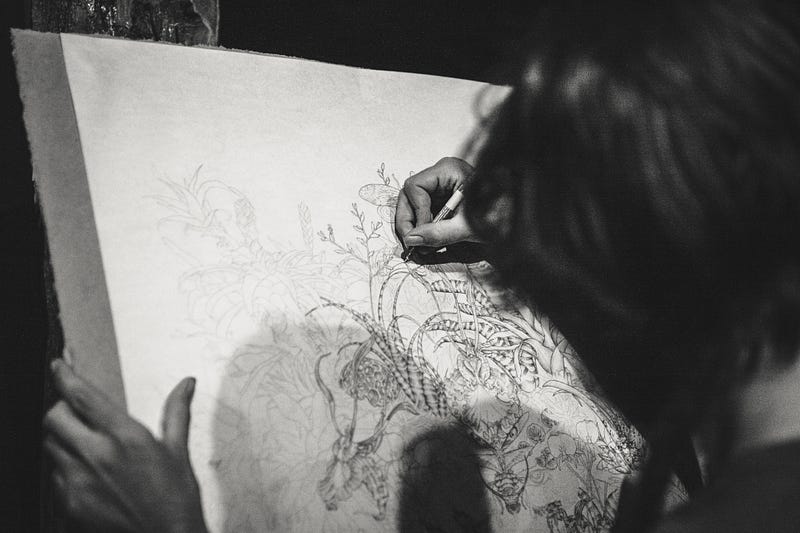
As an animation student, part of my core education was intense training in drawing. Drawing isn’t just for art students- it can often be used in military training because of the valuable skills that you develop in other areas that are transferable.
Similar to my experiences in marching band, I learned a lot of different skills from my drawing education that I use today, such as patience, observation, Revision, non-perfectionism, and criticism.
Patience

From drawing, I learned how to be patient. Before I started my journey in animation, I could not draw well. I realized that it was a required foundational skill, so I started taking drawing classes in high school. I needed to build my portfolio to get into art school.
Drawing is not an easy skill to pick up. Learning to draw takes a lot of time and effort. Mastering a skill takes a lot of patience. I had to be patient with myself while learning.
On a smaller scale, I learned how to be patient with a particular project and not give up too early. Drawings tend to evolve as you observe your reference and adjust your drawing to make it more accurate.
When learning a new skill or working on a new piece, it is important to be patient. You need to allow yourself time to improve before giving up, or else you’ll never learn. Similarly, when writing a new article, being patient and letting it evolve as you continue to write and edit will only strengthen the result.
Observation

A lot of times our minds play tricks on us. This is well documented with various optical illusions, such as the Rubin’s Vase illusion. A big challenge of observation is that you need to overcome these false assumptions in your mind’s eye and truly inspect what is in front of you. And not what you think is in front of you and what your perception is.
Observation is an incredibly useful skill. Just as it’s important to translate 3d space into 2d space, as a 3d artist, I use it to translate 2d concept art and reference photos into digital 3d pieces.
Observation skills are important in understanding and interacting in the world.
Improving your observation skills allows you to “listen” with more than just your ears and make better decisions. It also enhances your ability to interact with others and to respond in an appropriate manner. Both are keys to success at work and at home. -MIT
Being able to observe and analyze what’s at hand can be useful for problem-solving. Observation skills also improve your ability to communicate with others. The better you can observe and assess situations, the more equipped for success you are.
Revision
As I mentioned earlier, drawings continuously evolve. Even in their final state, things are never truly final and can always be improved. You typically don’t get things right on the first attempt. That’s why revision is important. This translates into writing- rarely is your first draft a final product.
An important part of revision is looking at your work with a fresh perspective. A drawing trick is to use a mirror to look at your work- by flipping the drawing, you clear your mind of your skewed perception fo your drawing and makes proportion issues much easier to spot.
In writing, you can clear your mind by revising in separate sessions, reading your work aloud, or having it read back to you.
Non-Perfectionism

My whole life, I have been a perfectionist. I would strive for the ultimate quality of work. Through drawing, I quickly learned how damaging this is.
By learning non-perfectionism and undoing my way of thinking, I was able to relax and give myself more creative freedom.
Creative liberty allows you to not take things literally. In a drawing, just because you’re going for realism doesn’t mean you should be copying exactly what you see- that’s a photograph. In the end, your interpretation and the quirks that you apply are what make things more personable and adds richness and texture to the works.
There’s beauty in imperfections. Additionally, we are used to imperfect things. Humans are imperfect creatures, we are flawed- our faces aren’t perfectly symmetrical, and one leg is longer than the other. So, imperfection is more natural and more beautiful.
Criticism
Self-critique can be quite important. You’ll never improve if you can’t see the issues with your work.
Being able to critically analyze is how you will be able to improve. As an artist, your portfolio speaks volumes and is typically just as important- if not more important- than your resume.
An artist, Laura Price, said that nothing about your work matters, except for if it is up to industry standards.
Compare your writing to the work of successful authors, and ask yourself:
Is my work at the same level?
Reflect on what they do better than yourself. Identify the areas where you can improve your work, and focus on those areas.
You need to critique your work to make sure that you are reaching and even exceeding these expectations. That’s how you’ll succeed.
Final Thoughts
A lot of these skills play into each other. Observing the world around you is important for communication, and therefore writing. Patience allows you to take your time with your work, revising and improving it. Non-perfectionism allows you to adapt to the iterative process of writing, unblocking your creativity.


