
5 Reflection Questions from Becoming (by Michelle Obama)
Adapted from her best quotes
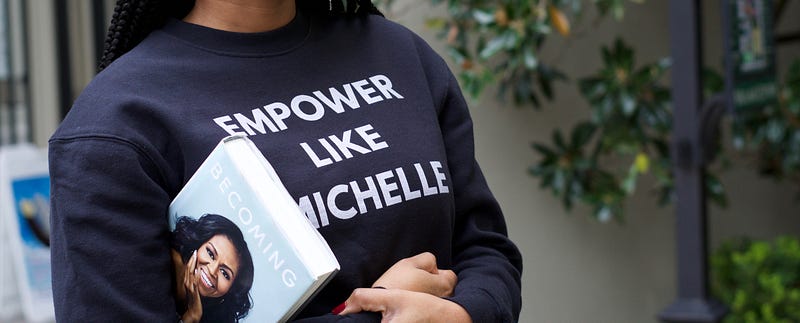
In finishing Michelle Obama’s book, “Becoming”, I wanted to share the top five most empowering quotes. She is not simply a previous FLOTUS (First Lady of The United States), but a force of nature of her own, a story that stands alone regardless of whether her path ever crossed Barack Obama’s.
In her words, I found strength and validation as a woman of colour and as someone who fiercely wants to protect the rights of children to grow safely and healthily.
In her words, I also found myself reflecting on key aspects of racism, boundaries, emotions, life goals, etc. (As an avid journaler, her words have inspired me into many hand cramps.)
I can’t wait to pass on the same experience to you too, so get your journals and Google docs ready!
“Now I think it’s one of the most useless questions an adult can ask a child — What do you want to be when you grow up? As if growing up is finite. As if at some point you become something and that’s the end.”
We begin this list at the end of her book, where she shares that she is fifty-four and has so much more to learn.
This quote resonated with me, as someone who spent all but her most formative years chasing structured achievements in the form of grades and awards (and still am, in graduate school). In her words, I realized that growing up isn’t “getting smarter” or “knowing more”.
It’s about tripping over your own feet, learning how to decide whether to fit in or advocate for change, of building a routine that works for you.
There is no end point, unless we glumly think about death. But few of us “work towards” death. We work towards life, and life is an ongoing process of bitterness and sweet, like this quote embodies.
Reflection Question: What values and intentions define your current season of life? What would you like to strive towards? What is the gap (and the corresponding steps to fill in the gap) between these two?
“Now that I’m an adult, I realize that kids know at a very young age when they’re being devalued, when adults aren’t invested enough to help them learn. Their anger over it can manifest itself as unruliness. It’s hardly their fault. They aren’t “bad kids.” They’re just trying to survive bad circumstances.”
Michelle spent much of her role as FLOTUS building an initiative that improved children’s nutrition and encouraging kids to stay active. She carefully made choices to decline to speak at prestigious schools, choosing instead to speak to students who come from a background with much less privilege. She spoke to children whose education was interrupted daily by the ongoing trauma of the instability going on within their city.
This all came together in this quote — that she knows that kids know from a young age whether they are given the care, education and support they deserve. I knew from the bat which teachers valued our work as kids and which simply became a teacher for the stable job income.
I was privileged to have ended up with more teachers from the first part, who supported their students and challenged them to learn beyond their comfort zone.
As adults we need to make the choices that support children, whether or our own or others, to receive the love, support and care that they should. Neglecting these needs at the systemic level stays with children forever.
Reflection questions: How did the adults within your life support your well-being in growth, and what did you bring from it? What was missing that you wished happened? As an adult, what would you like to bring forward, either for your own children or in your capacity in interacting with other children?
“His money went largely toward books, which to him were like sacred objects, providing ballast for his mind.”
This quote showed two things to me.
One, it reinforced and revived my old love for books that I had long abandoned in my childhood days. It provided me with an image of a person who ferociously loved to read. Someone familiar.
This was juxtaposed with Michelle’s own relationship with reading, which I think is more similar to mine. In contrast to her bookworm husband, she spent less of her free time buried in a book.
As a child, I had a false notion that people who didn’t read weren’t smart. Even though I grew up to learn that this wasn’t true in the slightest, I carried guilt for no longer having the time to read as much as “I should be”.
Michelle’s story validated my experiences. She read when she was intrigued and interested. When met with the overwhelming stress of her FLOTUS duties, she relaxed with home renovation shows. Her sharing of this story helped me reflect on my debunked yet lingering rigid notion that “you must be an avid bookworm, 24/7/365” to be someone of importance, someone who contributes positively to her community, to be smart and productive.
That is untrue.
To set boundaries and consider self-care are two of the biggest lessons she showed through her actions described in this book.
Reflection questions: What is your relationship with reading? What did you like to read for leisure as a kid? How can you bring what you enjoyed from when you were younger into your daily life now? What are some other ways you relax and work self-care into your day to day?
“It’s remarkable how a stereotype functions as an actual trap. How many “angry black women” have been caught in the circular logic of that phrase? When you aren’t being listened to, why wouldn’t you get louder? If you’re written off as angry or emotional, doesn’t that just cause more of the same?”
Every time I see the “angry black woman” trope anywhere, I see the deeper underlying truth clearer: the anger comes from decades of being unheard, dismissed and invalidated. Dismissing someone’s message as “purely emotional” missed the underlying message being communicated, fueling this anger. That’s exactly what she illustrates here.
When we focus on tone policing women and people of colour, and especially women of colour, we focus on how things are said and not what is being said.
What is being said is far more important.
Anger is the emotion that functions as a megaphone, shouting out boundaries and messages that are being ignored, empowering you to speak louder when unheard.
So the next time you encounter someone and are finding yourself moving towards tone policing, think about the message being said and not the manner in which it is being said. That will move things forward significantly more than things have before
Reflection questions: How does anger appear in your day to day? What message is being unheard and how can you honour and validate your own message? How have you contributed to the tone policing of women or BIPOC? What has your tone policing of women or BIPOC looked like in the past, how would you notice it again in your future, and what do you plan on doing to shift away from it?
“When it came to the home-for-dinner dilemma, I installed new boundaries, ones that worked better for me and the girls. We made our schedule and stuck to it. …It went back to my wishes for them to grow up strong and centered and also unaccommodating to any form of old-school patriarchy: I didn’t want them ever to believe that life began when the man of the house arrived home. We didn’t wait for Dad. It was his job now to catch up with us.”
This is a snippet from Michelle unfolding her story of how her life and career, her children’s lives were put on put on pause as she navigated around her husband’s chase for his career.
The most empowering part is that she acknowledges his needs and dreams and avidly supports him, yet continually reflected and returned to a central spot where she did not let her husband’s grand dreams overshadow her own career and role as a mother.
She constantly advocated for changes so that she could continue chasing her own dreams of making a difference in healthcare within Black communities. She protected her children’s lives so that their needs weren’t swept aside or minimized.
This balance is so precarious considering how much time a career towards the presidential end goal can take over an entire family’s life. It wasn’t perfect and surely wasn’t easy, but she had the tough conversations and made the tough decisions so that all of her values would be upheld.
Knowing how to set these boundaries is hard, and something a lot of people are still learning. That’s why it’s empowering to see her share her journey.
Reflection questions: What are your current values and how do you balance between them? What are barriers to upholding these values? How can you advocate for all of your values to be upheld, while honouring others’ boundaries and goals?
Lucy (The Eggcademic) is a casual bookworm who is revisiting her childhood love of books via the power of audiobooks. Please support your local libraries! Most of them have amazing ebook and audiobook collections that you can borrow for free without getting off your butt to put on pants. Lucy has also written a poem to her feet, about how to create when you feel artist block, and about ending her Talkspace online therapy subscription. She absolutely loves Carolyn Riker’s poem: A Bridge To Loving You.


