
5 Little-Known ChatGPT Prompts to Learn Anything Faster
Including templates, you can copy.

Leveraging ChatGPT for learning is the most meaningful skill this year for lifelong learners. But it’s too hard to find resources to master it.
As a learning science nerd, I’ve explored hundreds of prompts over the past months. Most of the advice doesn’t go beyond text summaries and multiple-choice testing.
That’s why I’ve created this article — it merges learning science with prompt writing to help you learn anything faster.
Level 1: Become Strategic About What to Learn
People intending to learn a new skill often need help understanding where to start and what to focus on. But being strategic about the learning journey helps you learn any new skill faster.
When I wanted to learn DJing, I didn’t really know the sub-skills required to become a DJ. While I knew I needed to learn some skills, like beatmatching and music library organization, others, like scratching and harmonic mixing, weren’t on my radar.
And that’s where skill trees come in — they clarify what to learn next for maximum learning efficiency. By offering a structured roadmap, skill trees help you gain a sense of direction, making it easier to assess what to focus on to acquire a particular skill. Here’s an example from polymath Danny Forest:
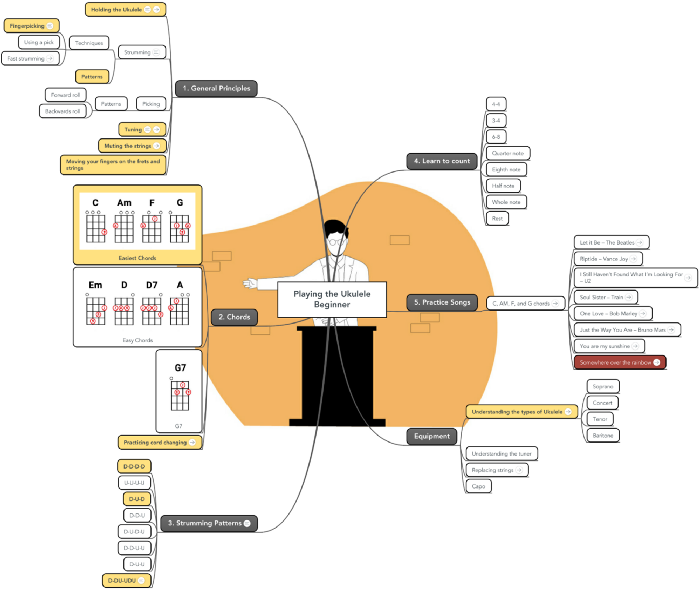
ChatGPT prompts you can use:
Use ChatGPT to uncover the sub-skills required to acquire broader skills.
Role: You are a world-class [skill/topic] teacher with +20 years of experience.


Task: What are the sub-skills required to become masterful at [skill]?
Create a mind map on the skills required for [skill/topic].
List out the central ideas, main branches and sub-branches. 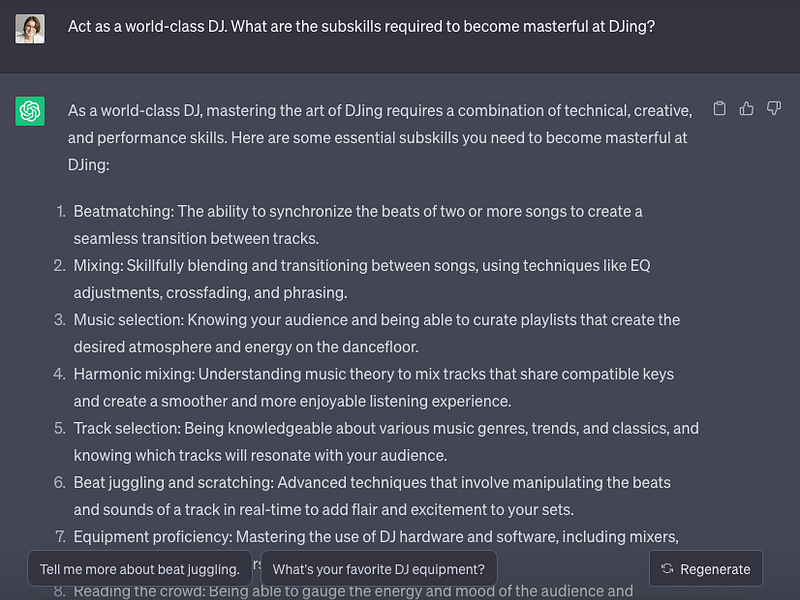
Level 2: Your Discovery Agent to Find Resources
Now that you know which sub-skills you want to focus on, it comes to finding trustworthy learning materials. Often it takes effort to find the right resources to achieve your learning goals.
Once you have initial clarity about the sub-skills required to master a specific skill, you can start focusing on getting better at one of the sub-skills required.
ChatGPT prompts you can use:
Use ChatGPT to uncover the sub-skills required to find excellent resources.
As always, when working with AI, maintain a healthy skepticism and verify everything ChatGPT tells you. Consider the AI as your personal assistant, not a professor, and remember that its knowledge is up to 2021. If what you’re learning changed within the last years (e.g., data science), you will need to fill in any gaps with information that has emerged since then.
Role: You are an expert in [topic] with 20 years of experience in [area].

Task: Can you suggest expert-recommended resources to learn
about [topic/skill]?

Follow up-question: What are five of the highest-rated online
courses/websites/books/podcasts/teachers to learn about [topic/skill]?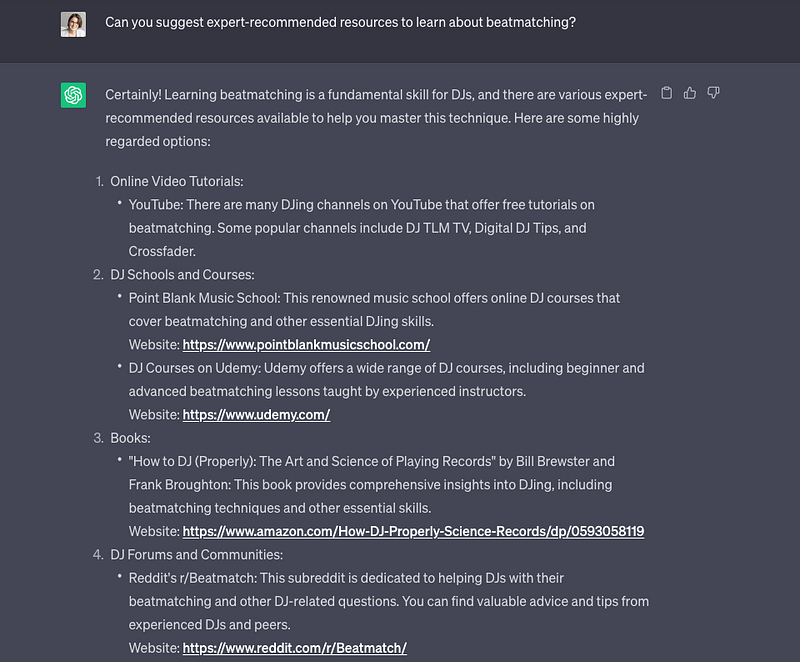
Level 3: Immediate Feedback to Improve Faster
Practice doesn’t make perfect. Practice makes permanent. You can repeat a specific behavior indefinitely without getting better at it. All you do is manifest the existing technique.
You'll never improve if you practice soccer with the same ineffective dribbling technique. You need to know what you’re striving to improve and become aware of your shortcomings.
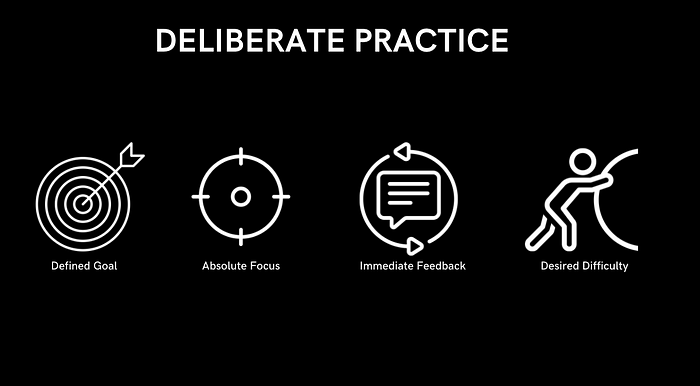
That’s why immediate feedback is one of the key components of deliberate practice, a strategy to improve performance.
“If doing something repeatedly might be considered practice, deliberate practice is a different animal: it’s goal-directed, often solitary, and consists of repeated striving to reach beyond your current level of performance,” the authors of the learning bible ‘Make it Stick’ write.
ChatGPT prompts you can use:
If you were looking for feedback before the age of ChatGPT, you depended on coaches and trainers, language learning tools such as Lingvist or Memrise, or programming learning software such as Codecademy.
One way ChatGPT can give you immediate feedback is as a language partner. You can use it to practice conversations, learn new vocabulary, or even explore the nuances of idiomatic expressions.
Here’s an example of how to use ChatGPT as your personal feedback coach for language learning:
Role: You are [a person that inspires you] and a language teacher.

Context: I want to learn [language] through a written conversation and
get immediate feedback on how I can improve.

Task: Let’s have a conversation in [language] about [topic you want to learn].
For everything I write I want you to 1) correct my sentence structure
and word choice in bullets and 2) reply as [a person that inspires you] to
what I said. Here's my first text:

[your first text in foreign language]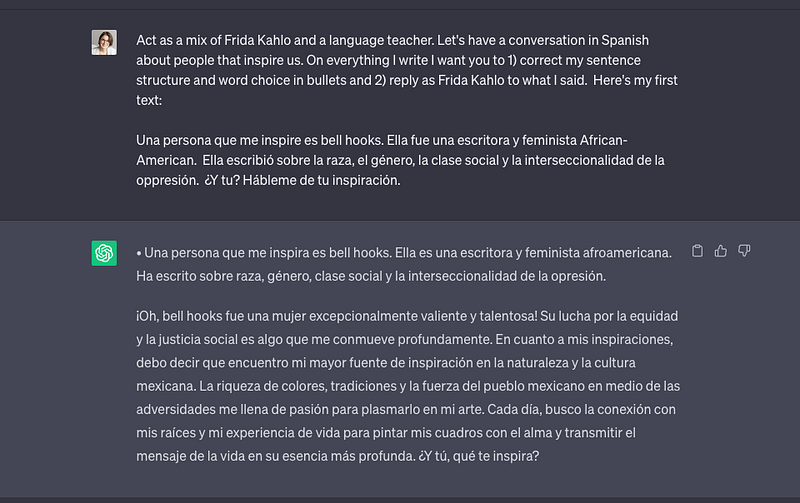
Level 4: How You Can Make the Most From Your Notes
While many people use ChatGPT to summarize texts, they miss out on the bigger potential for learning. Summarising articles with tools like ChatGPT can help you reduce extraneous cognitive load and support basic recall, but it doesn’t help you learn.
One great way to make the most out of your notes is by using ChatGPT for the Cornell Method, an easy note-taking strategy applicable to lectures, online courses, meetings, and more.
As Dr. Philippa Hardmann writes, the method enables learners to turn recall into understanding and application by encouraging them to review, explore and interact with their notes (something called learning transfer).
In this method, you have your main notes, a smaller one on the side for cues and questions, and a summary section at the bottom.
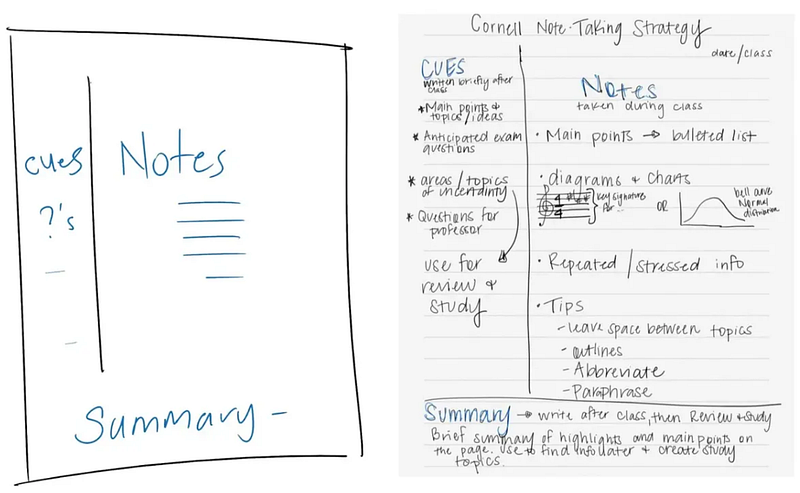
ChatGPT prompts you can use:
Using the Cornell Notes method, the following prompt, as shared by Dr. Philippa Hardmann, helps you turn your notes into meaningful learning experiences.
You are a professor of [subject you’ve made notes on] who is expert in
the Cornell Note-taking method. First, you will review my notes on [subject]
below and structure them using the Cornell Method. Then, you will deepen
my understanding of the core concepts covered in my notes by:

  1. Explaining the core concepts back to me in simple terms,
     using analogies to help me connect what I already know to what
     I am trying to learn.

  2. Identifying and explaining any core concepts I have missed.

  3. Providing real-world examples where each concept might be applied.

  4. Comparing and contrasting all core concepts.

  5. Explaining how all core concepts relates to [another concept] which
     I studied last week.

Finally, once you have done this, you will set me a series of questions
which will test my recall, understanding and ability to apply the core
concepts covered in my notes.

Wait until I give a response to one of your questions.

Once I have responded to a question, provide me with targeted, actionable
feedback which highlights what I did well, what I did less well and how I
might improve. Then, wait for me to respond to another of your questions.
Once I have responded to a question, provide me with targeted,
actionable feedback which highlights what I did well, what I did
less well and how I might improve. Repeat this until all questions
are answered sufficiently.

My notes: Paste notes.
Level 5: Optimize Flashcard Writing to Remember Things Forever
If you’ve read this far, you’re officially a learning nerd — well done! If you’ve never heard about the power of Anki and spaced repetition, start here.
Contrary to common belief, our brains all learn very similarly. Learning styles don’t exist — while you might prefer auditory, visual, or kinesthetic learning, no evidence from controlled experiments suggests teaching in a person’s preferred learning style will help them learn.
To become an effective learner, understand your cognitive architecture, including sensory memory, working memory, and long-term memory.
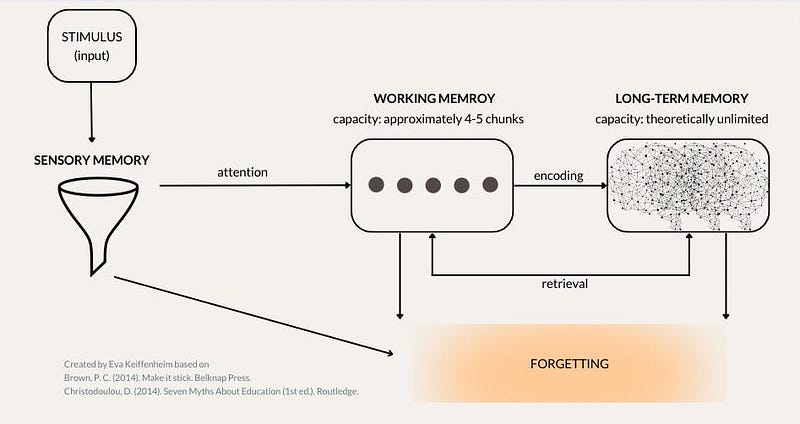
You learn when you successfully transfer information from your working memory to your long-term memory. Without this transfer, you won’t remember much of what you “learned.”
Encoding knowledge into your long-term memory works best when you reproduce the same information from your mind over increasing time intervals.
A task is not as difficult as it sounds — brilliant minds have developed software, like Anki or Neuracache, that helps you see the information exactly when you should. In my TEDx talk on mastering learning, I talk about the power of these programs.
In essence: spaced repetition memory systems make memory a choice.
“One-shot learning is not enough. Routinization frees up our prefrontal and parietal circuits, allowing them to attend to other activities. The most effective strategy is to space out learning: a little bit every day.”
— Stanislas Dehaene
ChatGPT prompts you can use:
To write better flashcards in Anki, you can use ChatGPT to suggest specific examples for a scenario.
Role:
You are a professor in [subject]. Your aim is to ensure that I have
a reliable understanding of the foundational concepts associated with the
topic: [your topic].

Context:
Without the ability to retrieve information, the learning process is futile.
You want to support me to recall and process accurate information. You want to
use the evidence-based strategy of using retrieval with spaced repetition to
increased the effective memorisation of knowledge.

Flashcards for practicing retrieval over inscreasing time intervals
are particularly helpful when they are well-written. Here are some examples
for good and bad questions (q) and answers (a).

Ill-formulated knowledge – Complex and wordy
Q: What are the characteristics of the Dead Sea?
A: Salt lake located on the border between Israel and Jordan.
   Its shoreline is the lowest point on the Earth’s surface, averaging
   396 m below sea level. It is 74 km long. It is seven times as salty
  (30% by volume) as the ocean. Its density keeps swimmers afloat.
   Only simple organisms can live in its saline waters

Well-formulated knowledge – Simple and specific
Q: Where is the Dead Sea located?
A: on the border between Israel and Jordan
Q: What is the lowest point on the Earth’s surface?
A: The Dead Sea shoreline
Q: What is the average level on which the Dead Sea is located?
A: 400 meters (below sea level)
Q: How long is the Dead Sea?
A: 70 km
Q: How much saltier is the Dead Sea than the oceans?
A: 7 times
Q: What is the volume content of salt in the Dead Sea?
A: 30%

Ill-formulated knowledge – Sets are unacceptable!
Q: What countries belong to the European Union (2002)?
A: Austria, Belgium, Denmark, Finland, France, Germany, Greece,
Ireland, Italy, Luxembourg, the Netherlands, Portugal, Spain, Sweden,
and the United Kingdom.

Well-formulated knowledge – Converting a set into a meaningful listing
Q: Which country hosted a meeting to consider the creation of a European Community of Defence in 1951?
A: France
Q: Which countries apart from France joined the European Coal and Steel Community in 1952?
A: Germany, Italy and the Benelux
Q: What countries make up the Benelux?
A: Belgium, Luxembourg, and the Netherlands
Q: Whose membership did Charles de Gaulle oppose in the 1960s?
A: that of UK


Task: Using the information from my notes below generate flashcards with Q:
and A: which helps me understand the core foundational knowledge related
to the concept of [your topic].


Your notes: [paste]


Follow up Questions:

Can you provide examples of [mathematical concept] in real-life situations?

What's a useful metaphor/visual to understand the concept of [topic]?

Identify the blind spots that I have not included in my note about [topic] and
suggest a resource I should look at to learn about the blind spot.
Final Thoughts
Your ChatGPT output depends on your input. Using powerful prompts can help you learn faster than ever before. Some of the most helpful use cases, for now, are using the tool to:
- Be strategic about what to learn
- Find the best resources for learning
- Get immediate feedback while you practice
- Make the most out of your notes
- Write better flashcards to remember anything forever
Want to feel inspired and become smarter about how you learn?
Subscribe free to my Learn Letter. Each Wednesday, you’ll get evidence-based tools and resources that elevate your love for learning.


